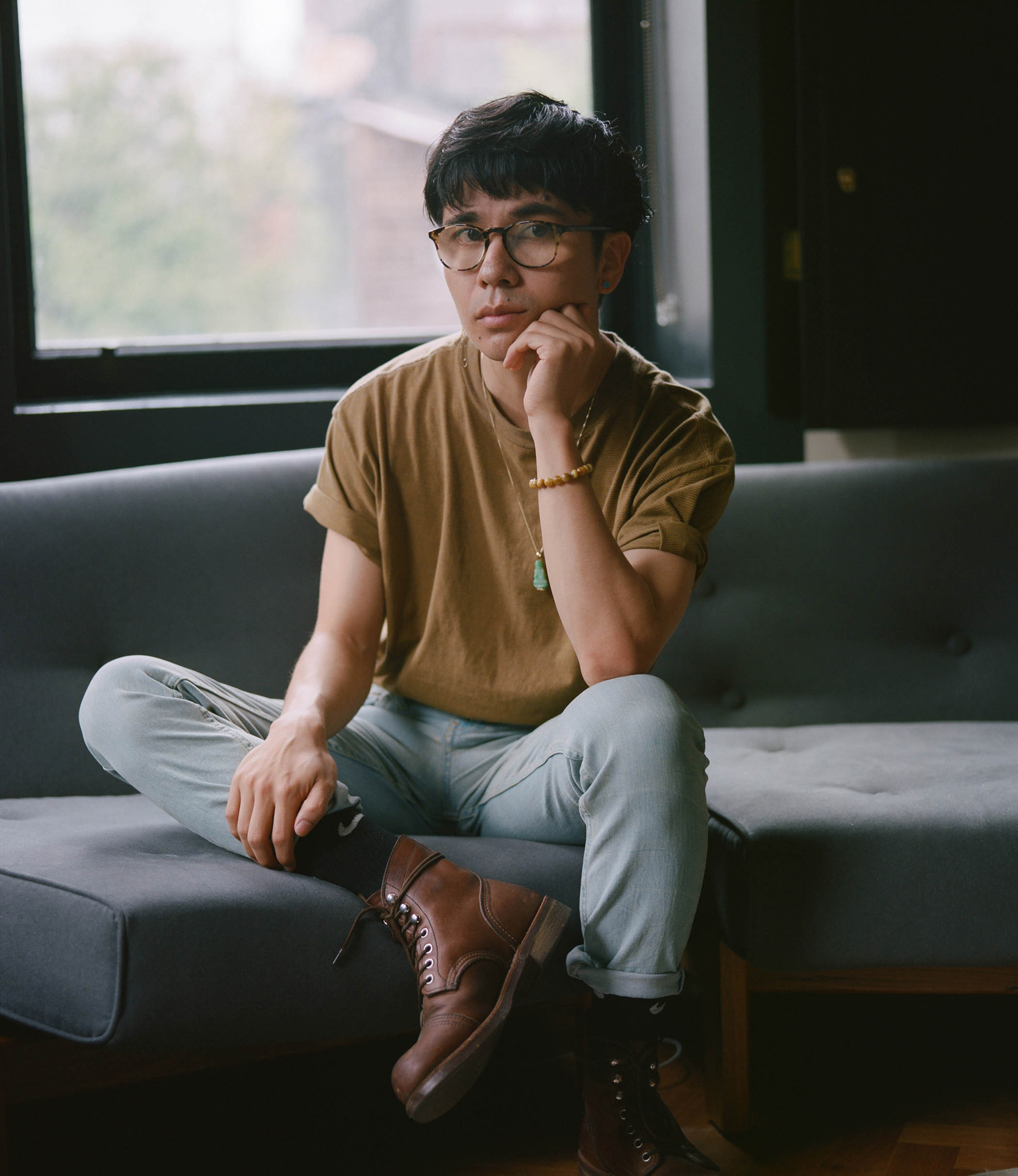
Ocean Vuong, 37, is a bestselling poet and novelist, and a professor of creative writing at New York University. Born in Vietnam, he and his family emigrated to the US when he was two years old, settling in Connecticut. His books – including the TS Eliot prize-winning poetry collection Night Sky With Exit Wounds and the novel On Earth We’re Briefly Gorgeous – explore immigration, queerness and the American dream. His second novel, The Emperor of Gladness (out now in paperback), follows Hai, who tells his mother he has gone away to college, but is instead working in a diner and living with an 82-year-old, Grazina.
What has the response to The Emperor of Gladness been like?
What has been surprising has been the amount of parents reading it with their [teenage or adult] children. My first novel is about parents and children, but it’s a very R-rated book. So this time that has been a delight I didn’t expect, especially since a lot of the children work in service industry jobs. It has allowed the mothers and fathers to mention that they did the same work.
Why has the service industry element struck such a chord?
It’s a rite of passage in so much of American life, which is my myopic perspective. I’ve done it myself. In the fast food restaurant, no one wants to be there. There’s another dream [people] are deferring in order to be there. There’s something really honest about being in a place where you know every hour you put in is taking you further from where you want to be.
How did your experiences influence this book?
I worked all through my teenage years, as soon as I could, to help my single mother. I wanted to write the story because I didn’t see novels about wage work. Usually, if wage work comes up, it’s an exposition: they had to get a job, and then they go on to the next adventure. I wanted to close that cycle and say: no, this is it.
Did any details from your workplaces make it into the novel?
My question was: could I get my characters to be as interesting as the people I met? My boss at [the chicken chain] Boston Market was an evangelical Christian refugee from Pakistan. He would walk around [playing] a recording of evangelical speeches [from a device] on his belt. We went back and forth about whether we should complain about it or not, but decided to let him do it because we knew exactly where he was at all times. When we were slacking off, we could tell when he was coming because this fiery proselytising would be getting louder and louder. But if I put that in a novel, [the critic] James Wood would say, “This is hysterical fiction.”
By that comparison, your protagonist, Hai, is pretty together.
That’s the power of the job. I didn’t just want to write a polemic about how horrible fast food work is – that would be too easy. But I think there’s a psychotropic power to the work, in how you clock in and know that for the next eight hours you will be in this tiny place with these exact people. In retrospect, it felt very much like the sonnet to me: 14 lines, this little rectangle from which so much innovation has occurred.
Does that mean something distinct to you as a migrant to America?
My family had no English, so as a kid, when we would go on a road trip, the immense comfort of seeing the McDonald’s arches, and going in and it smells the same… Hai goes in and thinks, “I’m the truest version of an American citizen I’ve ever been because I’m working in a fast food restaurant. I’m feeding the country.” There’s a tragic angle to that pride, but it’s definitely real.
Tell me about your character Grazina and her real-life inspiration.
She was my partner’s grandmother. She was an extraordinarily ordinary American, a refugee who fled Stalin during the second world war. I ended up living with her while I was a student and we had this symbiotic relationship. It’s very common in the States for the elderly to live alone as long as they can and resist being put into a nursing home. I was the band aid over the inevitable, and when you add in severe mental illness – dementia – it gets really tough.
What did living with her teach you about dementia?
I don’t think it’s [necessarily] a disease of memory loss. That’s true at the end stage, but for the most part, I’d argue that it’s memory without agency – she did [have] beautiful, descriptive memories, but it wasn’t her choice to remember them. And so I, being the one with agency, followed her. I would play along. We would make up novels.
She’s not the only character who makes things up.
There’s a puritanical obsession with truth in America. Our politicians perform truth, but they lie to us in the backrooms. They do the whole switcheroo. For people in the working class, extending these fantasies can be incredible, life-giving moments of reprise. And that’s what these characters do. They lie to each other. None of them are evil. They lie because they’re scared. They lie to delay reality. There’s something heartbreaking about that.
You’ve spoken elsewhere about reading being a form of class betrayal in your Connecticut home town.
Where I grew up, in the late 1990s, early 2000s, there was this idea that if you are engaged in a book, you’re entering the realm of leisure. And if you have leisure time, then you must be eyeing a way out. There’s a material reality: most of my neighbours and relatives couldn’t read a book, even if they were literate. When you put in a 12-hour shift at the gun factory, where a lot of people I knew worked, when will you read Dickens or Dostoyevsky? Holding a book was a symbolic gesture of investing in a way out. I think a lot of folks were saddened by it, and that sadness manifested as resentment. In school, I would put my head down on the desk in the lunchroom to pretend to be asleep in order to read. The book would be in my lap. It was better to perform unconsciousness than to read.
Were you ever found out?
No, I was pretty good.
The Emperor of Gladness is published by Vintage (£9.99). Order a copy from The Observer Shop for £8.49 (15% off RRP). Delivery charges may apply
Photograph by Celeste Sloman / New York Times / Redux via Eyevine
Newsletters
Choose the newsletters you want to receive
View more
For information about how The Observer protects your data, read our Privacy Policy