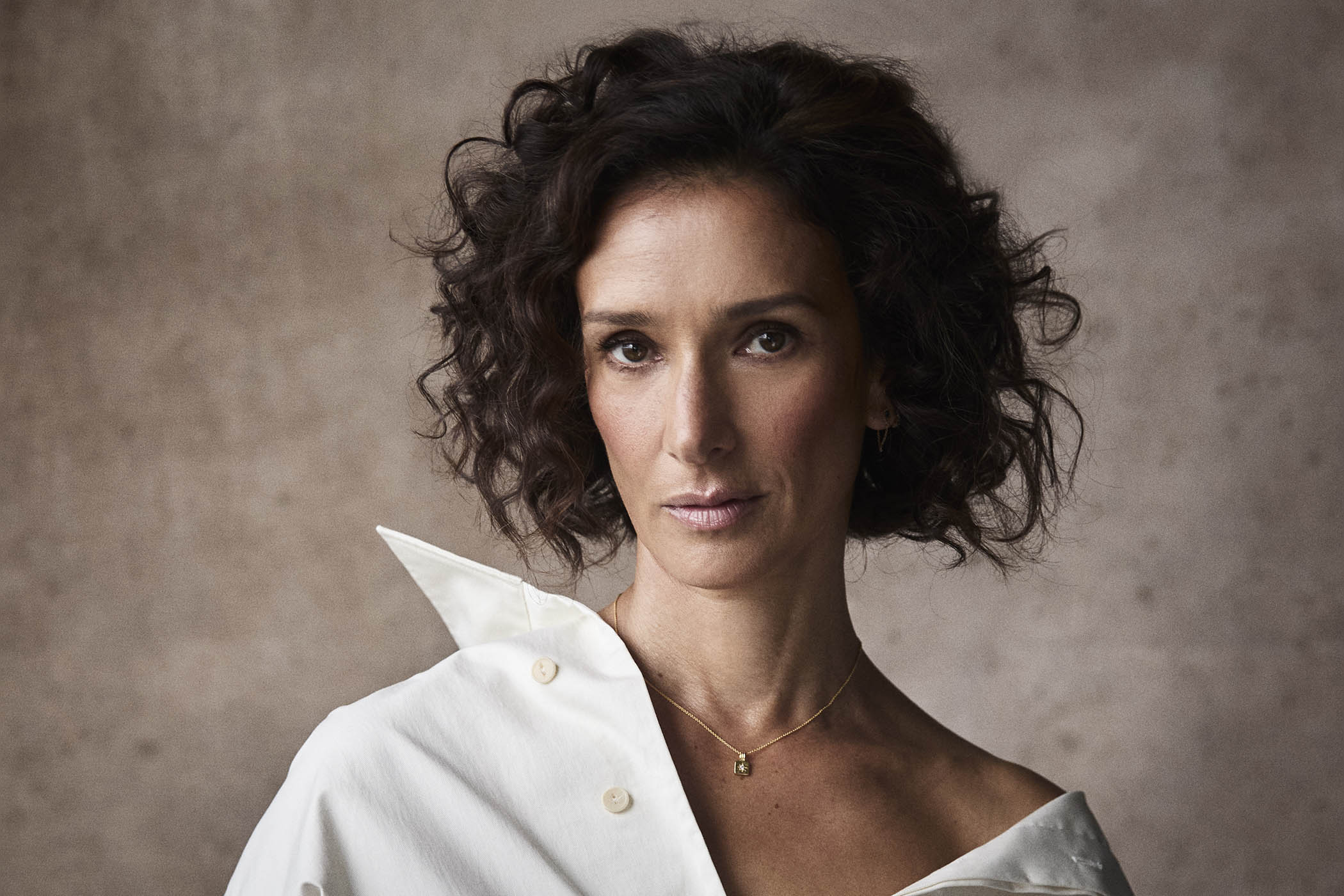
Actor Indira Varma, 52, has moved between work on stage and on screen for 30 years, performing in David Harewood’s landmark 1997 Othello, then in a string of Harold Pinter productions, and scoring a comic hit in 2019 in the West End in Noël Coward’s Present Laughter. In 2005 she appeared in HBO’s Rome, before switching to another television epic, Game of Thrones. Raised in Bath, Varma lives in London with her husband, actor Colin Tierney, and their daughter. She is about to star in an all-female version of David Mamet’s Glengarry Glen Ross at the Old Vic, set in a cut-throat Chicago real estate office.
Are you braced for the attention this female take on a testosterone-fuelled drama is likely to get?
My adrenal glands are on full throttle, although I don’t usually think much about how my work is going to be received. That’s not my job. It’s not even the job of the director, Patrick Marber, really. The joy of this is that it’s an experiment: an unknown equation. Although Patrick has already said the female cast is making it a slightly different play.
What’s it like delivering Mamet’s rapid-fire dialogue?
It’s like music or percussion, but I learned about that working with Pinter. I remember him saying: “Don’t ask why your character says this. Just say the words, truthfully, in the right order, and it will reveal itself.” There’s so much choppy dialogue in this play, which initially meant it was a fucker to learn. You don’t know where a train of thought is going. There is the beginning of an attempt to express something, then a holding back, and then a going off on a tangent, all jammed up against one another. But that is what makes it exciting.
Women are expected to be supportive of one another, at least on the surface. How has that worked in rehearsal for Glengarry Glen Ross?
Patrick has set up this game in the rehearsal room and put a winners’ board on the wall, because in the play we all have these sales incentives, where you can earn a Cadillac or just a set of steak knives. We have to throw a playing card so it hits a bin. If you hit the bin and it makes a sound, you get two points. If it goes in the bin, you get three. That kind of vibe. Yesterday we did another ridiculous thing. The four salesmen sat on rolling office chairs, moving on castors, and we had a race. So Patrick is trying to instil this competitive atmosphere, but we’re all going, “No! We’re not interested! We support one another.” Of course, on stage, the characters will be in competition. We do already see an analogy with our own profession as actors. These salesmen are even after what they call “leads”, just like us.
When did you first think, ‘I’ve made it’?
I’ve never quite had that moment. In my first Pinter play though, working with Lindsay Duncan, there was a moment when I was sharing a dressing room with her and Lia Williams and Susan Wooldridge. I thought, “Wow, I’ve arrived”. But I was still an onlooker, watching these great actresses. I used to weep on the way home on my bus, thinking, “This is such a privilege. I’m sitting at the same table, even though I feel I haven’t quite got my elbows on it yet.” Being acknowledged by Harold as someone who could do his work was massive for me.
Where do you feel you belong?
Well, my mother was Swiss and my dad was Indian, but that place is really Bath, where I was born, and where my mum lived until she died in December. I still go back and I do still call it home. I know all the people on the street and there’s a real community. There’s a moment when I drive in through a certain bit, approaching Lansdown, and it’s so beautiful. I love the river and the weir, near where we used to go swimming.
Did the teachers at Rada think you had a certain professional path ahead of you?
I only went to drama school in order to then go on to mime, but they all told me not to be ridiculous and that I would do screen work. I’ve done some comedy now, but I am not really what is thought of as a comic actress. I have a gentle wit, I think, and, if I’m lucky, someone might laugh at something I happen to do. I loved being in Present Laughter. That was one of my best recent theatrical experiences. It was great and I think it helped that, thanks to my mother, I have a good sense of the absurd.
Was your mother funny?
She taught graphic design, but was just an eccentric and very much herself. She was very direct and had no fear of laughing at the ridiculous, or in seeing the ridiculous in things. She was 93 when she died.
Do you get the chance to say goodbye to her?
My mum wrote a miniature memoir about eight years ago. It was very slight, with so much missing. There was hardly anything about her and my dad in it, so I didn’t bother reading it. But then, when our conversation started to break down with her Alzheimer’s, I thought I would read her memoir to her. And it was like plugging her into a socket. It triggered so many memories. I saw her in her youth, in her wild days; the naughtiness and all the struggles.
Would you like to direct?
I don’t feel I’m clever enough. I also think it is a lonely world. You have to have vision and certainty, and I don’t have that. I waver. I did a bit of work in prisons a long time ago and I was sort of directing then, because we put on plays. But it was more like being an “encourager”, or a facilitator. Ideally, I’d like to do a play every year, and then some screen work to finance it. I like the discipline of screen work. But I do really love the contact with the audience in the theatre. Having said that, I’m fucking scared too.
Glengarry Glen Ross is at the Old Vic until 18 July
Photograph by David Reiss