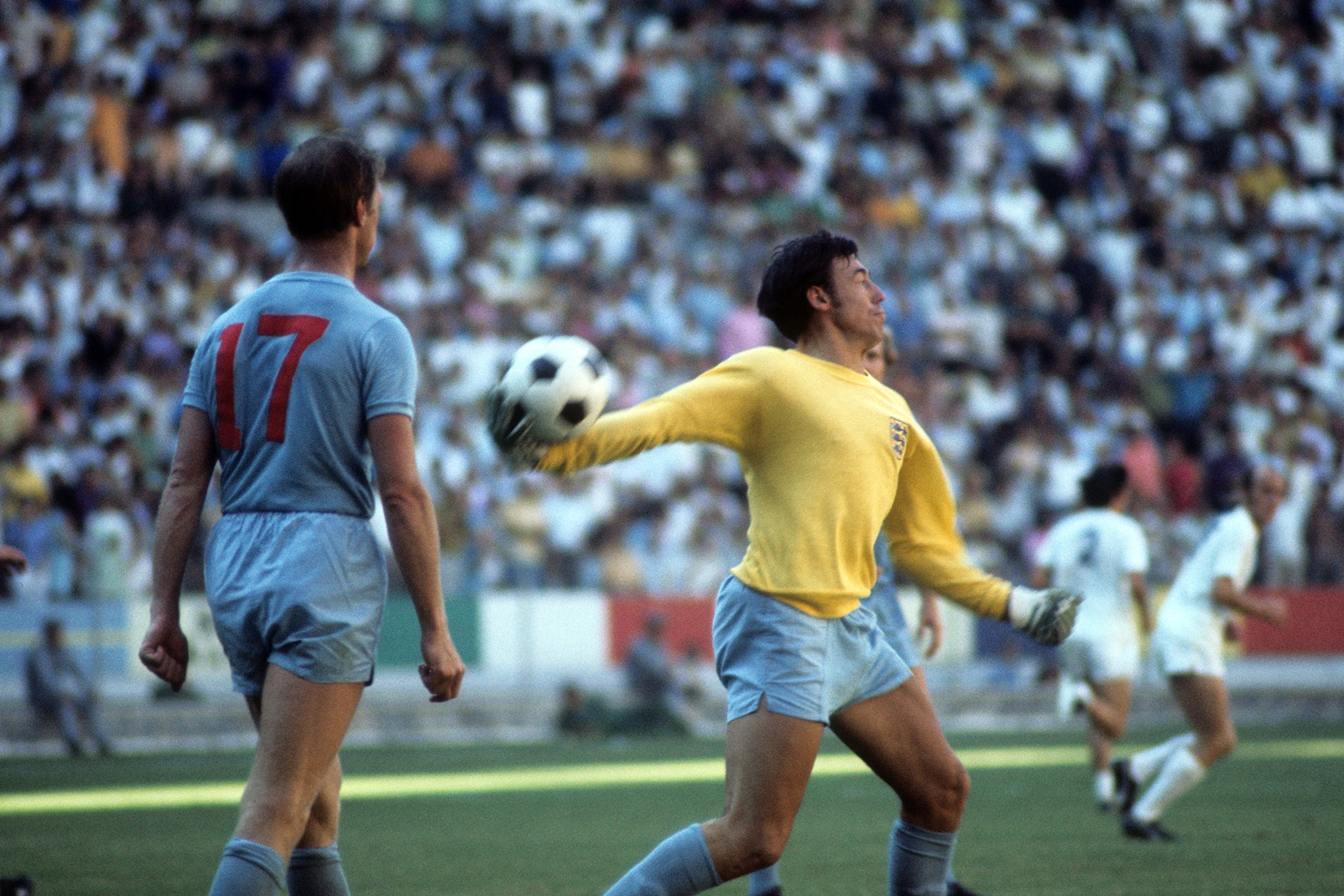

Room 1208 at the Guadalajara Hilton in Mexico, 11 June 1970. The room is shared by three members of the England World Cup squad: Bobby Charlton, Keith Newton and the goalkeeper, Gordon Banks. Towards the end of the day, they and some other players are having a few “quiet drinks” to celebrate England’s victory in their final group game, against Czechoslovakia. Three days later, Banks is sick, with disastrous consequences for England. “It was my nightmare scenario,” the team doctor would later write. “I wondered what had happened at the “quiet drinks…?”
It’s a great question.
England, the reigning champions after their success in 1966, arrived in Mexico for the 1970 World Cup without their captain. Bobby Moore was under arrest in the Colombian capital, Bogotá, accused of stealing a bracelet. It was an inauspicious start. But worse was to come.
When Banks was struck down with food poisoning ahead of the quarter-final against West Germany three weeks later, Alf Ramsey’s team crashed out. This simple sporting misfortune marked the beginning of decades of hurt. But was it just a case of bad luck? Or could there be some truth to a crazy rumour I heard: that Banks was the victim of sabotage? That England’s World Cup dreams were scuppered as part of a cold war plot hatched by the United States?
______________________________
When Gordon Banks’s grandson, Ed Jervis, first came to me with this story, I thought it sounded like a classic conspiracy theory. But after a three-year investigation that has taken me from Stoke-on-Trent to Mexico, via archives of declassified government documents in Britain and the US, I’m beginning to think this might have actually happened. Because this unlikely tale appears to come from a highly credible source: a senior US senator who received secret briefings from the CIA.
The story, at least in print, appears to originate with Brian Glanville, a football writer in the 1960s and 1970s, and an investigative journalist for the Sunday Times. In his 2007 book England Managers: The Toughest Job in Football, Glanville writes: “Though not, I hope, an addict of conspiracy theory… I have steadily come to believe that Banks was the victim of sabotage.”
The plot then thickens. According to Glanville, Bob Oxby, another football journalist, told him he had a cousin, Stuart Symington, who was US senator for the state of Missouri from 1952 to 1976. On the subject of Banks’s illness and England’s quarter-final defeat, Symington allegedly told Oxby: “That was the CIA! You don’t think we were going to let England beat Brazil, do you?”
Why would the CIA want to poison the England goalkeeper to help Brazil? The rationale, supposedly, goes as follows: it was the height of the cold war; Latin America was a proxy battleground between the US and the Soviet Union. In 1964, the administration of Lyndon Johnson had helped instal a military dictatorship in Brazil as a bulwark against the spread of socialism in the western hemisphere. By 1970, the regime had become increasingly repressive and felt it needed a popularity boost.
This much is backed up by the historical record. “The military government is run by football fanatics,” says Matthew Brown, professor of history at Bristol University, who has studied the intersection between football and politics in Latin America. “A footballing victory is understood as being a good way of cementing popular support for the regime.” Brown says the Brazilian dictator, Gen Emilio Médici, was obsessed with winning the World Cup. “[He] is constantly on the phone to the manager, he’s on the phone to the dressing room after every match during the 1970 tournament.”
Newsletters
Choose the newsletters you want to receive
View more
For information about how The Observer protects your data, read our Privacy Policy
Even if football were politically important to the Brazilian dictatorship, it seemed like a stretch to think the Americans, not known for their interest in soccer, would go so far as to poison an England player to bolster a friendly regime. But in the CIA’s archive I discovered a document that suggested they were at least aware of the political power of the World Cup. The memo is dated 2 February 1971 and marked “SECRET”. It is an assessment of the stability of the Brazilian dictatorship.
“In many respects, the Médici regime in Brazil is riding high,” it begins, adding: “General Emilio Garrastazu Médici… is becoming a relatively popular president. He skillfully managed to associate himself with Brazil’s victory at the World Cup soccer games last summer.”
Could Symington have been aware of the CIA’s interest in the World Cup in relation to Brazil? He served on the Senate armed services committee, which received classified briefings from the CIA. Might the senator have let something slip to his cousin, Bob Oxby?
By the time I heard about this story, in 2023, both Symington and Oxby had died. As far as I could tell, neither Oxby nor Glanville had ever written anything more about this potentially explosive tale. When I went visited Glanville at his home in London, he was alert but taciturn, aged 91 and suffering from Parkinson’s disease.
“We were very suspicious of the way [Banks] got ill,” he said. “The general feeling was that he was sabotaged.” But when I pressed him for more details on the CIA theory, all he would say was that Oxby was a reliable reporter, and that Symington had told him it was “part of a plan”.
With players including the likes of Jairzinho, Carlos Alberto and Pelé, Brazil went to Mexico in 1970 with perhaps the greatest team yet to play in a World Cup. England were their main rivals. The 1970 England squad had grown in strength since winning the World Cup four years earlier on home turf. Alf Ramsey, the England manager, was confident he could pull off a repeat of 1966.
At the heart of the England defence were two men: Gordon Banks, considered by many – including Pelé – to be the best goalkeeper in the tournament; and Bobby Moore, the team’s unflappable captain.
When Moore was arrested in Colombia, accused of stealing a bracelet, it became clear how important the World Cup was to British politics as well. Harold Wilson, the Labour prime minister, had called an early general election, timed to coincide with the World Cup. Government documents, declassified in 2000 and held at the National Archives in Kew, show frantic communiques between Downing Street and the Foreign Office in London, and embassies in Bogotá and Mexico City.
“The prime minister would like urgent advice on whether he himself should send a personal message to the president of Colombia,” reads one. Another: “Every minute’s delay in securing Moore’s release militates against England’s World Cup chances. Request urgent action at highest levels.”
Like the Brazilian dictatorship, the British government thought a win at the World Cup might boost its popularity.
“One of the elements in [Wilson’s] thinking was that this was a very good squad, and so they would do very well,” says Keith Morris, who was chargé d’affaires at the British embassy in Mexico City when Moore was arrested, and who played a key role in getting the England captain released in time for the start of the tournament.
(When England kicked off their World Cup campaign against Romania on 2 June, Labour were ahead in the polls. The election was held on 18 June, four days after England crashed out. Labour lost. Wilson, a keen football fan, reportedly described his defeat to Edward Heath as a “relegation”.)
The government files at Kew contain references to a possible “Latin American plot against British football”. Though dismissed as fanciful by officials in Whitehall, according to Keith Morris, some suspected the allegations against Bobby Moore were a “put-up job by Brazil”.
Moore always maintained his innocence, and the mystery of the missing bracelet has never been solved. Could the “Bogotá bracelet” incident and Gordon Banks’s illness be linked? Were they part of a wider campaign designed to destabilise the England team? And could the CIA possibly have had something to do with it?
Mexico was an important base for the CIA in Latin America during the cold war. By 1970, the Mexico City station had become the agency’s largest in the western hemisphere. “The network of surveillance that was set up in Mexico at this time is spoken about even today,” Michael Scott, the son of one of the agency’s most noted officers, told me.
Scott’s father, Winston, known as “Win”, was a founding member of the CIA and served as the chief of station in Mexico from 1956 to 1969. As well as dozens of CIA officers working under him, Scott also had a team of Mexican security officers at his disposal. Declassified files in the CIA archive show that he had three successive Mexican presidents on the CIA payroll.
By the time of the 1970 World Cup, the CIA was a powerful force in Mexico, with a vast network of agents. If Banks were poisoned, and there were a CIA connection, might the deed have been done by one of Win Scott’s Mexican agents?
In recent years the Mexican intelligence service, the DFS, has begun declassifying some of its own files from the period. They are held in Mexico’s national archives, housed in a notorious former prison in Mexico City known as the “Black Palace”. When I visited the archive last year, I could find no smoking gun about the poisoning of an English footballer during the 1970 World Cup. But I did find one intriguing reference linking the CIA to another major international sporting competition two years previously.
According to the memo, in 1968, Scott sent one of his agents to infiltrate the Mexico City Olympic Games. The spy’s name was Philip Agee. He later turned whistleblower and published a book, Inside the Company: CIA Diary, a tell-all memoir about his time in the agency.
“We’ve been in every Olympics since the Soviets appeared in Helsinki in 1952,” Agee wrote. “Melbourne, Rome, Tokyo, and now Mexico City. Provocations, defections, propaganda, recruitment of American athletes for Olympic village operations, winter games and summer games, all the way with the CIA.”
Agee died in 2008, in exile in Cuba. His memoir is frustratingly light on detail about what exactly he got up to at the Mexico Olympics. His son, Chris Agee, says his father told him his primary mission was to make contact with officials from the Olympic delegations, particularly from behind the iron curtain, “for the purpose of recruiting them as potential moles and perhaps even better yet, double agents”.
This suggests the CIA was interested in sports primarily as a hunting ground for new spies, not for fixing matches. But Chris Agee tells me: “I would be surprised if they’re not. It’s very much in the goals of the CIA to nurture nationalism, because that is one of the most important currencies that they have to maintain a dominant ideology that supports the American mission. So of course they’re going to focus on the Olympics, on the World Cup and all of these sports and cultural activities.”
Both Chris Agee and Michael Scott think the idea of the CIA giving an England footballer a bout of tummy trouble perfectly plausible. Which seemed encouraging. The trouble was, when I ran the story past my contacts in the world of intelligence, not one of them had ever heard of it.
“It would be quite an effort to try to find the British goalkeeper and get to his food,” says John Sipher, an ex-CIA clandestine officer. “You’d have to recruit people in the hotel food industry or whatever and make sure you’re not caught. I don’t even know what kind of poison [you would use] or how easy it is to deploy.”
Sipher tells me there might be scenarios where giving someone a bout of food poisoning could be useful. “I can imagine an operation where you might want someone to be sick and stay in the room while the rest of the group goes somewhere else, so you can then go into that person’s room to talk to them.”
But Sipher says in all his 28 years working in the CIA’s clandestine service, he had never seen or done such a thing. So, if the CIA was the cause of Banks’s illness, I would have to at least prove they were using food poisoning operationally in 1970, and that they had the means to poison Banks in the way he got sick.
Having made it through the group games in Guadalajara, England and Brazil were favourites to meet in the final on 21 June. But a day before the quarter-final against West Germany on 14 June, Banks fell ill.
“When I got into the room, I could hear him in the toilet,” Alex Stepney tells me. Stepney was Banks’s room-mate the night before the fateful game, one of two reserve goalies in the squad. “You don’t want to describe it, but you know what I mean. You could hear everything. And I shouted to him, I said, ‘Gordon, are you all right?’”
Gordon was not all right. Stepney ran to fetch Neil Phillips, the England team doctor, who diagnosed acute gastroenteritis. Banks was ruled out, and it fell to Chelsea’s Peter Bonetti, the other reserve goalie, to fill his shoes.
Whether it was an ill-judged late substitution by Alf Ramsey (who replaced Bobby Charlton with Colin Bell in the 70th minute) or Bonetti’s lack of preparedness (some blamed him for all three German goals), but England squandered a 2-0 lead and the game ended in a 3-2 defeat.
Stepney does not believe Banks was “nobbled”. But he does believe his absence was England’s undoing. “Gordon was the greatest goalkeeper in the world, it was simple as that,” he says. “I think it was just one of those stupid things that bloody well happens. And it cost us the World Cup. Because I think we’d have won it again.”
Banks died in 2019. In his autobiography, Banksy, he appears to blame his illness on a suspect bottle of beer, writing: “I can’t remember if the bottle I was served was opened in my presence or not, but I do know that half an hour after drinking it I felt very ill indeed.”
So what did happen after that game against Czechoslovakia on 11 June in Room 1208 of the Guadalajara Hilton? Banks’s family says he suspected foul play. “He was always vaguely suspicious,” says Jervis, his grandson.
“He thought it was damned odd that only he got ill, and very seriously ill,” says Robert Banks, Gordon’s son. “And none of the other players got even a little bit ill.”
Robert and his sister Wendy were 12 and seven respectively at the time of the 1970 World Cup. Both remember something curious: when their father returned from Mexico: the whole family was quarantined in the house for two weeks. “We thought it was great,” Wendy says, “because we had two weeks off school.”
And that wasn’t all. “We had these people running around the house with white coats on trying to take samples off us,” Wendy adds. “To this day I couldn’t tell you who they were or where they came from.”
As far as I could ascertain, none of the other players was quarantined on returning home. The current director of public health for Stoke-on-Trent, Stephen Gunther, could find no record of anyone being quarantined that year. “A two-week quarantine does sound surprising for food poisoning,” he tells me, adding: “If it was food poisoning.”
Neil Phillips, the team doctor, kept meticulous notes during the tournament. In his memoir, Doctor to the World Champions, he writes in minute detail about the “very harsh regime” he imposed to keep the players healthy. “No salads, unpeeled fruit, or ice cream was eaten… I advised the players never to be tempted to buy or eat anything from a stall or shop.” He shipped out 15,000 bottles of Malvern mineral water, which he cooled in batches in the bathtub in his hotel room. All the players’ food was supplied by Findus, the frozen food company, and flown out from the UK.
Like Stepney, Phillips, who died in 2015, believed Banks’s illness was just bad luck. Or perhaps the result of a lapse in food discipline. “A sandwich, pieces of salad or unpeeled fruit, prepared by a Mexican, was, in my opinion, the most likely source of the infection,” he writes in his memoir.
Throughout the 1950s, 1960s and into the 1970s, the CIA did make use of poisons and other unconventional methods. But they were mostly deployed against political targets. The agency’s alleged failed plots to assassinate Fidel Castro reads like an inventory of Hollywood plotlines: exploding cigars, a poisoned milkshake, a poisoned diving suit, an exploding clam shell.
“There’s no question that the philosophy within CIA at the time was that we needed to do some extraordinary things to counter the Soviets,” Bob Wallace tells me. Wallace spent 32 years in the CIA, retiring in 2003 as head of the agency’s Office of Technical Service (OTS), the department for gadgets and disguises – think Q in the James Bond films. “The range of things that the CIA would consider doing had few limitations.”
The extent of the CIA’s secret use of poisons was exposed in the mid-1970s in the wake of the Watergate scandal, when the US Congress began investigating the agency’s illegal activities. During a Senate hearing on toxins, the Church committee revealed the CIA maintained an illegal stockpile of exotic poisons, including cobra venom and lethal shellfish toxin.
These and other revelations made headlines around the world. But in the transcripts of the hearings I found a detail that has gone unreported for more than 50 years. The senators interviewed a CIA biologist by the name of Nathan Gordon, who stated in his testimony: “There are certain substances that can give you a real severe case of the ‘tummies’, as we know it.” He added that these substances have “a potential application in the field. If we want to, in effect, put an individual, shall we say, indisposed, at a particular evening, at a particular place.”
In an appendix to the committee’s report, I found a CIA document detailing the agency’s secret stockpile of toxins. It includes the following items: “Salmonella typhimurium (food poisoning) 10 grams; “Salmonella typhimurium (chlorine resistant) (food poisoning) 3 grams”; and “Staphylococcal enterotoxin (food poisoning) 10 grams”.
When I mention this to Wallace, he tells me he knew nothing about the CIA using toxic substances to incapacitate anyone. “I have never heard of the story about giving the case of the tummies to any goalkeeper for any soccer team any place in the world, ever.”
When ex-CIA officers talk to journalists, they are bound by a simple rule: “sources and methods.” This means they cannot divulge information that would expose any living sources, or sensitive methods used by the agency. I put it to Wallace that, if he did know about a CIA plot to poison Gordon Banks at the 1970 World Cup, he would be duty-bound to lie to me.
“I wouldn’t necessarily lie to you about it,” he says, “but I wouldn’t address it.” When I asked him whether, by addressing the rumour by saying he’d never heard about it, I could infer that it was not true, he responded: “I don’t know that you should infer anything. You should infer that at least Bob Wallace and maybe other people have said they don’t know anything about it, so they don’t know anything about it.”
He added: “There’s now more work for you to do.”
Was Wallace’s cryptic remark a hint that if I continued searching, I might find evidence that would conclusively prove the CIA did poison Banks? That Britain’s closest ally, the United States, meddled in the 1970 World Cup in support of a Latin American dictatorship, killing England’s dream of a second trophy? Or have I spent three years chasing a crazy conspiracy theory?
As for Symington, I could never prove that he was the original source of the story. All we have is his cousin Oxby’s word, as related by Glanville, who died last May, aged 93. Perhaps Oxby made the whole thing up?
But in the senator’s archive, I found evidence that Symington was close to successive CIA directors during the 1960s and 1970s. In one letter, William Colby, who ran the agency from 1973 to 1976, mentions that he briefed Symington, in person, on “a collection, made by our inspector general, of questionable activities in the agency’s past… much of which is still classified”.
Symington’s papers provide no further details of what those “questionable activities” entailed. But Oxby couldn’t have known about that briefing. If he did make the story up, then he accidentally made up the perfect source.
Foul Play: Sport, Spies and Family Secrets, presented by Gabriel Gatehouse and Ed Jervis, is available as a seven-part Audible podcast series from 28 May.
Thanks for reading. You can tell us what you think by writing to letters@observer.co.uk
Photograph by Neil Leifer / Sports Illustrated via Getty Images