
This article is part of the Rory Smith on Football newsletter – a guide to help understand what is happening on the pitch, off the pitch, and why all of it matters.
Throughout the tournament, Rory will be travelling across America, delivering daily commentary on the biggest World Cup ever direct to subscribers. Never miss a newsletter, subscribe now here.
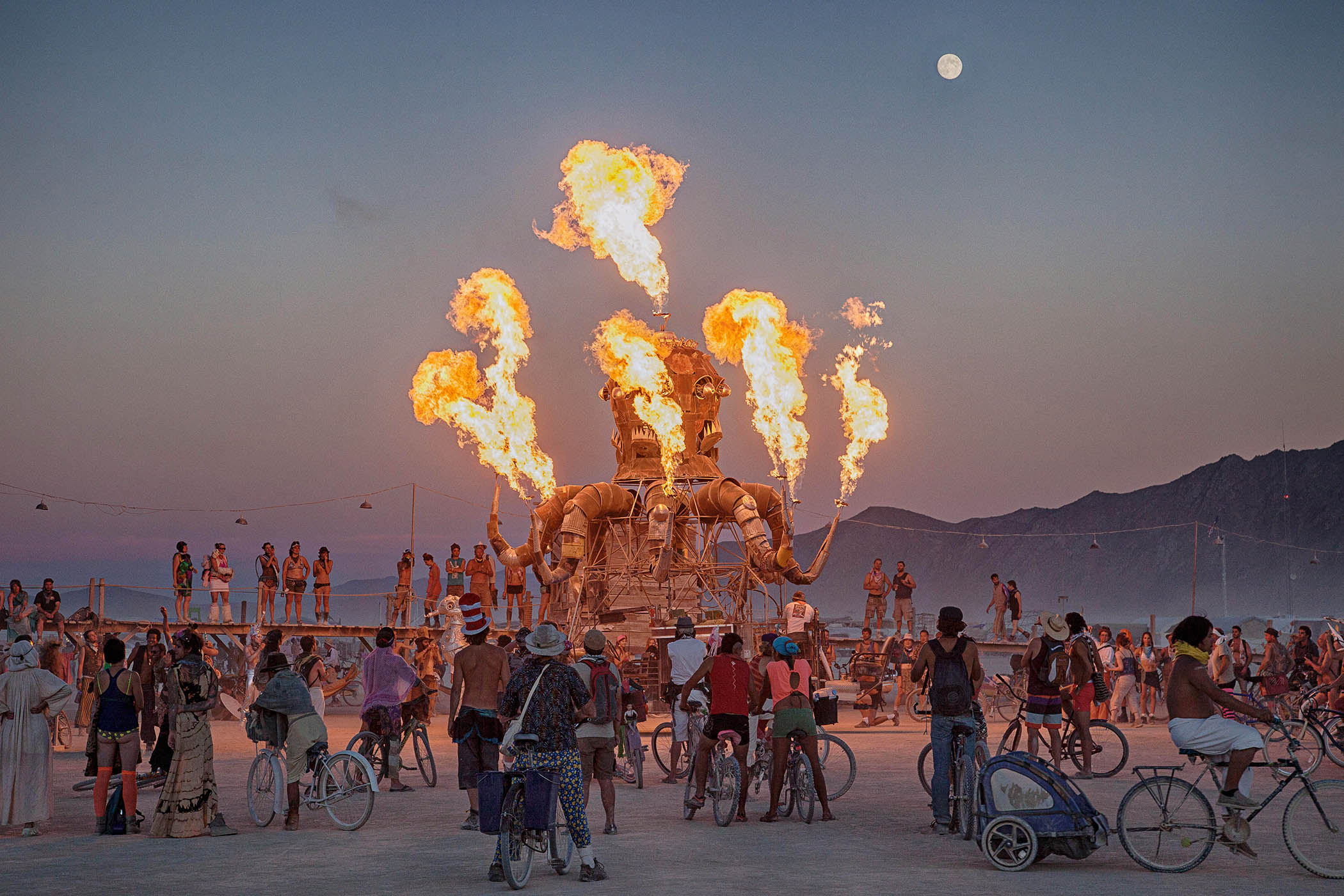
The debate about the coffee rumbled on for the better part of two decades. Well, not the coffee, so much, as the fact that you had to pay for it. The founders of Burning Man, the annual art-and-effigy festival held in the Nevada desert, had always regarded their creation as a vision of society unbound by the strictures of commerce.
From the mid-1990s, as the event grew in scale and cost, they had made one exception: at the Center Camp Café, attendees could pay for a shot of espresso from – initially – a single machine, mounted on a few hay bales. Larry Harvey, one of the festival’s co-founders, wanted it to recreate the experience of the Mexican city of Oaxaca, idling over coffee in the shade of laurel trees.
But to some Burning Man regulars, it was unacceptable. Harvey also wrote the event’s 10 Principles, the values it should both represent and promote. Second on that list, according to its own website, is “decommodification.” Selling coffee – selling anything – contradicted that ideal. In 2022, citing environmental and philosophical considerations, Burning Man finally shut the coffee shop.
That same year, tickets to attend cost $575 but for anyone wanting a guaranteed place that cost rose as high as $2,500 in a so-called FOMO sale. Parking passes – quite important, given that public transport access to Black Rock City, out under the stars beyond Reno, is best described as “limited” – were an additional $140.
At first glance, this seems like more of a challenge to Burning Man’s all-important ethos than whether you can get a flat white: there is, after all, something inherently jarring about an event that has always been seen, and has seen itself, as a standard-bearer for the counter-culture – all artistic freedom and self-expression – charging premium fees.
The event had, admittedly, never been free – early editions, when first held in San Francisco, cost $15, rising to $40 when it moved to Nevada – and Harvey, writing in 2013, made it very clear that he had never “espoused a non-commercial ideology.”
“When most people say that any thing or act is too commercial or has been commercialised,” he wrote, “very few of them mean to say that the practice of commerce is necessarily bad. Instead, they are expressing the feeling that something essential – something that should never be bought and sold – has been commodified.”
Which brings us, neatly, to the imminent World Cup, which makes Burning Man look something of a bargain. You will, by this stage, be familiar with the consequences of Fifa’s decision to institute what it calls “dynamic pricing” but we might refer to as “rampant price-gouging.”
Newsletters
Choose the newsletters you want to receive
View more
For information about how The Observer protects your data, read our Privacy Policy
Tickets for random group games are going for hundreds of dollars, while meaningful fixtures cost several thousand; as a consequence, sales for less attractive matches have been unsurprisingly sluggish; in the last few days, more and more tickets have become available at discounted prices through corporate sponsors and from the allocations held by host cities. Still, it seems inevitable that some games will be played out against the backdrop of empty seats.
That is, really, only the at-a-glance version of what feels like a scandal even this Teflon-coated version of Fifa might struggle to downplay: it ignores the fact that the body supposedly tasked with protecting the game has decided it should also be a sort of official tout, too, and that it seems to have adopted a ticketing policy designed to create scarcity where it may not be strictly necessary.
And even that does not take into account all of the other costs that have been attached to this tournament: the host cities ramping up transport and parking prices in order to make up the shortfall created for them by Fifa’s sponsorship policies; the surging mark-ups on accommodation and flights and once everyone gets to the United States, presumably plenty of other things, too.
The fact that Fifa has now generously decreed that fans can take one – ONE – plastic water bottle into venues, rather than none, sort of sums the whole thing up. Yes, yes, fans have to be safe in the heat. But not to the extent that it might really affect our primary partners at Glacéau SmartWater.
Taken together, it is not hard to see why Peter Moore, the former chief executive of Liverpool, suggested in April that we are witnessing “the early stages of something quite profound,” he wrote on X. “The World Cup is shifting from (a) mass access global festival toward (a) high-value, limited access mega-event.”
That change, he wrote, was the result of a “deliberate repositioning” by Fifa, recasting the World Cup for the benefit of “premium entertainment, corporate hospitality and high-spending global consumers.” If the 2018 World Cup was a Potemkin event staged to showcase the power of the Putin regime, and the 2022 World Cup was designed to glorify the nation state of Qatar, then 2026 is being held for the enjoyment of the global elite. The rest of us are, very clearly, not invited.
That process, though, is by no means limited to football. It is the same with almost every form of aspirational live experience, from Glastonbury to Burning Man, the consequence of what we might think of as bucket-list culture. These are the places everyone wants to be, the places everyone wants to see, a uniformity accelerated by social media.
The prices duly go up, rendering all of these events as the exclusive preserve of those who can afford it, or those who can milk it for sufficient content that they can justify it.
And so Burning Man, founded by anarchic artists looking for “radical self-expression,” is invaded by luxury campervans housing the Silicon Valley technocracy; the World Cup is slowly but surely stripped of the fans who lend it its colour and create its magic. What is being commodified, packaged up and sold off by those who are meant to protect it, is far more than coffee. It is the very act of experiencing.
Photograph Bob Wick/BLM/Alamy