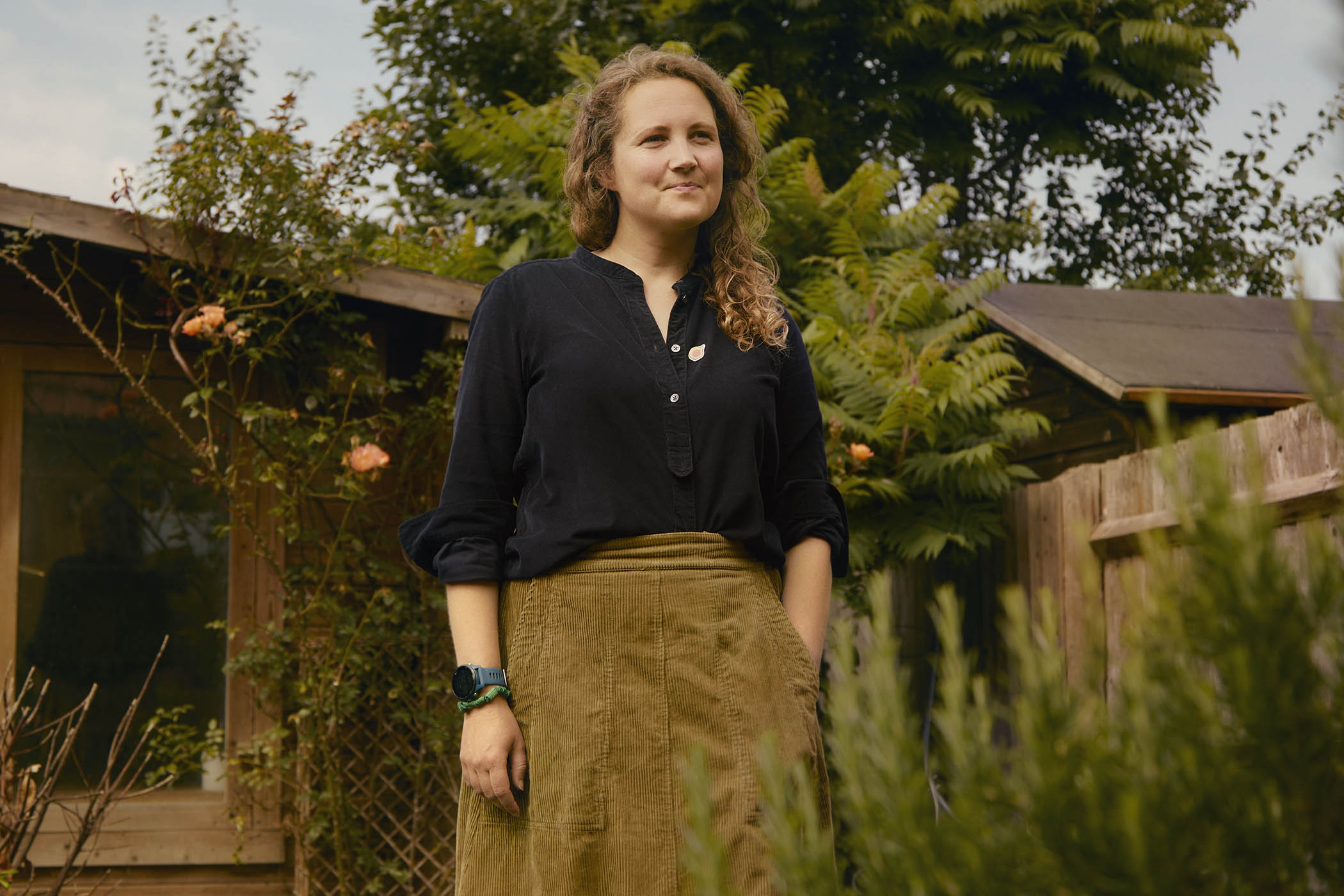
Daisy Johnson, 35, is a British short story writer and novelist, who lives in Oxford. In 2018, aged 27, she became the youngest ever author to be shortlisted for the Booker prize for her debut, Everything Under. Across her books, which also include the novel Sisters and the story collections Fen and The Hotel, Johnson explores myth, the uncanny, and human connection to the natural world. Her latest novel, Long Wave, is a trippy tale that follows three generations of women – Edith, Ruth and Ori – in the same family, each coming to terms with what it means to be a mother and a daughter.
Long Wave is a multi-layered novel. What’s the idea at its core?
When I was struggling with an early draft and couldn’t conceive of what it was about, I spoke to a friend. He talked to me about the image in the Sistine Chapel of Adam and God reaching out to one another [Michelangelo’s The Creation of Adam]. There’s this space between their fingers. It became clear to me that it was a book about that – people trying to find one another. That really came about during Covid, during that period of epic isolation, fear and loneliness, which occurred for me at the same time as having children for the first time.
The book’s structure is surprising. How did you come to it?
Memory isn’t linear and so life isn’t linear. Things reoccur and come back to us. It mirrors the experience of Ori having a very young child, and the disorientation and fragmentation of self that comes with that. I wanted it to have this exploded feel, and a tidal feel.
You depict cruel mothers and loving mothers. What did you want to explore by showing that spectrum?
The turbulence of it, and also the humanity. When we become parents, we’re expected to know what to do. But we are so human, so fallible. Even Edith, who does something possibly unforgivable, does it out of a desperate attempt to do her best, to hold on to something that she cares about. I wanted to explore these characters trying as hard as they could. That was why the book then began to think about collective parenting – the idea of the village, which we need not just in parenting but in life.
How did your experience of becoming a mother influence the novel?
The book did not come from a good place. I had no expectation at all that early parenting was going to be as hard as it was: we just don’t talk about it. With my first son, the birth was very traumatic. It was also during Covid, so there were limited times that my partner was allowed in the hospital. I had an emergency C-section, and then was pretty much alone with this baby who I didn’t really know how to look after. He did not sleep unless you were holding him upright. I’d never experienced anything like it, and it brought up a lot of anger, red rage, despair, fear. The reason the book took so long is that it began as a scream, and some of that scream is still in there. But the book changed as I got better, and as my son grew up, and when we had our second child and began to figure it out.
What was your relationship to writing like during that time?
Newsletters
Choose the newsletters you want to receive
View more
For information about how The Observer protects your data, read our Privacy Policy
When I had my first son, I couldn’t write, I couldn’t read, and I forgot words. It was very frightening. I didn’t know whether it was going to come back. It felt like the person I had been was gone, and along with it any confidence about the words. I didn’t have the words to explain what was happening.
Were there friends you could turn to who had had similar experiences?
No, there weren’t. Eventually I found a therapist, and began to talk about it to family and friends. There’s power in saying [aloud] the worst possible thing – the invasive thoughts, which I think are more common [than you’d expect]. The baby’s in your belly, and it’s safe, it’s part of you; and then it’s out in the world, and the person I was most afraid of was myself, and these violent, frightening thoughts that were in my head. It felt like that was not something I could say, and so you bury [these thoughts], and they rot inside you.
When could you write again?
My process is always one of writing drafts very fast, and then getting rid of almost all the words. Within each published novel are seven novels, which have come and gone. But [with Long Wave] I would sit at the desk and nothing would come out, or it would but it was incomprehensible. It didn’t feel like the words were connected to my brain. Then when my son started learning to talk – his first word was “cheese” – and we were reading to him, that was a turning point. I went back to those books I loved when I was a child – Maurice Sendak’s Where the Wild Things Are, Helen Cooper’s Pumpkin Soup, So Much by Trish Cooke – and was like, “Woah! Words are amazing.” He was finding his language as I was trying to find the language to write the book.
Did you find books that mirrored your experiences?
Adrienne Rich was really important. Her book Of Woman Born is about community and the power of telling stories. And Olga Ravn’s My Work, which is about her experience of becoming a mother. Lucy Jones’s Matrescence blew my mind. And Women Talking by Miriam Toews. She talks about the book being an act of “wild female imagination”, because it’s imagining the women [characters who have been raped] being able to have the words to talk about escaping. That phrase became really important for me, because while I was having a very hard time and felt incomprehensible to myself, let alone to anyone else, I could see my book as an act of wild female imagination: maybe one day it’ll be OK, things will come together, and the connections will make sense.
Long Wave by Daisy Johnson is published by Jonathan Cape (£18.99). Order a copy from observershop.co.uk for £16.14 (save 15%)
Photograph by Ellie Smith for the Observer