


For years, the unassuming little German town escaped the allies’ notice. The relatively small population – around 30,000 people – and its place in the foothills of the Black Forest was offset in importance by Nazi barracks just several miles away. Then, in 1944, the planes finally arrived. In the aftermath of the allied campaign, much of the town’s housing was completely destroyed. The mission had also eliminated 11 industrial plants.
The town’s motto was, and is, “the good-good life”. The bombing campaign was probably the worst thing in history to have happened to Baden-Baden. Until the Wags arrived.
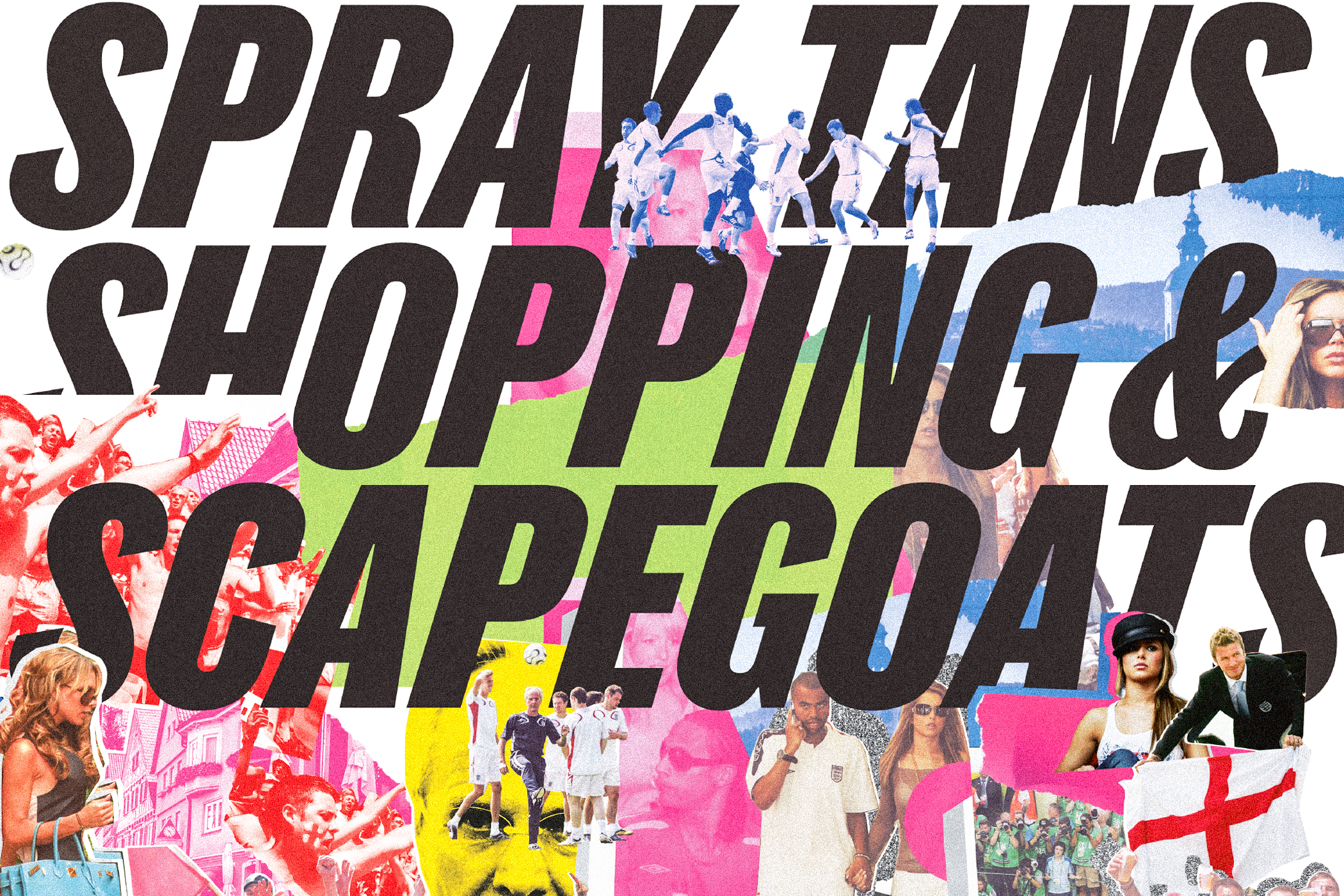
The year was 2006. Germany had been named the host nation for the World Cup, and England had choices to make. One of those choices concerned the location for their training camp. A tiny village, Bühlertal, which had an acceptable stadium, Mittelbergstadion, presented itself as an uncontroversial option. Other choices were more contentious. Should the team bring their partners; and, if so, where should they be installed? Twenty years on, as England prepare to embark on their next World Cup journey, the country still hasn’t decided on whether the decision to drop some of England’s most glamorous women in a sleepy German spa town was as tactically and culturally disastrous as it seemed at the time.
In 2026, England and Germany’s fates are entwined once again. The squad picked to compete in the USA by German coach Thomas Tuchel are already igniting the embers of a familiarly ferocious debate about loyalty and tactics. As the English press questions the motives and mentality of the Bavarian manager, I set out for Tuchel’s home country. On a quiet spring afternoon, I touched down on the tarmac of Baden-Baden’s minuscule airport and began a search to find meaning, if any was to be found, in the legacy of noughties football’s biggest bender.
Twenty years before I arrived in Baden-Baden, England was a country seized by cautious, deluded optimism. The squad that year featured a selection of men who played for the most elite clubs: David Beckham, Peter Crouch, Ashley Cole, Rio Ferdinand, Gary Neville, Steven Gerrard, Frank Lampard, Wayne Rooney, John Terry, Jamie Carragher, Sol Campbell. Led by manager Sven-Göran Eriksson, they arrived in Germany to embark on training with huge expectations on their shoulders – and even bigger entourages in tow.
As the team settled into Schlosshotel Bühlerhöhe, a luxury spa hotel in the Black Forest, their wives and girlfriends touched down in Baden-Baden, unwittingly setting off a media circus the likes of which noughties tabloids had never seen. In 2006, though, these women weren’t called “wives and girlfriends”. They were something else – a shiny, different beast: the Wag.
Traced back to 2002-era newspapers – a piece in the Telegraph attributed the coinage to staff at Dubai’s Jumeirah Beach Hotel – by the mid-noughties the Wags were the apex predators of British celebrity culture. Footballers Wives, a fictionalised portrayal of excess told through the fictional team Earls Park FC, was an ITV sensation. It would be another four years before the European Equalities and Human Rights Commission criticised the term “Wag” as demeaning to women.
It would be another four years before the European Equalities and Human Rights Commission criticised the term “Wag” as demeaning to women
It would be another four years before the European Equalities and Human Rights Commission criticised the term “Wag” as demeaning to women
Just as the 2000s England squad was known as the Golden Generation, this was the golden generation of the Wag archetype – tall, thin, tanned and terrifying. Led by their queen, Victoria Beckham, the lineup included Cheryl Tweedy, Alex Curran, Elen Rivas, Carly Cole, Abbey Clancy, Melanie Walcott, Louise Owen and 19-year-old Coleen Rooney. The squad were joined in many cases by their extended families. Joanne Beckham, David’s sister, was stationed in Baden-Baden, along with both parents. Theo Walcott’s one-year-old nephew was there. So many of the Carragher family were resident that the local nightclub was rechristened the Scouse House. (Carragher describes Baden-Baden as the “best experience of his family’s life”.)
It is hard to overstate just how unsuited Baden-Baden is for this kind of noughties celebrity invasion – a three-week extravaganza of football fame concentrated almost entirely in Brenners Park, a £1,000-a-night 1800s spa hotel on the outskirts of town, and Garibaldi, a mid-tier Italian restaurant the Wags frequented almost nightly. Although the women themselves were concentrated in a few locations, and although the entourage, while large for a football tour, was still reasonable – 22 of the 23-man squad brought their families with them to Baden-Baden in some form, with the exception of Aaron Lennon – this was not the only new addition to the little town. Where the Wags went, a tabloid media circus followed. Along with the usual football journalists, an army of paparazzi, gossip writers and news hacks suddenly took up rooms across the town.
Exploring during my own visit 20 years on, the picturesque Bavarian market idyll reminds me of the inside of a cuckoo clock, or a souvenir snow globe. There is a restaurant where waiters serve you wearing lederhosen, and there’s a museum of Fabergé eggs. The visitors are usually made up of geriatric German ramblers headed towards the Black Forest, and a surprising amount of uber-wealthy Russians. Everyone appears to own one or more chihuahuas. The main attraction is, of course, the thermal baths – Baden-Baden means quite literally Bath-Bath – although there is also a bowling centre, a funicular and exactly one “nightclub”. In nearby Rheinmünster there is a camel and ostrich farm. Baden-Baden’s celebrity clientele is more Weimar Republic than Dubai influencer. Marlene Dietrich adored the huge, gilded casino, and Queen Victoria was once a regular visitor. There is, in short, not much to do.
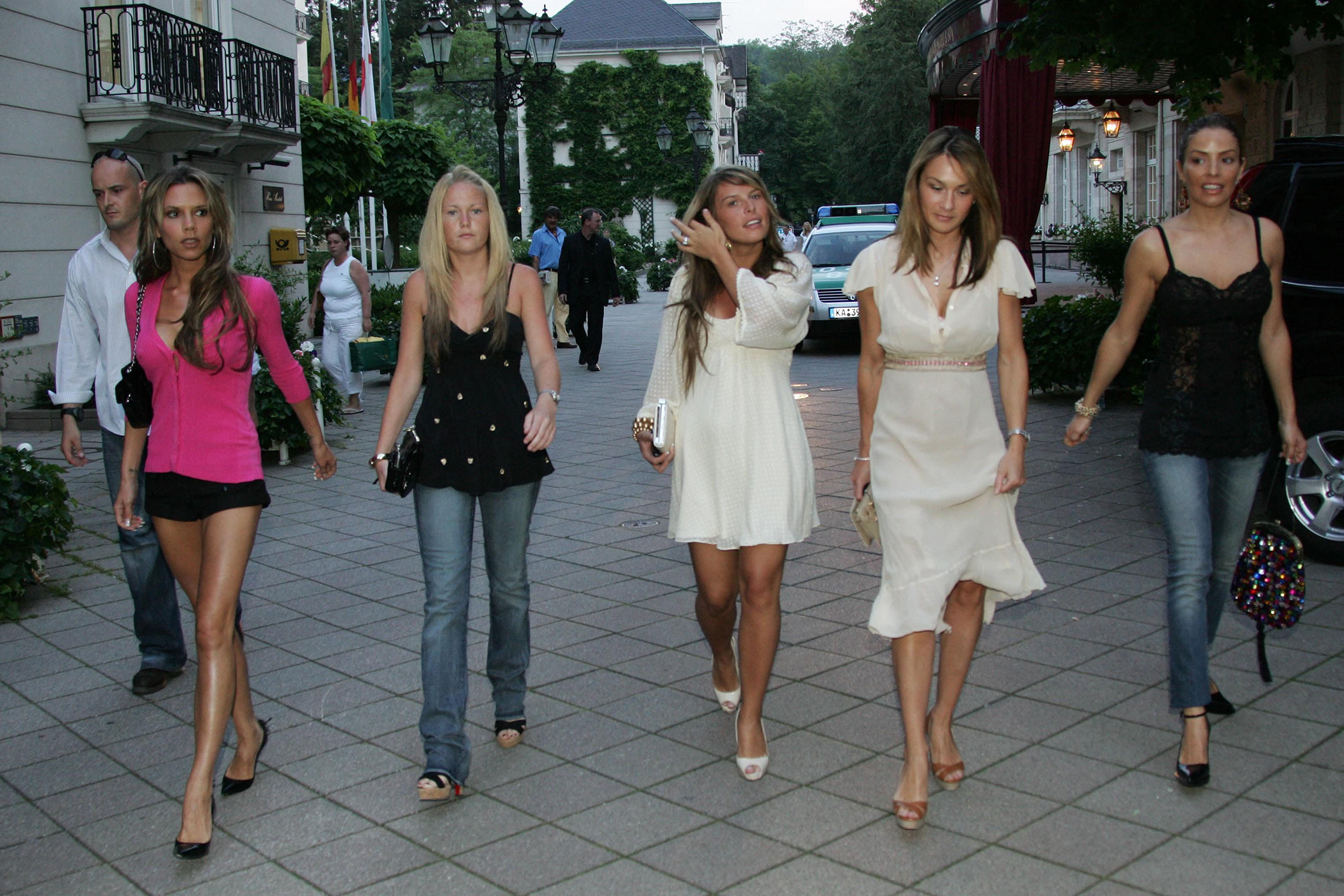
The England wives and girlfriends on the town (from left): Victoria Beckham, Coleen Rooney, Louise Owen and Elen Rivas.
Stuck with not much to do, the 2006 Wags were mostly quarantined in their luxurious hotel base camp, the best Baden-Baden has to offer. Periodically, various players would descend from the hills to Brenners Park, to visit their families and to sort out various disputes – hotel complaints over guest conduct, or various other domestic incidents. The Wags also had the misfortune of sharing the hotel with most of Britain’s football reporters. Among them was Paul Hayward, football journalist and author of England Football: The Biography, who describes the atmosphere in the hotel as “genteel”. The staff wore bow ties and maid outfits. A tinkling piano played at all times. And nobody knew what to make of the England families. “It regressed rapidly,” he says. “But it was fun.”
“They were in a laboratory without fully realising it,” says Hayward, who avoids using the “pejorative but useful” term Wag himself. Until the fallout of Baden-Baden, the Wags’ relationship with the press had been reasonably symbiotic. They used journalists to tell their stories; journalists used them to sell their papers. Before the full extent of the phone-hacking scandal, before the Leveson inquiry and before social media, the relationship between the football world and the media world was much closer than how we understand it to work today. “Some of the wives and girlfriends were very conscious of their branding, and saw this as an opportunity to raise their profiles,” says Hayward. “We always noticed they would be in the breakfast room grumbling about the press, but in the mornings they’d go and get the papers to see what page they were on. It was quite interesting to see those women empower themselves while also being preyed upon and slightly sneered at.”
The column inches and headlines the women inspired are a time capsule in noughties lasciviousness, nastiness and invasiveness. The Sun called the Wags “suitably well-oiled”. Bild sniped that Germany should change the name of Baden-Baden to “Shopping-Shopping”. Ashley Cole was long-lensed, then pounced on up close by photographers while sitting outside a café, doing absolutely nothing.
Newsletters
Choose the newsletters you want to receive
View more
For information about how The Observer protects your data, read our Privacy Policy
Perhaps unsurprisingly, then, although they tolerated football journalists (with notable exceptions – Hayward recalls getting “a bollocking” from Sandra, Beckham’s mum, for an article he’d written about the politics of the England camp), the Wags became terrified of the tabloids. “They were afraid of the reporters working undercover in the hotel,” Hayward says. “They’d come and sit in the lobby or the bar and earwig conversation. They were gossip writers just doing their jobs, but that was the stressful part of it.”
At one stage, in response to the chaos unfolding before them, a concierge at Brenners Park Hotel was overheard remarking to an employee working on reception that he “couldn’t believe they’d lost the war to these people”.
“It turned into a reality show, where the press was preying on the families,” says Hayward. “There was a lot of class-based sneering as well. The middle-English disdain for working-class people with money was really evident; and then, when you add gender into it, it goes into a whole other dimension. The men always got it hard. You know: look at these guys buying Bentleys and living in these big houses. But the women got a different kind of condescension. It was based on the same assumptions, though – that you just should not give money to working-class people because they don’t know how to use it or behave”.
When the Wags weren’t cloistered in the Belle Epoque base of Brenners Park, it’s true that they shopped. Baden-Baden is made for the kind of luxury shopping they indulged in. Today its streets are lined with some of the world’s most famous luxury brands, from Moncler to Prada. There are luxury car shops, jewellers and secondhand Birkins are sold in tourist shops for £20,000 a piece. During the 2006 World Cup, the Wags liberated their credit cards at plenty of these kinds of stores. On one occasion, they spent £57,000 in a single, hour-long shopping trip. “The families spent prodigiously,” says Hayward. “The paparazzi were completely in their element, because they didn’t have to do anything – they just followed them into town.”
The Wags transcended football. They became a sideshow and then the main attraction, dominating the papers for weeks on end. The Spanish newspaper ABC called them “hooligans with visas”. A BBC report described them as “the women Britain loves to hate”, roaming around Baden-Baden in a pack, “like Reservoir Dogs, but with better tans, bigger hair extensions and more shopping bags”. Coleen Rooney reportedly flew her spray-tan expert to Germany with her. At one point Elen Rivas – then girlfriend of Frank Lampard – stood up on a table at local restaurant Garibaldi and belted out Gloria Gaynor’s I Will Survive.
Few people were angrier about the media circus than Gary Neville, who became known for his constant lectures to the rest of the squad, telling them to stop their families going out, and to keep them under control. “I was fucking fuming with the wives,” Neville said on the podcast Stick to Football last year. “I can only describe it as an actual circus. There were stories breaking every day about nothing – they’ve eaten there today, they’ve shopped here today. It was a constant distraction, and when you went to the press conferences the players were being asked about it all the time. There was nowhere to go. You couldn’t escape.”
Neville was also critical of the FA for allowing the creation of the Baden-Baden bubble, which marked the first time that partners and families were allowed to stay for the whole tournament. And of his own family. After weeks of hectoring, Neville awoke one morning to see his father, Neville Neville, splashed on page four of the Daily Mail. He was standing on a table, drenched in beer and holding a replica World Cup trophy above his head. The picture even inspired its own song, set to the tune of David Bowie’s Rebel Rebel (“Neville Neville, your shirt is a mess”). Gary Neville remembers the story as the only time he ever fell out with his dad.
This was the golden age of the Wag archetype: tall, thin, tanned and terrifying
This was the golden age of the Wag archetype: tall, thin, tanned and terrifying
Twenty years later, Garibaldi is still standing. When the Wags left Baden-Baden, its owner, Carmine Tortora, wept. At the time, he told the Times it was “the best three weeks of his life.” Now, speaking through a translator, he says: “There were beautiful things here, and it was a really good atmosphere. It was filled with important people and they filled the town. The Wags were very nice.”
We’re meeting on a quiet Wednesday afternoon, although in Baden-Baden it’s always kind of a quiet Wednesday afternoon. Garibaldi is blasting an Italian-language cover of Total Eclipse of the Heart while Tortora chats to customers outside over many espressos and cigarettes. Everyone in Baden-Baden seems to know Tortora, who enjoys this very much. He tells me he knows David Beckham’s sister, mother and father. He knows Victoria, too – although, already world famous by the time of the 2006 World Cup, she maintained a degree of separation from the other Wags. She travelled “more secretively”, with four personal bodyguards. “Victoria didn’t like to walk,” says Tortora. He points to a photo of himself with the woman herself on the wall of his restaurant. “One journalist said to me, ‘I’ve never seen Victoria laugh.’ But she’s smiling in this picture! It’s because she felt at home here. She felt safe, no stress.”
The Wags came to Garibaldi almost every night, turning it into a kind of personal bacchanalia in the Black Forest. They downed champagne laced with syrups. They emerged, absolutely smashed, to meet a sea of flashing cameras. They were, England seemed to be saying, not behaving themselves the way rich women should. Tortora, for what it’s worth, didn’t seem to mind any of this. “They were all educated and polite,” he insists.
Too much of a gentleman to say which Wag was his favourite, Tortora has kept his restaurant almost exactly the same since 2006. “At that time, Garibaldi was almost the most famous local in the world” Tortora beams. “Why? Because of the Wags. They were on the front page of every newspaper in England, and they were at Garibaldi. From that I became world famous.” Tortora likes his famous customers. The walls are lined with photos of celebrities – not just Victoria but Rio Ferdinand, David Beckham, Wayne Rooney, the Nevilles. There’s a photo of Al Pacino, too, but this one is photoshopped. “I’m just a fan,” says Tortora. “But the rest of them are real.” He pauses. “I was fantastic during that time,” Tortora adds. “I was here every day, and there were German television crews, English television crews. They were here just for the ladies, of course, not for me.”
That the stories of Wag Baden-Baden were wildly exaggerated by the tabloid press becomes obvious the moment you set foot in the town. This is not Chinawhite, not Essex or Dubai. There are no nightclubs to fall out of, and barely any pubs. Most of the pedestrianised streets are lined with cafés populated by wealthy septuagenarian German couples or Prada-clad, chain-smoking Russian teenagers. Garibaldi is the busiest restaurant in town, but even here you can wander in without booking a table.
“Stuff was being made up about them, predictably,” says Hayward. “It looked like they were going clubbing every night till 4am. They weren’t. They went for a meal, and they ordered too much champagne and wine. They sang songs. They were probably out of there by half 10, 11. They were going to restaurants and being boisterous in the way Brits are in restaurants. And that’s pretty much it. It was all very innocent.”
The only time Tortora comes close to losing his cool is when he talks about the media. “The journalists were lying,” he says. “The problem was that the girls were always followed by the journalists when they came here. But the girls didn’t make any problems in Garibaldi. Zero problems. I’m telling the truth, I don’t like to lie. I’m not here for popularity. I’m a gentleman, I’m educated and polite. And it was a beautiful moment. No arguments, no problems. I don’t like to fight with the public. I fight for real, I don’t fight with newspapers. The journalists weren’t rude, but they were just taking a lot of pictures.”
Today, the Wags of 06 say the same thing about Baden-Baden. “It got exaggerated and people got annoyed,” Coleen Rooney told Stick to Football last year. “The place was tiny. There were only a handful of places you could go. The press exaggerated and made out we were having these parties every night. It was unfair the way we got the blame.” She recalls a setup by an undercover journalist who followed her back to Brenners Park in a Rooney England shirt before pulling his pants down and mooning her, at which point a paparazzo jumped out of the bushes to capture the moment. The headline the following morning read “Rooney Moony”.
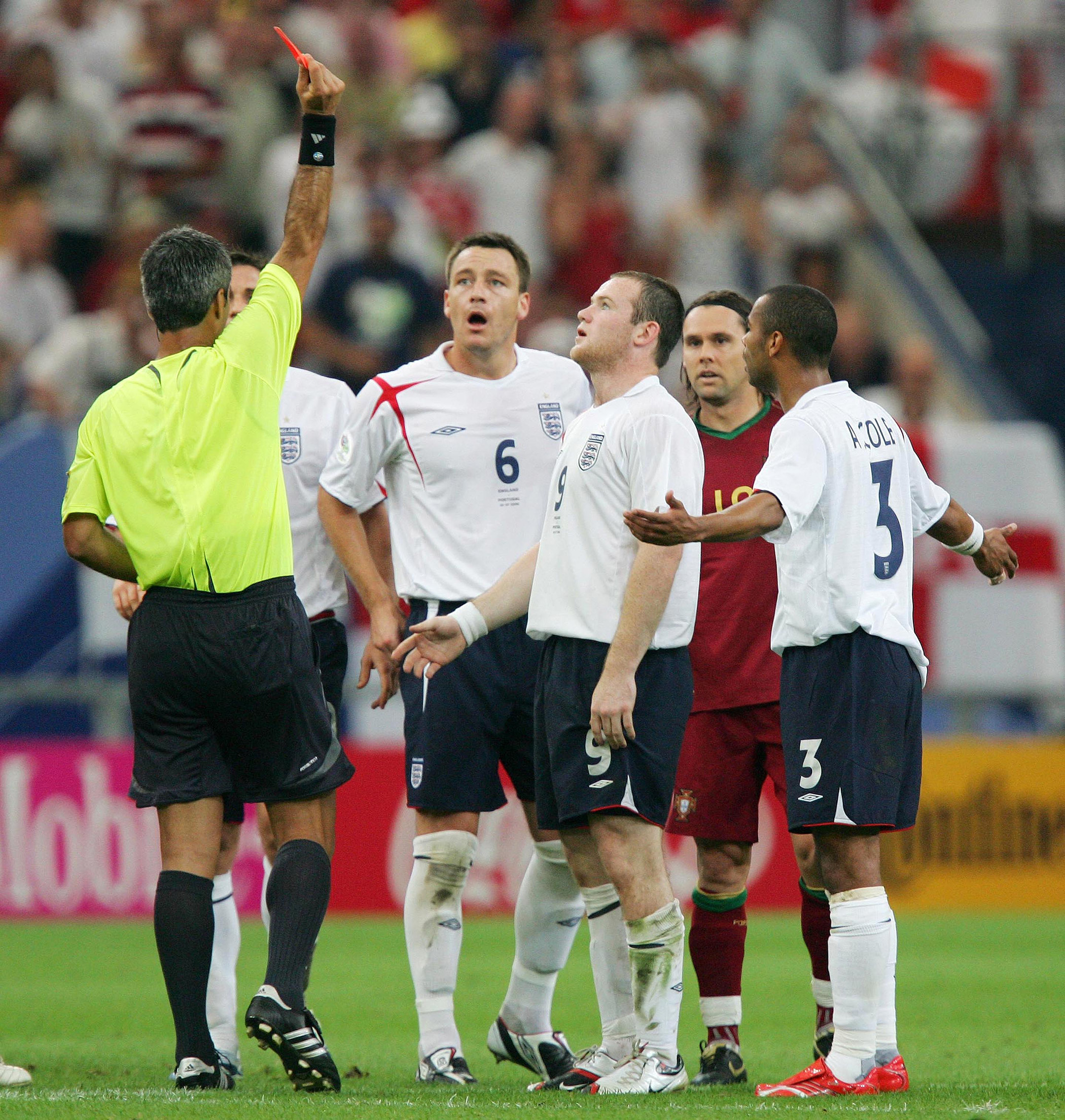
Wagatha Christie was, of course, correct – when England eventually crashed out of the competition, the Wags became the enemies. On 1 July 2006 England played Portugal in the quarter-finals, when 52,000 people in Gelsenkirchen’s AufSchalke stadium watched England lose 3-1 on penalties once again. Beckham went off injured at half-time. In the 62nd minute, Rooney received a red card for a stamp on Ricardo Carvalho. But the world blamed the Wags. The families, sensing a shift in atmosphere, quickly left Germany, as did the England squad. “They got scapegoated,” says Hayward. And in the aftermath, they were punished for it.
For the following World Cup (2010, in South Africa), Fabio Capello cut the entourage and relocated the England squad to a remote, austere training camp at Rustenberg. Capello went to extreme lengths to avoid a repeat of Baden-Baden; the grilles were pulled down on hotel bars, even for FA staff. The team were bored, frustrated and bad-tempered. “They felt that they were being treated like children,” says Hayward. “Eriksson was very permissive. He couldn’t see a problem with having huge numbers of family members 10 miles down the road and having the players going backwards and forwards between the two camps. But Eriksson didn’t really understand the media.”
Capello’s attempt to understand what the media wanted did not mean that England fared any better in South Africa. In fact, they fared worse. After a humiliating loss to the United States in the group stage, England were knocked out by Germany in the last 16. The final score was 4-1, notable for being England’s worst performance in a World Cup final match. Without the Wags to blame for such a subpar performance, fingers were pointed at another distraction: the noise of vuvuzelas in the stands, along with a controversial disallowed Frank Lampard goal.
In the years since Baden-Baden, there has been a quiet reckoning on how the Wags of 2006 were treated by the press. The Telegraph admits they “changed fashion for ever”; Grazia writes that they “deserved better”; Vogue calls out the “misogyny and classism” of the tabloid’s Baden-Baden coverage, while also noting that the Wags were, in effect, the world’s first ever Taylor Swift-esque girl squad. A general queasiness around the media moral panic that Baden-Baden became has emerged.
It wouldn’t be the first time the press have looked back in horror at how the women of elite football were perceived. In 1966, when England won the World Cup, a grand banquet was held at the Royal Garden Hotel in Kensington. In one room were the players, officials, celebrity hangers on, bureaucrats in blazers and glory hunters; in the other room were all of the women. That the players’ wives were kept segregated from the main celebration, eating on their own, was a mark of shame that hung over the 1966 win. It’s tempting to draw an arc from the wives of 1966 to the Wags of 06, a collection of women who were much more influential, powerful and in some cases famous in their own right. Except they were perhaps not treated any better for it.
There remains an archaic, sexist nervousness about women’s behaviour, even during later, more progressive eras of English football. During the 2022 World Cup, while the team were being managed by Gareth Southgate, known for his more sensitive approach to football culture, an article in the Sun nonetheless compared wives’ “ludicrous” presence in Qatar to “a gynaecologist inspecting your nether regions while her husband watches spellbound from the corner” or “a plumber bringing his wife and kids along to fix your leaking cistern”.
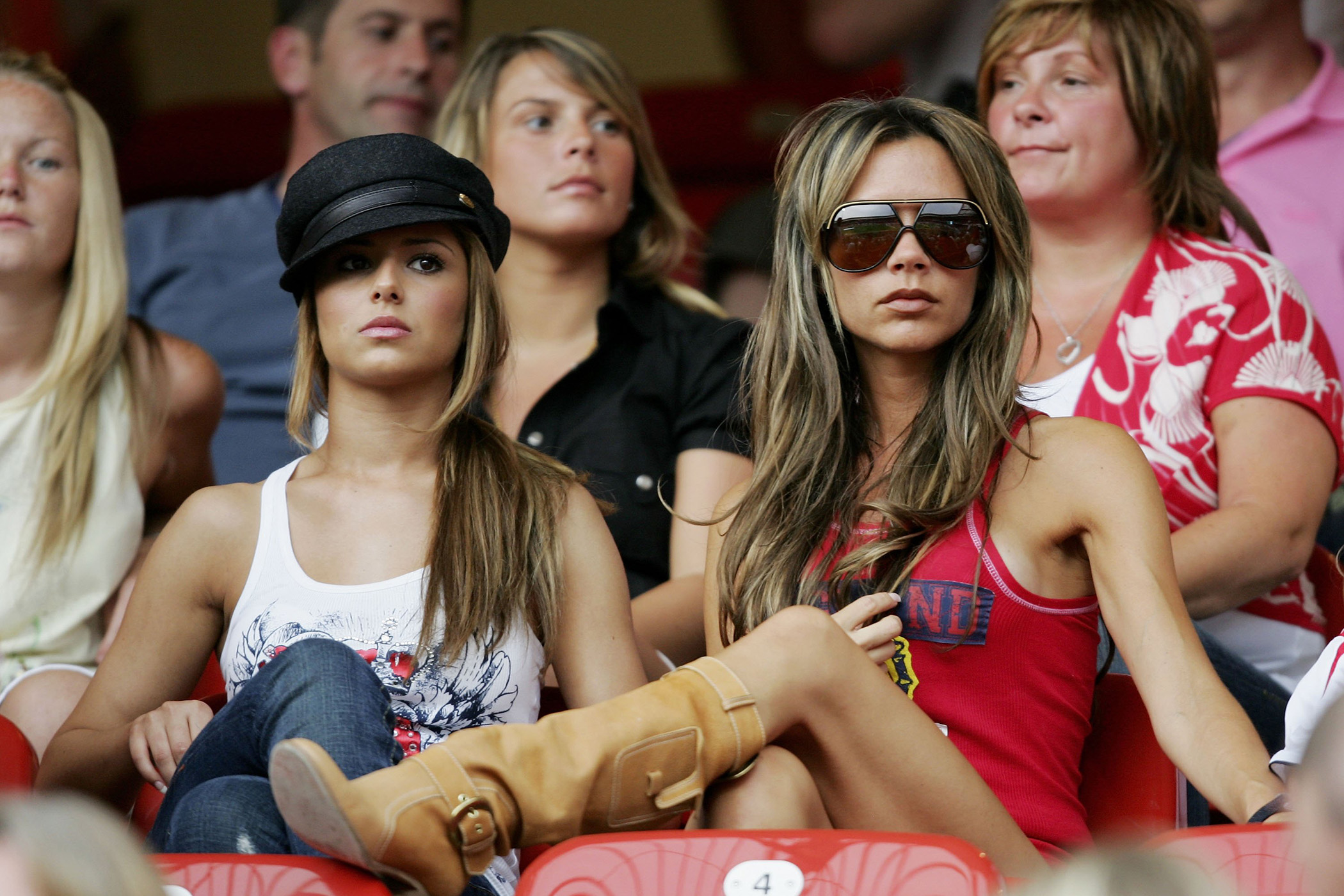
Cheryl and Posh in the VIP box.
The Baden-Baden Wags have distanced themselves from the “Wag lifestyle”. Coleen Rooney now is less known for being Wayne Rooney’s wife than she is for her legal battle with Rebekah Vardy, wife of former Leicester star Jamie. Victoria Beckham is a fashion mogul. Today’s football partners are often either influencers in their own right, or simply shy away from press. Neither approach is foolproof. “There are certain expectations for Wags,” says sports sociology academic Carrie Dunn, “and there are plenty of stories about Wags today who don’t look a certain way. It seems to me, as in so many situations, women can’t win. If they present themselves in this kind of glamorous way, they get ‘Oh, they’re just ‘Wags.’ If they present themselves in a different way, it’s ‘Oh, what’s he doing with her?’”
In Baden-Baden, too, things have moved on. The Wags have never returned to Garibaldi, much to Carmine Tortora’s dismay. Only Victoria Beckham, the most secretive and elusive Wag, has been drawn back to the genteel atmosphere of Brenners Park, where she checks herself in for “wellness weeks” with “longevity naturopath” doctor Dr Harry Koenig. His 10-day programme is around £17,000 per person, and it is understandably free of champagne, strawberry syrups and pasta. But at Garibaldi, where a photo of Posh Spice with a shadow of a smile still remains, Tortora still has his memories of summer 2006. “Everything was perfect,” he smiles, before returning to his espressos and cigarettes. “Just look at my face – can’t you tell I didn’t want it to end?”