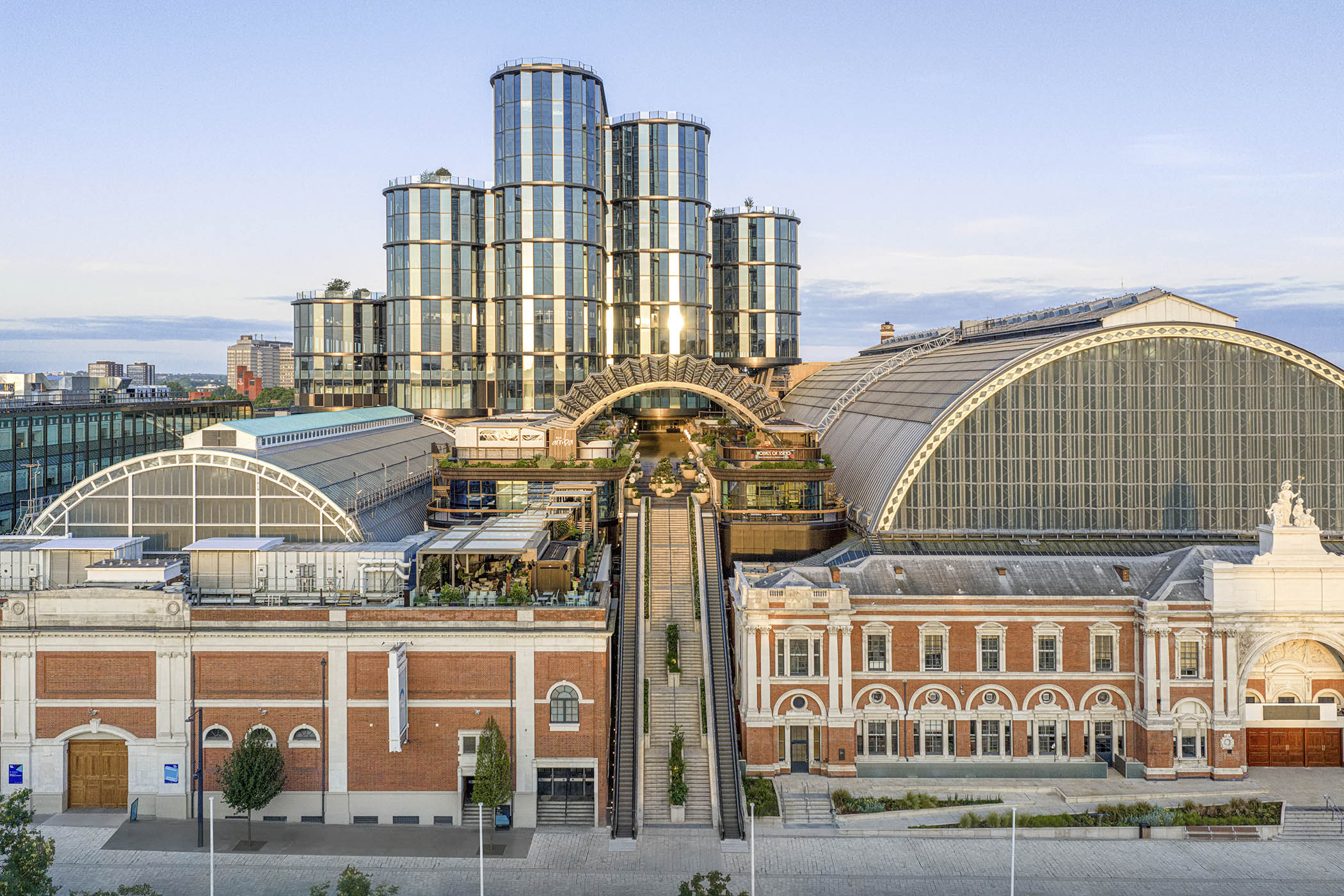

Olympia, a £1.3bn development built on more than five and a half hectares (14 acres) of west London, is, according to one of the architects involved, “an interesting cake”. By this, he means it is a thing of layers, constructed on top of the sprawling 1880s exhibition complex that was once the venue of events including Crufts and the Royal Tournament, and is still the location of the Ideal Home Show. It is surmounted by the largest new permanent theatre to be built in London since the National opened in 1976, plus a 3,800-capacity music venue called the British Airways ARC and a multistorey ziggurat of offices, whose tenants will include the Premier League. The fabric also incorporates hotels, restaurants and a private school. Beneath it is a logistics centre, where the industrial work of getting shows in and out of the complex takes place.
In his great and influential 1978 book Delirious New York, the Dutch architect Rem Koolhaas wrote of the “culture of congestion” in 20th-century Manhattan, whereby the pressure of capitalism on a narrow island caused multiple different uses to be stacked up on one another. Now the phenomenon has landed in what is otherwise a sedate part of the capital.
The project is designed by Thomas Heatherwick and his studio and by the architects SPPARC. The former is famous for his desire to “humanise” the built environment, expressed in a book and radio series, and in highly embellished buildings around the world. The latter practice is run by Trevor Morriss, an architect who, with residential, office and retail developments in London and elsewhere, has also shown a fondness for flourishes. So the new Olympia was never going to be about retrained minimalism.
Their big idea was to animate the complex with a sequence of publicly accessible spaces across and through what was originally an impermeable block. They start with Olympia Way, in front of the development, where a road once dominated by service vehicles has been pedestrianised. It is to be brought to life by what the official blurb calls a “curated enlivenment programme”.
Escalators then take you to an elevated avenue lined with restaurants and bars. This leads to a long and broad barrel-vaulted space ceiled in an 83-metre-long “digital soffit screen” called the Canvas, carrying an ever-changing display of “art and activations”. The ample foyer to the offices opens to one side; at the end, you can reach the theatre and the music venue. To the left, there are more escalators, plunging through a chasm in the fabric, that take you back to the pavement.
It’s not every day that a theatre and a music venue of such size turn up, let alone ones built several storeys off the ground
It’s not every day that a theatre and a music venue of such size turn up, let alone ones built several storeys off the ground
The designers also wanted to add to and complement the styles of the old exhibition centre, an architectural mongrel that includes a spacious iron-and-glass vault like that of the Crystal Palace, Italianate facades in redbrick and limestone, and an art deco facade in pale concrete that runs like the flank of an ocean liner down one side of the complex. The new work is not exactly like any of the above, but creates its own repertoire of pleats, striations, curves and zigzags that takes its cues from the older buildings.
The new Olympia officially opened to the public last week. Parts of it – in particular, the theatre – are incomplete, but it’s possible to see that something extraordinary has landed. It’s not every day that a theatre and a music venue of such size turn up, let alone ones built several storeys off the ground. Architecturally, it’s a thing of pizazz, a mountain of accommodation and activities tunnelled with thoroughfares. There’s splendour in the way the curving towers of the offices rise above the teeming mass beneath them. The raising up of the open spaces is a great move.
There’s delight to be had in the crinkles of the glass vaults and roofs, and in the recurring barrel vaults that surmount one of the hotels, while the offices have planted terraces with majestic views. But there’s also some incoherence in the project’s pile-ups of motifs and moves. There are curves that start and stop again for no apparent reason, and places where the multiple elements don’t really join up. There’s an odd corner from which you will be able to enter both the music venue and the theatre, a spot that might be the culmination of the whole endeavour, yet feels cramped and awkward.
There’s also an uneven distribution of energy. Intense care is lavished on some details; in other places – for example, in the landscaping in front of the Victorian exhibition hall – the design seems to run out of puff. I felt, too, a sense of confected fun, a flavour of marketing PowerPoints, communicated by the contrived concepts of food outlets, as well as by the swoops of the architecture. Though perhaps this will pass when the place is up and running.
The best way of looking at the new Olympia is as an heir to the Victorian and art deco structures it builds on. These too were works of commercially driven spectacle, promiscuous in their inspirations and unrefined in their composition. They also had personality, as a result of which they are now listed buildings – which, very possibly, will also be the destiny of this new work.
Newsletters
Choose the newsletters you want to receive
View more
For information about how The Observer protects your data, read our Privacy Policy
Photograph by Raquel Diniz & Moonshine