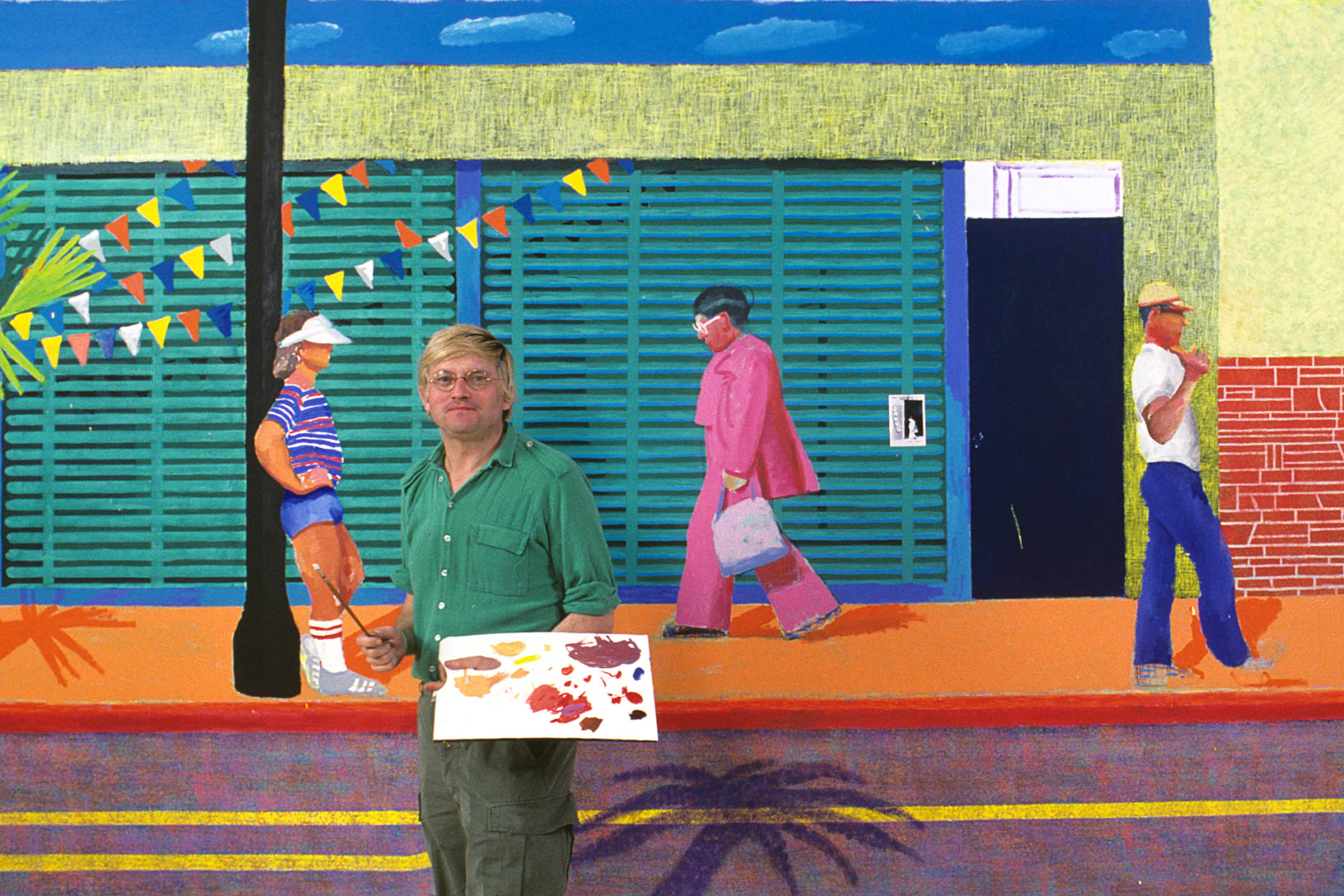

It is impossible to think of David Hockney, who sadly died at home yesterday, aged 88, in anything other than spectacular colour. Though he was born into a determinedly sepia world in Bradford just before the Second World War, he never had much truck with black-and-white, ration book Britain. Like a bee drawn to a flower meadow, he went in search of vibrancy. Having located it among the golden lads poolside in California, he subsequently saw it everywhere. The critic Robert Hughes once described him – with imagined hauteur – as the “Cole Porter of contemporary art”. When I mentioned that to Hockney once he was happy to accept the epithet: “What’s the opposite of [lightness and colour]?” he said. “Gloom, doom. Why would anyone want that?”
You got all the vividness from him in person, too (has any artist ever made a better palette of his own shirt, tie and jacket combinations?). I was lucky enough to sit down with him for a couple of afternoons at different times in his career for this paper, and recall being immediately drawn into his world as I walked into the Kensington studio that he had kept since the 1970s. He used to make a joke that he was often confused with Yorkshire’s other national treasure, his near contemporary Alan Bennett, and there was something fabulously apposite about that muddle: both men never let you forget that, however far they had ranged from Bradford, they hadn’t quite lost its cadences or its worldview.
It’s for that reason that for all the wonderful swimming pools and polaroids and landscapes and Mr and Mrs Clark and Percy, the painting I love most of Hockney’s is that indelible 1977 portrait of his father and mother that hangs at the Tate: Laura Hockney in her best blue dress sitting patiently and upright, Kenneth Hockney poring over one of his son’s catalogues as if to finally make some sense of it, (and Piero della Francesca’s cool annunciation framed in the mirror on the dresser -– a reminder that epiphanies came in all shapes and sizes if you look hard enough).
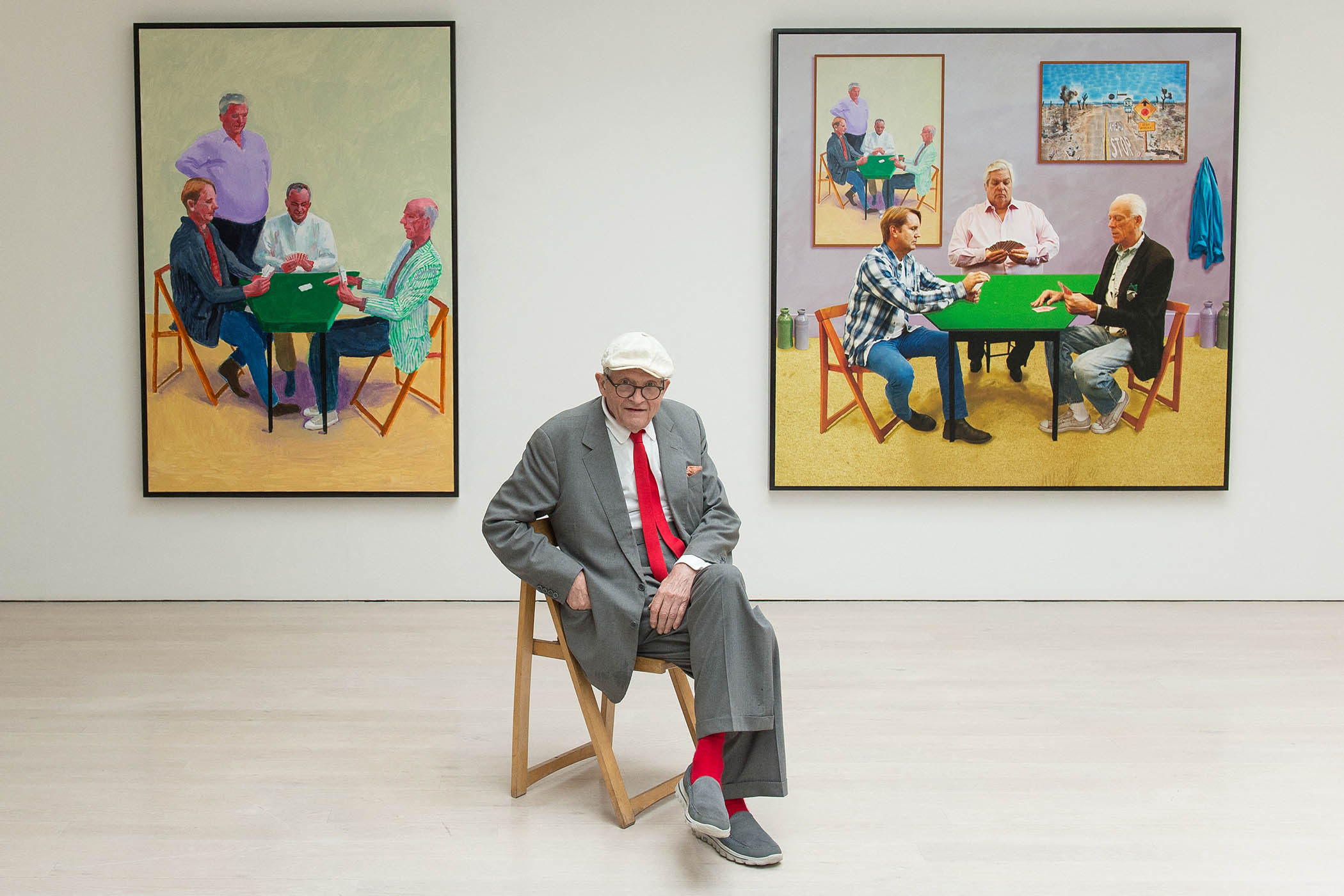
David Hockney with his artworks “Card Players #3 2014” (L) and “A Bigger Card Players 2015” at his exhibition entitled “Painting and Photography” in London, 2015
Hockney never stopped seeing both the pathos and the comedy of where he fell to Earth. Two memorable stories he told me captured both that affection, and the distance he travelled. The first was an account of his mother, who came to stay with him in LA soon after his father died, when she was in her 60s. She spent a few days sitting with him around his famous Malibu swimming pool, before commenting: “It’s strange – all this lovely weather and yet you never see any washing out.”
Hockney never stopped seeing both the pathos and the comedy of where he fell to Earth
Hockney never stopped seeing both the pathos and the comedy of where he fell to Earth
From his father he inherited a great stubbornness around certain causes – there was never, of course, a more passionate advocate for smoking than Hockney. Kenneth Hockney, a clerk in Bradford, was a firm believer in international socialism and an eccentric letter writer: he corresponded with Khruschev, Gandhi and Nasser as well as, routinely, the Bradford Telegraph and Argus. When I spoke to Hockney in his 70s, he recognised that he was becoming more and more like his old man: “I can certainly sense him in me a bit more,” he said. “He was very eccentric. One time I came home at night and he was sat halfway down the street in one of our armchairs out of the front room, outside a phone box. I said: ‘Well, what are you doing?’ He said: ‘I put an ad in the paper to sell the billiard table and told people to ring this number between 6 and 6.30pm.’ At 6.30pm he wheeled the chair back up the street. It’s important to be comfortable, though, isn’t it?”
No doubt in his youth such eccentricities seemed a little limiting. Hockney never had any issue with coming out, even though it remained illegal to be gay (at the Royal College of Art he found fabulous ways to express all elements of who he was; he once took to the cabaret stage in miner’s boots and a frock, to sing “I’m just a girl who can’t say no”).
He emigrated to California in 1964 because it offered “sun, sea and sex”. Bridlington, where he holidayed in his formative years could traditionally only guarantee one of these opportunities. Still, that didn’t stop him returning there later in life, and finding all kinds of excitement in the changing colour of Yorkshire wolds, full of unexpected oranges and purples. “Even in the winter up there, there is far more colour than you think,” he says. “You just have to know how to look.”
The keenest student of the techniques of the old masters, he was ever a passionate adopter of new technologies. No one was more quickly adept at the artistic possibilities offered by a computer tablet. “As you get older,” he says, “it gets a bit harder to keep the spontaneity in you, but I work at it.” At the time I spoke to him before the triumphant retrospective at the Royal Academy in 2012 he had got into the habit of texting about 20 or 30 friends a thumb-made sketch made on iPhone, a habit that never stopped. On a good day each of this group might have been getting half a dozen original works by Britain’s best-loved artist before breakfast. Were they suitably appreciative, I wondered. “Well, I think so,” Hockney said. “Someone said that if they see an email from me they know they don’t have to answer it, it’s a bit of pure pleasure and it’s free. So that’s all right, I suppose.”
How much, I wondered at the time, did his ongoing creative energy, which flamed right up to the end, feel like a rage against the dying of the light?
Hockney grinned. “Actually, I think I have more energy now than I did 10 years ago,” he said, aged 74. “I’ll always run up the stairs, especially for a cigarette.”
Newsletters
Choose the newsletters you want to receive
View more
For information about how The Observer protects your data, read our Privacy Policy
Photographs by Susan Wood/Getty Images, Leon Neal/ AFP via Getty Images