“Spend little time on letters. Lie in bed no longer than five minutes after waking. Shorten and hasten your affaires of dress.” As soon as your thoughts begin to wander, the Welsh artist Gwen John exhorts herself in 1910, “bring them back with the question: what was my subject?”
Out of this tiny notebook, propped open at a page from late summer, comes the very question that lingers all through this enormous exhibition, the most comprehensive retrospective in 40 years. What exactly was her subject? The content is famous: solitary female sitters, nuns, convalescents, self-portraits, empty rooms, girls with books or cats on their lap. The look of her art is equally distinct, with its pale light and close tones, the surfaces so delicately dappled and chalky. But none of this can quite account for the atmosphere or achievement of John’s work.
Take what may be among her best-loved paintings: a corner of the artist’s room in the Paris eaves, c1907-09, light filtering through gauzy curtains, a parasol leaning against a chair drawn comfortingly close to a table bare of anything except flowers. Still, quiet, calm, the visual ideal of Virginia Woolf’s A Room of One’s Own, this is a sanctuary from the strife and chaos of the outer world. And it has the same effect on the viewer.
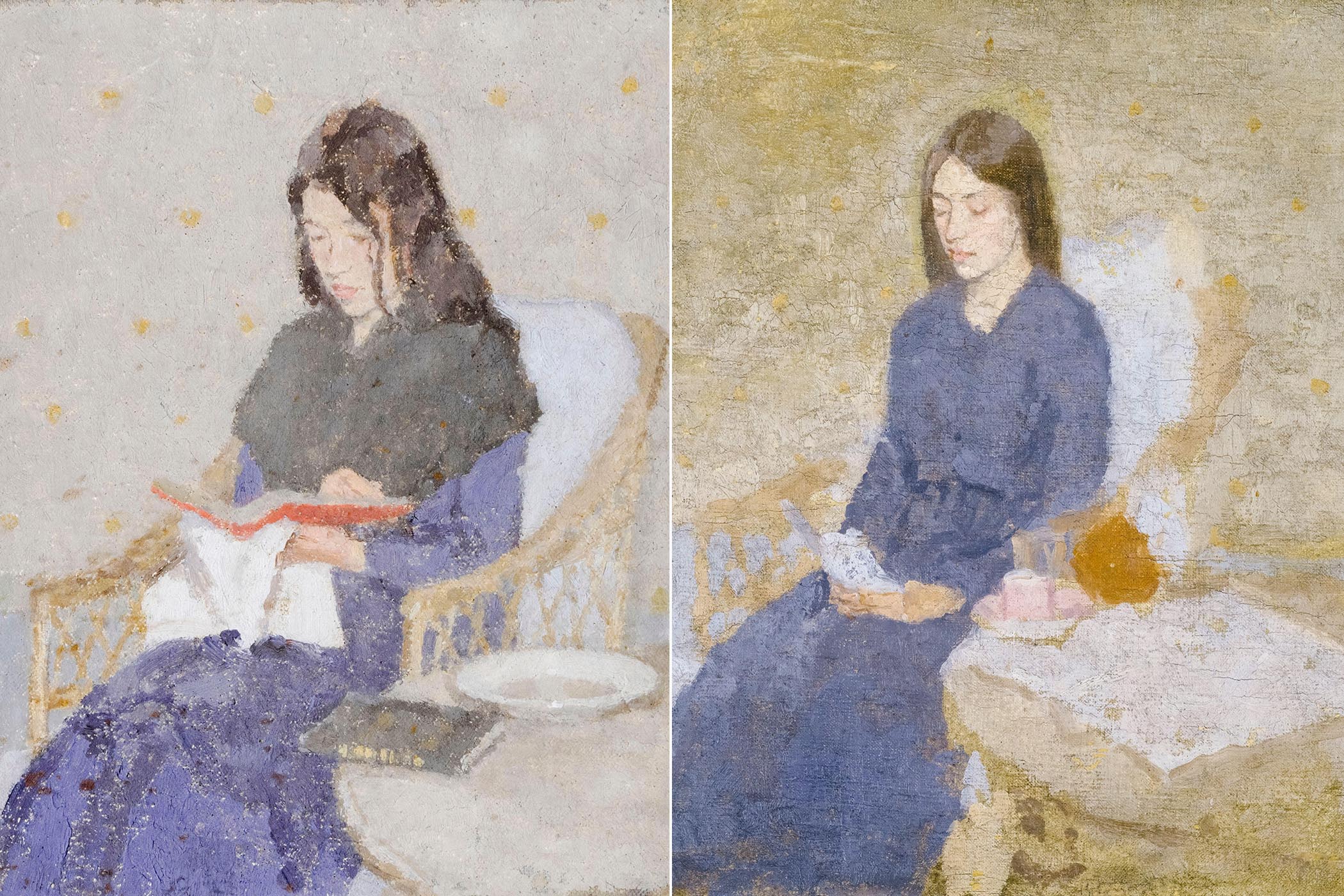
A Corner of the Artist’s Room in Paris, c1907-09, depicts a private sanctuary. Main image: The Seated Woman, c1910-1920
“Une petite morceau de souffrance et de désir” (a little bit of suffering and desire) is how John described herself around this time, kept at arm’s length by her lover, the priapic Rodin. She is there but not there, too, in this scene.
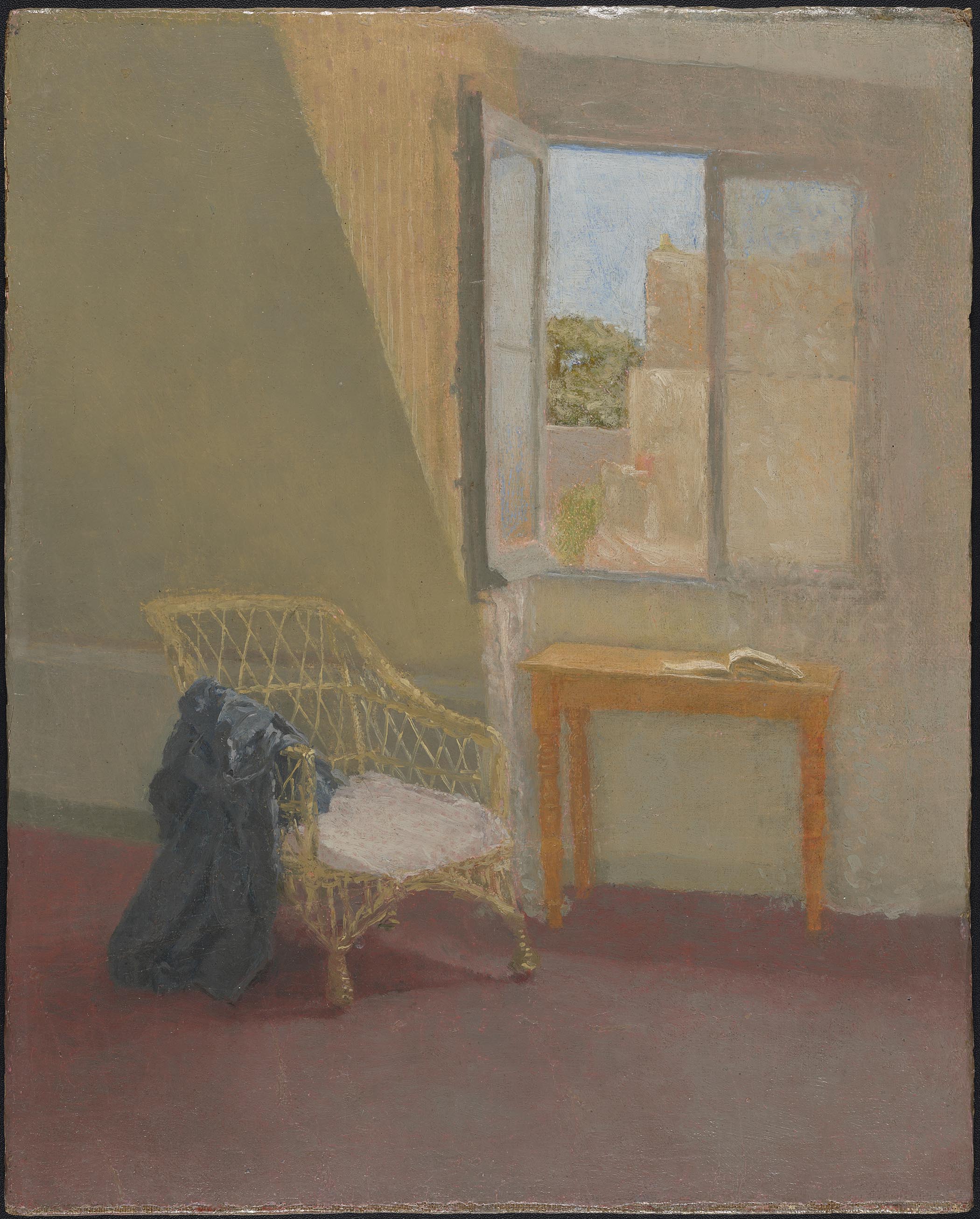
The curators of this show display it alongside the identical corner of the room in a second painting, however, and the mood shifts ever so slightly. Now one curtain and a window are open to reveal a patch of blue sky. The parasol has gone. An open book lies on the table in place of the posy, as if the artist was getting on with reading, or possibly sketching (its pages are blank). The wicker shines, the light and shadow are sharper. Look closely and you see that John has taken half a step back and this canvas is a couple of centimetres wider, showing more of the room and her life. The whole painting appears active.
The room itself is no different. What has altered is her state of mind or heart. She is not Moneinnt, registering the change of light through winter to spring on the facade of Rouen Cathedral. The weather of her art is internal. Sometimes the works feel so mute their meaning is all but sealed up behind that dabbed and stippled brushwork.
A portrait – if that is the right term – about halfway through this exhibition shows a girl in blue whose face is by now familiar from several other images. But is it a likeness, an invocation or an approximation of the sitter in any way? She is so trapped behind the paint as to be almost invisible, no more than a frail echo of herself, like the disembodied mouth struggling to speak in Samuel Beckett’s great 1972 monologue Not I.
John’s sitters take something from the woman herself, partake in her complicated secrecy, withdraw into her self-concealing brushwork
John’s sitters take something from the woman herself, partake in her complicated secrecy, withdraw into her self-concealing brushwork
These portraits are not exacting records of status, personality or even appearance (one of the revelations of this show is how often the sitters come to resemble the painter). They are images in which human consciousness seems fused with the act of painting itself. The convalescent, for instance, appears five times in this show with her long pale face and dark hair, reading a book or a letter, mouth closed or slightly open in absorption, a pink teacup on the table beside her. In one painting, the cup is replaced with an empty plate as if she has regained her appetite and is starting to recover. But that is entirely a function of the altered props, the stronger tones, the larger size of the canvas and the greater proximity of painter to subject: as if John, and not the girl, was getting better.
If you want to see the ways in which a painting can change, then this is the ideal show. There have been others down the years – John and her brother Augustus; John as modern painter in London and Paris; John turning to God and French nuns after Rodin. This one takes a principled stance against biography in favour of method. It includes multiple images of the same subject, many watercolours and drawings (some of bewildering weakness) as well as her own stringently scientific notes, which startled Augustus when he read them after her death, aged 63, in 1939.
It is good to see the nuns together again, not least because these images are so varied and subtle: nuns smiling, thinking, dreaming. A superb sequence depicts the same elderly nun on her deathbed. In the drawing, she appears truly dead; whereas the watercolour, in a few strokes, gives her a strange glowing afterlife.
Newsletters
Choose the newsletters you want to receive
View more
For information about how The Observer protects your data, read our Privacy Policy

‘Resurrected for the nuns in her local convent’: Mère Poussepin Seated at a Table, c1915–1920
Sunday worshippers, minds wandering: John is behind them in church, watching and drawing. She resurrects the Dominican Mère Poussepin, dead for centuries, for the nuns in her local convent by working from an old prayer card. Her many portraits of a beaming Thérèse of Lisieux – photographed in the late 1800s – are based on a snapshot. Images made as acts of worship: that so many are on cheap department store paper seems part of her self-abasing devotion.
Did John really want all these sketches to be shown, this artist who was so reluctant to show her art, so chary of exhibitions, so likely to sidestep commissions? The curators quote John’s statement that her works on paper were “quite as serious” as her oils. That may be true of the marvellous self-portraits – naked, uncertain, defiant, or sorrowful with lank plaits – but surely not the litter of barely legible cats in this 200-work show.
And commendable as it may be to bypass the doomed love affairs with men and women, the ascetic life after Rodin, the night wanderings or the final years in a spartan cabin – except in terms of the images they yield – the emphasis on method itself becomes too scientific.
It is well said that John’s sitters take something from the woman herself, partake in her complicated secrecy, withdraw into her self-concealing brushwork. Yet all through this show there are moments of defiance, or at the very least schism between image and sitter. The Parisian concierge who has altogether too much force of personality for John, breaking free of her style. The fellow artist who won’t disclose her own inner being as she waits to get on with her book on Russian politics. Above all the girl with a cat who looks as if she has just been in tears, sitting still for hours, and who will have to do it all again for the next portrait. But in this one she appears in equal tension with the painter. Her hands have grown heavy in her lap, her face is strained with resistance: all of a sudden, she has come into her own.
Gwen John: Strange Beauties is at National Museum of Wales, Cardiff, until 28 June. It tours to Gallery of Scotland, 1 August 2026 to 4 January 2027, thereafter Yale Centre for British Art in New Haven Connecticut and National Museum of Women in the Arts, Washington
Photographs by Gwen John/Alamy/Amgueddfa Cymru, Museum Wales