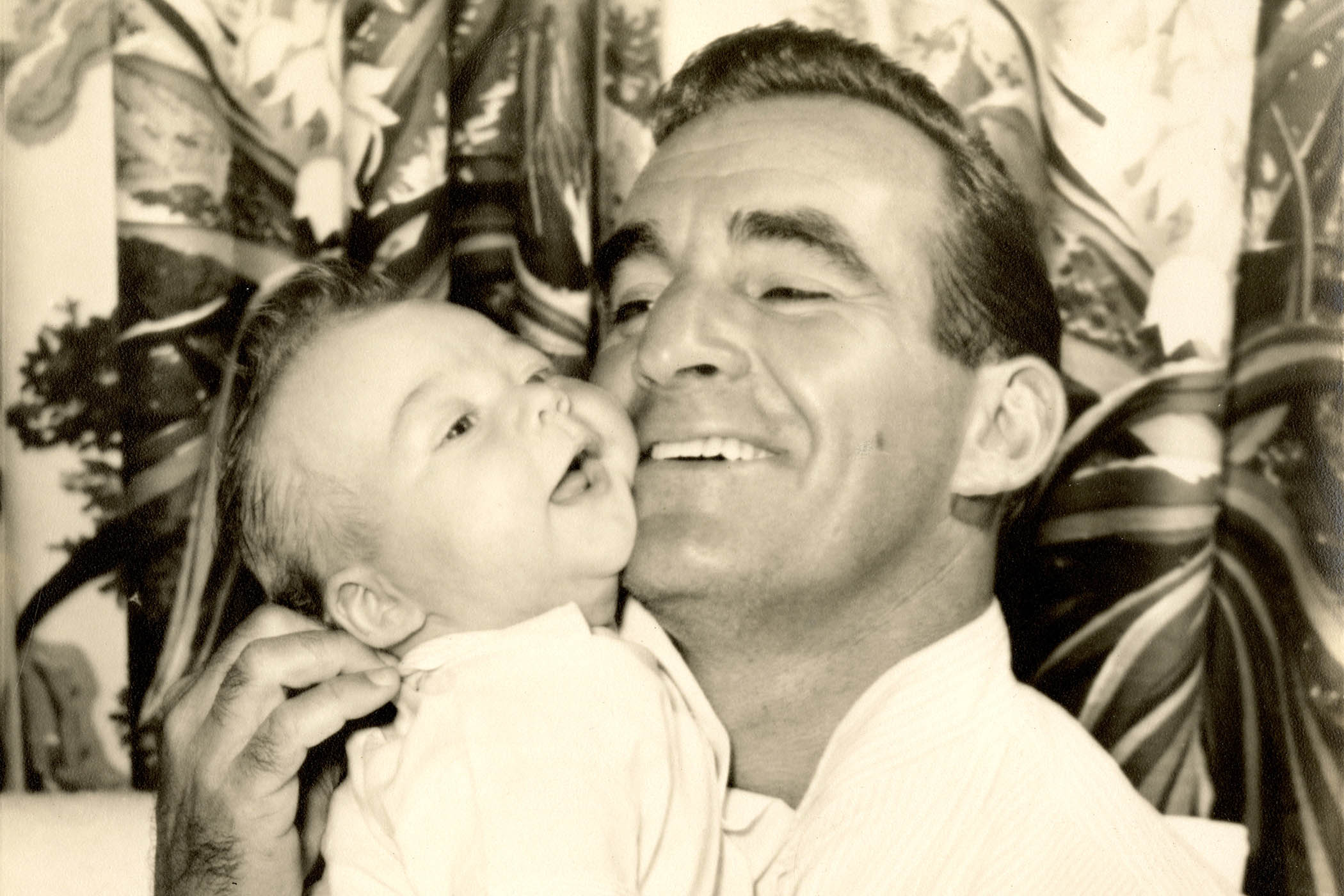


I did not meet my father until I was 14. And yet when I walked up to him in the fraying summer light, it was as if to a mirror. Our gestures and manners would suggest we had spent a lifetime together. It hadn’t been a second.
Such is the arrangement of nucleotides. Every son shares traits with his father. Every son, at least once, becomes him. The experience can be prosaic or profound, but it proceeds in the same way. The son looks at himself, as if outside of himself, and asks: “Well, how did I get here?”
Tom Junod’s memoir has several of these moments because as much as it is a study of the self it is a study of his father.
Lou Junod is a war veteran and handbag salesman who learned that the best way to succeed was to “sell himself” in business and in life. He is a married man who beds women with abandon, including his friend’s wife and, it is rumoured, the Hollywood starlet Zsa Zsa Gabor. He is besotted with his appearance, a sun-seeker who lathers himself in baby oil, dons black bikini shorts to the beach, and hails the turtleneck as the most flattering thing you can wear.
But what he cares most about is the genetic and environmental cocktail that constitutes being a man. He tries to pass on what he has learned to Tom, a trembling child split between fear and worship of his father. He advises him on how to dress, to drive, to talk, to date, and even, at one point, to clean his navel. (With a Q-tip and some witch hazel.)
Junod ought to be on comfortable ground in writing about his father. He is one of the finest magazine journalists of our age, known for his extensive profiles about complicated men. But to write about Lou Junod – iconoclastic, philandering, chauvinistic – is to take a scalpel to his own heart. To ascertain from the efforts that a damaged father made to mould his son in his image, how often and how deeply he succeeded.
Exhibit A: Manhattan, September 1996. Junod is in a hotel bathroom on the phone to his mother. After wishing her a happy birthday, Junod walks back into the bedroom, “where a woman who is not my wife is waiting for me”.
Exhibit B: Long Island, September 2006. Junod is on holiday when he gets a call from his brother. Their father has died. Everything goes dark. Junod finds himself flat on his back, “my father’s body a thousand miles away”.
Tom becomes Lou once, twice, and many times more. But even the act of writing a memoir defies a father who saw the past as a kind of fiction.
Lou Junod says repeatedly that he “never had a father”, as if born by immaculate conception. When Tom tells his father about a newly discovered relative, Lou says it “never happened”. Junod concludes: “Our history, and indeed American history itself, begins with Lou Junod.”
Newsletters
Choose the newsletters you want to receive
View more
For information about how The Observer protects your data, read our Privacy Policy
Except it doesn’t. “That’s your fatha,” Tom Junod’s aunt says. “If he don’t like something, he just walks away.” And here lies the difference between Lou and Tom. Because Tom Junod’s memoir is a detective story, a 10-year mission to understand what dance of nucleotides created his father; to face the fires that his father lit and then left to smoulder.
Edifices fall away like the last days of Rome. Some are trivial: the discovery of false teeth discreetly worn by Lou Junod, the vainest man on the Atlantic seaboard. Some are bigger: an entire second family whose complexity of traumas will require readers to keep notes. For all the secrets that Lou asked his son to keep, to protect the family, to protect his mother, to protect himself, more linger beneath the surface.
Tom Junod’s memoir is best read alongside his other work, not least because he invites us to revisit his own canon. A 1996 GQ story on his father’s rules for fashion is a yarn about Lou’s secrets that doesn’t reveal “any of his, well, secrets”. A 1998 Esquire profile of the TV host Fred Rogers (the basis for the Tom Hanks film A Beautiful Day in the Neighborhood) gives every impression that Junod has learned to diverge from his father, having met a singular figure who presents a more open-hearted, more compelling, model of masculinity. “But that’s not simply an untruth,” Junod writes. “It’s a lie, and I’ve been living it for 23 years.”
Is it right to reveal a father’s secrets? Is it right to enlist others in the quest, no matter what it might reveal? Junod himself seems uncertain
Is it right to reveal a father’s secrets? Is it right to enlist others in the quest, no matter what it might reveal? Junod himself seems uncertain
In these admissions, Junod reveals secrets from his own work and exposes the falsehood at the heart of the profile form. A profile is not a complete picture; it is only ever a side view. In every word we say are the ghosts of those we don’t. Lou Junod treated speech as performance, and was a lifelong fan of the dramatic caesura: “Have you ever seen a body… like this?” The ellipses might be implied for the most part, but they are always there.
Since Tom Junod was a child, snooping on his family with a tape recorder, he has been hungry for secrets. It is what compelled him to write his magnum opus, The Falling Man, first published in Esquire in 2003. Junod tries to identify a person who was captured in a photograph jumping from the World Trade Center on September 11, leaving the Earth “like an arrow”. In his search for the man’s loved ones, Junod gets wildly different reactions to this final fall. What to one person represents a tragic loss of hope is, to another, a betrayal of love.
One can imagine that Junod’s prismatic book will also elicit a variety of responses. Is it right to reveal a father’s secrets? Is it right to enlist others in the quest, no matter what it might reveal? Junod himself seems uncertain. He acknowledges his late mother would be “mortified” by the book, and as he considers reaching out to the family of his father’s former lover he writes in his journal: “My father helped destroy this family once. Do I propose to do it twice?”
As with many sons, Junod tries to escape his father’s shadow, but instead falls into its familiar shape.
He discovers that he has a half-sister. He also sees a video that suggests his father may have molested his full sister. “How can I be angry at him?” he says to a stranger on a bus after telling her all that he has found out. “He gave me the ocean.”
Even after 400 pages I can’t help but feel like there is more ocean to be explored, not of the father but of the son. It is there in Tom Junod’s affair, mentioned in a single line, then much later in three short pages in which his wife forgives him. The ghosts of what is not said haunt the book.
Perhaps the key lesson was already there, 30 years ago, in that GQ story about his father. Lou Junod’s first and final fashion tip: “The knowledge that a man doesn’t belong to anyone. That he belongs to his secrets. That his secrets belong to him.”
In the Days of My Youth I Was Told What It Means to Be a Man: A Memoir by Tom Junod is published by Random House USA (£27). Order a copy from The Observer Shop for £24.30. Delivery charges may apply
Photograph courtesy Tom Junod