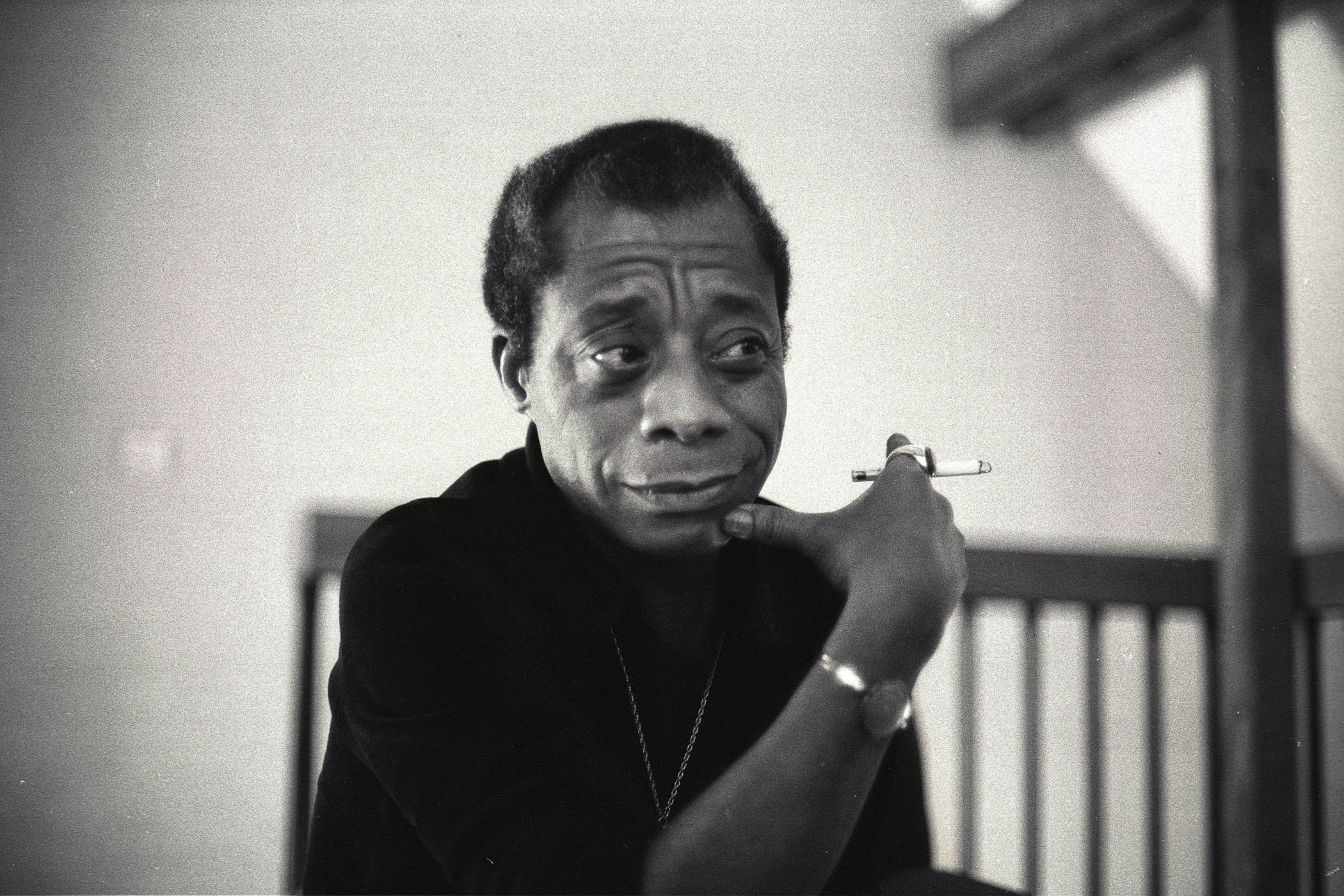



Love was key to the lexicon of the writer and civil rights activist James Baldwin. Throughout his life he was in search of it, from his impoverished childhood in Harlem, New York, to his peripatetic adulthood as a “transatlantic commuter” to France and Turkey. As a child, success in romantic love seemed unlikely, Baldwin recalls, because people like his stepfather convinced him that he was ugly, repeatedly expressing “hatred of my frog-eyes”.
In previous biographies, aspects of Baldwin’s sex and love life have mostly been confined to the margins, but in Baldwin: A Love Story, scholar Nicholas Boggs sets out in search of “the truth about Baldwin’s most sustaining intimate relationships and how they shaped his life and art”. Boggs is helped, of course, by Baldwin’s own virtuosic writing, which is threaded through this thrilling and comprehensive portrait of a man whose writer’s voice matured in a way that seemed to be uncannily synthesised with his personality.
Boggs captures the drama of Baldwin’s heady ascent through those people whose lives were illuminated by him. They’d eventually include Marlon Brando, whom Baldwin described as “totally unconventional … a beautiful cat”, and the novelist Richard Wright, who would accuse Baldwin, in his 1949 essay Everybody’s Protest Novel, of sabotaging Wright’s literary reputation to further his own career. That was all still to come when an early intimation of platonic love came from a nurturing teacher, a communist called Orilla “Bill” Miller. She recognised Baldwin’s fierce intelligence and sought to further his education and to free him from his oppressive, God-fearing Harlem household by regularly taking him to the cinema. Looking up at the silver screen, the 10-year-old was amazed to see Bette Davis’s “pop-eyes” were just like his, eliciting the thought: “Perhaps I could find a way to use my strangeness.”
The so-called “strange child” had a charm that won people over. Once, when he was attending a pentecostal church, the pastor, Mother Horn, looked down at Baldwin, smiling, and asked him: “Whose little boy are you?” Desperate for love and acceptance, his response was as swift as it was heartfelt: “Why, yours.”
Ultimately, Miller’s protege disappointed her when he became a boy preacher, eventually attracting a bigger congregation than his reverend stepfather – an experience which, a decade later, would inspire his first novel, Go Tell It on the Mountain (1953). The church’s hold on Baldwin proved tenuous, however, as he sought and embraced other mentors, like the “mystical” African American artist Beauford Delaney. Delaney was a fixture in Greenwich Village, and in their absorbing discussions, he schooled Baldwin in modernism. The fledgling writer saw in Delaney “living proof that a Black man could be an artist”.
Baldwin once argued that “to be a Negro in [the US] and to be relatively conscious is to be in a state of rage, almost all of the time”. He experienced countless reasons for that rage, including one startling exchange at a diner in New Jersey in 1942 when a waitress refused to serve Baldwin because he was a “Negro”. He threw a mug at her and stormed out. That angry young man was to become a public intellectual and guide, especially to understanding the price of white supremacy and racism, but first he had to get out of the US, he wrote, “to be in a place where I could breathe and not feel someone’s hand on my throat”.
The odds were stacked against him. But Boggs shows in forensic detail how Baldwin used the perspective of being outside the US to navigate the twin conundrums of his sexual orientation and race to refine his insights into the repressions and trauma of America. Intense relationships with men galvanised him to transmute his experiences into both fiction and nonfiction. In Boggs’s telling, Baldwin did not believe in a hierarchy of writing: lessons learned from his nonfiction would be folded into his fiction and vice versa.
Aged 24 and living almost as a vagabond, Baldwin’s lust for life was transformed at the first sight of a 17-year-old painter, Lucien Happersberger, whom he met in Paris. Happersberger was primarily interested in women – he would eventually marry a woman and have children – yet remained in an on-off romantic relationship with Baldwin.
What emerges most strongly from this biography is a portrait of a battle-hardened witness to America’s violence and bigotry
What emerges most strongly from this biography is a portrait of a battle-hardened witness to America’s violence and bigotry
Thanks to the assiduous research underpinning Baldwin: A Love Story, it’s possible to discern a pattern in Baldwin’s amorous adventures, as articulated by Yoran Cazac, a French man whom Baldwin loved “harder than the rain can fall”. According to Cazac, Baldwin “liked men, not [just] homosexuals”. Each moment of falling in love offered a chance to be born again and, in that regard, Istanbul was particularly important for Baldwin. “It was a culture, after all, that luxuriated in displays of public male intimacy,” writes Boggs, “and even if this affection was not explicitly codified as gay, the ambiguity and camouflage … made their networks of sex and sociality viable ones.”
The book argues cogently that Baldwin made bold choices in his fiction to conjure truths from real experiences without relying on the particularity of race or gender. That was true of Giovanni’s Room (1956), an exploration of his experience as a man who loved other men through white central characters; and of If Beale Street Could Talk (1974), in which a pregnant woman narrates a Black heterosexual love story that “would ultimately give voice to Baldwin’s love of a married European man”.
Newsletters
Choose the newsletters you want to receive
View more
For information about how The Observer protects your data, read our Privacy Policy
What emerges most strongly from this biography is a portrait of a battle-hardened witness to America’s violence and bigotry, a man whose loyalty to family and friends is unimpeachable, and a tender soul, whose fragility is always close to the surface. This is revealed not only in Boggs’s account of Baldwin’s three attempts to kill himself, but also in his grieving for those who were killed in the fight for civil rights.
Martin Luther King Jr, who Baldwin considered a “younger, much-loved, and menaced brother”, was murdered on 4 April 1968. Attending King’s funeral, he did his best not to cry. Tears, Baldwin later recalled, seemed “futile”, and “I may also have been afraid … that if I began to weep, I would not be able to stop”. According to Boggs, the murders, five years earlier, of Medgar Evers and of four black children in the bombing of a church in Birmingham, Alabama, hit Baldwin’s consciousness “with such force that never again would he see his individual life … in his personal quest for romantic love, as in any way superseding his responsibility to convey his messages about the necessities of achieving racial justice”.
There was never a unified approach to achieving civil rights, nor was there a consensus about who should be its spokespeople. Some members of the emerging Black Panther movement questioned the wisdom of aligning themselves with Baldwin. Shamefully, in Soul on Ice, Eldridge Cleaver’s criticism of Baldwin as a self-loathing Uncle Tom reeked of homophobia. Baldwin, in Cleaver’s view, exhibited a kind of “racial death wish” that was typical of “Negro homosexuals … frustrated because in their sickness they are unable to have a baby by a white man”. Boggs rallies to Baldwin’s defence, arguing that he was determined to explore the possibility of “self-love enabled by sexual intimacy between Black men”.
James Baldwin once wrote of his literary ambition: “I want to be an honest man and a good writer.” Early on, he came to realise that music was his language “rather than American literature” and that freed him to write in his unique voice. At times, he might have fallen short of his grand ambition. But Baldwin’s writing, both fiction and nonfiction, especially in the epistolary form, rehearsed in letters to family, friends and lovers, soars like the “mighty song” he planned for his last novel. To read this biography, which in itself is an unbridled love letter to him, is to fall in love with James Baldwin. How could you do otherwise? He was a beautiful cat.
Colin Grant is the director of WritersMosaic, a division of the Royal Literary Fund. His books include I’m Black So You Don’t Have to Be: A Memoir in Eight Lives.
Baldwin: A Love Story by Nicholas Boggs is published by Bloomsbury Circus (£30). Order a copy from The Observer Shop for £27. Delivery charges may apply
Photograph by Sophie Bassouls/Sygma via Getty Images