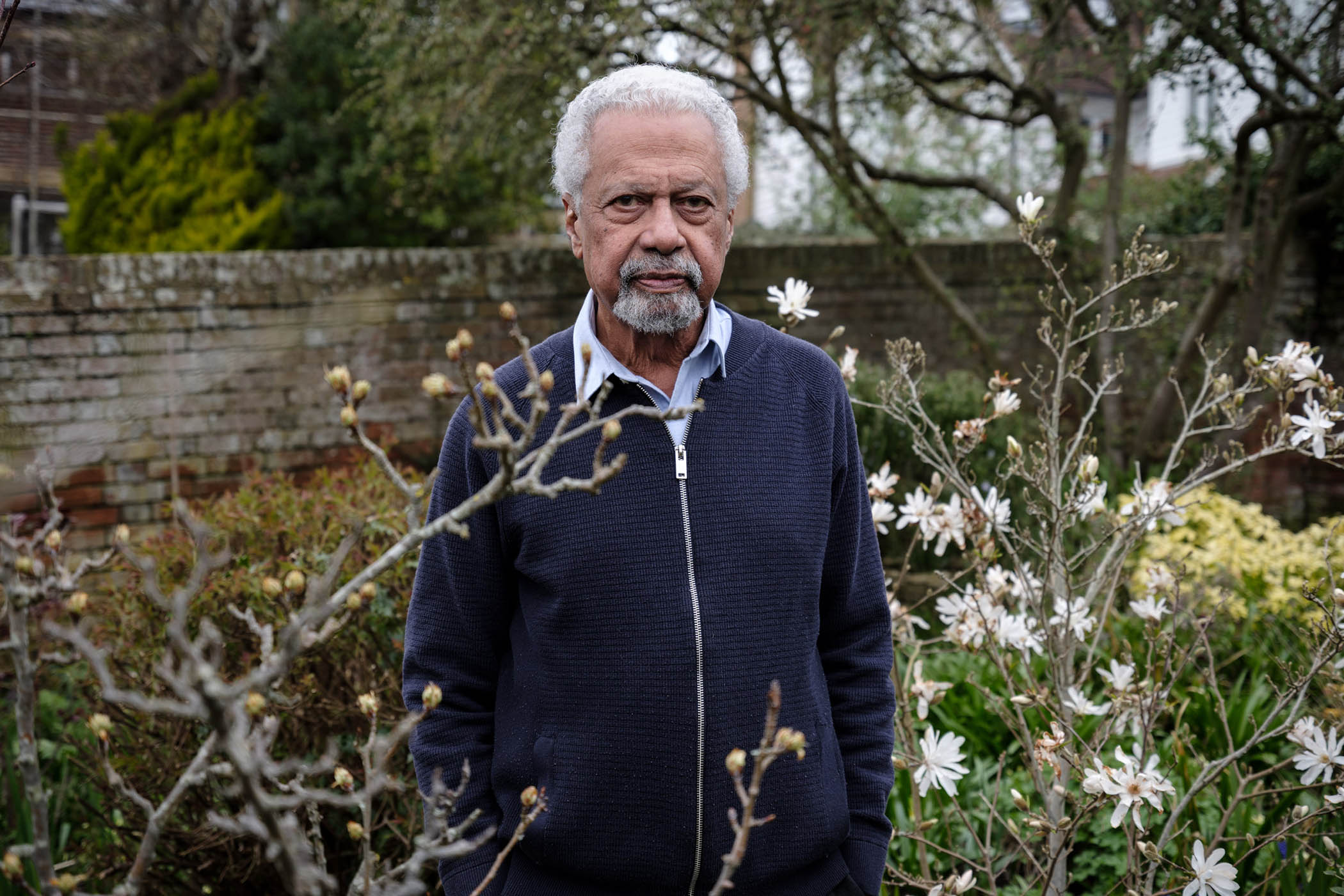

Potrait by Carl Bigmore
Abdulrazak Gurnah was born in Zanzibar (now part of Tanzania) in 1948 and came to the UK as a refugee in the 1960s. He taught postcolonial literatures at the University of Kent for many years and is the author of novels including: Paradise (1994), shortlisted for the Booker and Whitbread prizes; By the Sea (2001), longlisted for the Booker and shortlisted for the Los Angeles Times book prize; and Desertion (2005), shortlisted for the Commonwealth Writers’ prize. In 2021, he was awarded the Nobel prize in literature “for his uncompromising and compassionate penetration of the effects of colonialism and the fate of the refugee in the gulf between cultures and continents”. His novel Theft is now out in paperback.
Theft is your first novel published since winning the Nobel prize. Did the accolade make you feel constrained in terms of writing?
Only constrained because of time; I had started the novel before. It’s very nice when you’re awarded this wonderful thing and you get to meet new readers [and there are] new translations [going] back and forth. Time was the issue – and headspace, of course. Theft came out in the UK and in the US on the same day, which was a new experience.
Theft explores the coming of age of three young people – Karim, Fauzia, and Badar – in postcolonial Tanzania in the 1990s, a period which coincided with an escalation in western tourism. How did the novel come about?
The impulse was the memory of someone [I knew] like Badar, who lived in a house nearby when I was a teenager. We were friends in a casual sort of way. He was accused of theft, and it was a small theft – a packet of biscuits or a packet of sugar – and the outcome was that he was dismissed, he was humiliated. It was an exercise, I suppose, of unequal powers: the servant is always going to be wrong, the employer is always going to be right; an exercise in pettiness, of caprice.
It stayed with me and that’s why I began with this story. Thinking about all the things that are absent in the life of somebody like that: he’s not going to school, like I was; he was the same age as me, skivvying, a servant in rags. I’ve got a future, [but] what is there ahead for somebody like that? My interest was in the circumstances of such injustice.
The title also reflects the theft of Badar’s education – he’s taken out of school and deposited elsewhere to become a servant.
Yes, and also for Raya (Karim’s mother), the theft of her youth, married off at 17. And of course actual thefts, or accusations of actual thefts. Big thefts, small thefts. Thefts of life – not only of colonialism but postcolonialism – the thefts of the state and of people’s civil rights.
Having not lived in Tanzania for so long, how were you able to write so intimately and evocatively about it?
Well, I go there quite often, and much of my family is there. It’s deeply embedded in my imagination. It might be harder to write about it if I was there every day. If you are closer to the events, it’s impossible not to feel greater sympathy, more entanglement. Distance allows you to be more cruel.
Your 2001 novel By the Sea, with its description of a hapless and haphazard asylum process, seems almost to be a satirical take on a flawed system.
The system for dealing with asylum seekers, and with migrants, is broken. When I was writing the book By the Sea, around 2000, many of the problems we see [now] had not yet become so evident. There were no crossings across the channel, there wasn’t this hysteria. There was a different kind of hysteria, to do with European migrants, rather than from Africa or the Middle East.
The home secretary, Shabana Mahmood, recently announced strict measures to close the ‘back door’ to this country.
The home secretary is herself a product of immigration. We also saw statements with Rishi Sunak as prime minister, and with other home secretaries whose parents are from east Africa. It’s quite surprising and paradoxical that these are the voices that speak with such ferocity.
You worked various manual jobs while studying at night school for academic qualifications. What inspired you to write fiction alongside being a university lecturer?
I always enjoyed writing, but never thought it would be something I would do as a profession. We didn’t get a lot of books in Zanzibar when I was growing up. One of the unexpected pieces of luck coming here [to the UK] as an 18-year-old – impoverished, stupid and reckless – was seeing books everywhere. I didn’t at first think I was writing [to seek] publication; writing allows us to disentangle things, work things out. But then it just grew – and then you have to say: “What am I doing?” It becomes something mediated, a way of making something, an artefact.
You’ve been publishing books for four decades. How has the perception of postcolonial literature altered over this period?
It’s been tremendous: the variety, the wealth… For example, the number of women writers from Africa has multiplied. The dominance of certain regions like Nigeria, India, South Africa is no longer the case; we’re now getting writing from many different places because people have moved away from their ancestral homes, as it were – [postcolonial] writing from the United States, from Europe. Most importantly I think is the opening up of the publishing business to these other voices, which was not the case until about the mid-80s.
You are still teaching, having worked in academia for many years.
I retired from the University of Kent in 2017, thinking I would have time to look after my garden, grow vegetables, spend time with my children and grandchildren – but then the Swedish Academy thought otherwise. So the vegetable garden had to go. Then New York University Abu Dhabi approached me and asked me to teach a semester. I’d never been to that part of the world and I was curious, so I returned to teaching. But I’m just kind of dabbling in it – I don’t have any admin!
Do you have a favourite among your own novels?
They’re all products of labour, but some of them came at a particular moment, perhaps with a stronger connection. When Charles Dickens was asked this question, he would answer: “They are all my children.” Which I think is a good evasive answer.
Theft is published by Bloomsbury (£9.99). Order a copy from The Observer Shop for £8.49. Delivery charges may apply
Newsletters
Choose the newsletters you want to receive
View more
For information about how The Observer protects your data, read our Privacy Policy