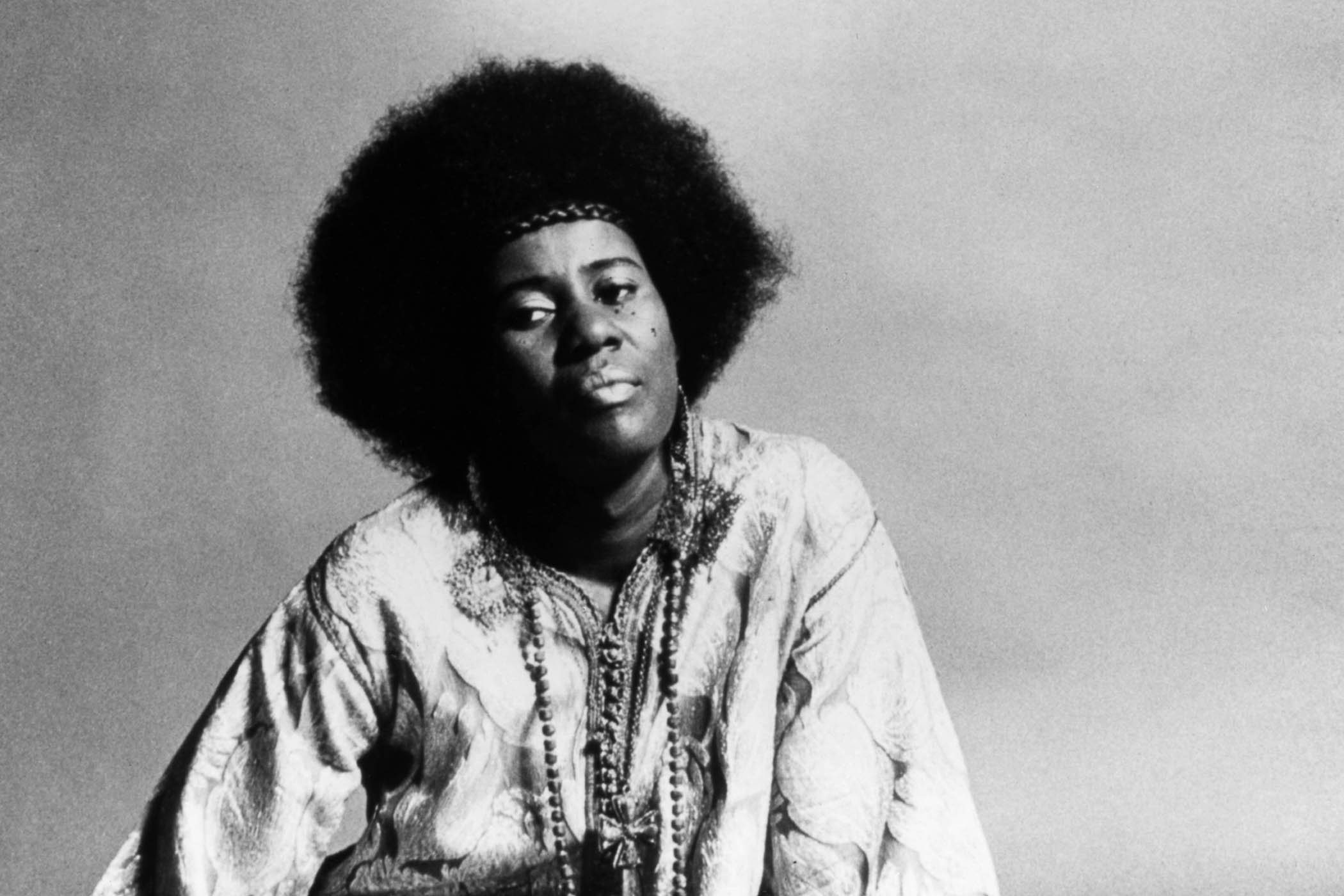


For most of her creative life Alice Coltrane was a mere footnote in jazz history, the groundbreaking music she made in the late 1960s and into the 70s either dismissed or ignored by contemporary critics. In the 90s, when her albums began to be reissued on CD format, that started to change as a younger generation was drawn to her genre-defying experimentalism and deep spirituality – she embraced Hinduism at the end of the 1960s and later founded her own ashram in California.
“Every generation appears to find its own lost musician to exhume and exalt,” writes Andy Beta in the introduction to his wide-ranging exploration of Coltrane’s life and work. Meticulously researched and underpinned by Beta’s devotion to his subject, Cosmic Music: The Life, Art and Transcendence of Alice Coltrane traces one of the most singular journeys in postwar American music. Her musical adventurism is detectable in the contemporary spiritual jazz of Kamasi Washington and the experimental stylings of producer/rapper Flying Lotus (Steven Ellison), who is her grand-nephew. Other artists who have acknowledged her influence include Radiohead’s Jonny Greenwood, drone mental band Sunn O))) and Paul Weller, whose instrumental Song for Alice was dedicated to “the beautiful legacy of Mrs Coltrane”.
As his introduction makes clear, Beta himself is emblematic of the youthful constituency that has helped rescue Coltrane from relative obscurity. Having grown up in suburban Texas listening to grunge, punk and hip-hop, he discovered her music in the 1990s when a friend recommended her 1971 album Journey in Satchidananda, describing it as “the most beautiful music in the universe”.
Having already had his preconceptions about jazz rudely upended by his exposure to the daunting sonic assault of her late husband, John Coltrane’s 1968 posthumous release Om, Beta was initially baffled by what he heard. In contrast to the combative ferocity of John Coltrane’s tumultuous free jazz, the drifting, dreamy soundscape of Journey in Satchidananda was a sonic balm: otherworldly, peaceful, transportive. And yet, as was the case for many listeners more used to the tried-and-trusted format of brass, keyboards, drums and bass, it took a while for Beta to orient himself to a soundscape in which Alice Coltrane’s harp – all dreamy glissandos and ethereal tonal textures – somehow held its own against the strident, searching saxophone solos of Pharoah Sanders. Slowly, though, it cast its beatific spell, propelling him on the journey of discovery that has led to this illuminating biography of an artist who can often seem as opaque and elusive as her music.
Coltrane was not the first female jazz musician to compose and perform music on the harp: a decade before, the pioneering Dorothy Ashby, who also hailed from Detroit, had stamped her signature on several bebop albums. Coltrane was familiar with and respected Ashby’s work and looked to other female outliers such as the great jazz pianist Mary Lou Williams for inspiration.
Her own creative mission, though, was more audacious and underpinned by her single-minded pursuit of spiritual enlightenment. For her, the harp – the most heavenly sounding of instruments – was ideally suited to the expression of profoundly devotional, divinely transmitted music. “Everything I do,” she once said, “is an offering to God.”
Coltrane’s musical and spiritual journey began in relatively traditional fashion in her native Detroit, where, as Alice McLeod, she attended Sunday worship at Mount Olive Baptist Church, playing piano for the choir and, during the evangelical fervour that often gripped the congregation, sometimes finding herself transported by the palpable presence of the Holy Spirit.
Beta describes how, aged nine, Alice frequently experienced “frightening and bewildering” out-of-body experiences during which, in her words, she was carried “beyond our universe [to] divine sacred places”. These disorienting bouts of astral travel were, she later said in her characteristically matter-of-fact manner, “God’s way of letting me know that there is more to life than what we see around us”.
For a time in her late teens and early 20s, she pursued a more secular calling, playing piano in various local jazz clubs, before marrying the jazz singer Kenny “Pancho” Hagood after a whirlwind romance. The pair relocated to Paris in 1959, where Alice was mentored by the pianist Bud Powell. But the following year she found herself back in Detroit, now the single parent of a daughter, Michelle.
In the early 1960s, she played piano in the Terry Gibbs Quartet, a traditional bebop outfit, whose leader soon noted how her approach was becoming increasingly influenced by the more modal music of John Coltrane. She would later recall that she detected “another message” in the great saxophonist’s music, a spiritual current that she seemed acutely attuned to.
The two met in 1963, when his quartet played a residency at the legendary Birdland venue in New York, their mutual attraction expressed through shared silences. “He would sit there and the quiet was strong,” she later recalled. “It didn’t make you feel isolated, but part of.”
She soon became even more “part of” when they married in Mexico in 1965. In January of that year, John Coltrane had released A Love Supreme, perhaps the most realised distillation of what has since become known as “spiritual jazz”. With hindsight, it is perhaps the most striking evidence of the ways in which her growing spirituality was influencing his music. The following year, at her husband’s request and to the surprise of critics and fans alike, she replaced the esteemed pianist McCoy Tyner in his group.
When not on the road, the couple lived together on Long Island in an isolated house complete with a home studio, both bound by an increasing determination to express the ineffable nature of the divine through their music. They had three children together, who were raised alongside Alice’s daughter, Michelle. It was an intense but mutually rewarding meeting of minds, shared musical ambition and eastern-based spirituality that lasted just two years until John Coltrane’s death from liver cancer in July 1967.
The year after her husband’s death was a tumultuous but dramatically transformative one for Coltrane. She oversaw the release of an album, Cosmic Music, in which two of her own compositions were paired with two pieces her husband had recorded in 1966, and released her first solo album, A Monastic Trio. She also experienced what Beta describes as “a total nervous breakdown”, brought on by the acute insomnia, dramatic weight loss and dark hallucinations that came with the tidal sway of overwhelming grief. In a narrative driven by its subject’s quest for spiritual oneness, her descent into near madness makes for jolting, disturbing reading.
The gold-tinted harp that arrived one day on her doorstep became the instrument of her transformation
The gold-tinted harp that arrived one day on her doorstep became the instrument of her transformation
“Once, she attempted to throw herself out of a second storey window,” Beta writes, before detailing her bouts of self-harm with “nails, needles, razors”. Unravelling at an alarming rate, while her neighbours looked after her bewildered children, she burned the skin on her right hand so badly that “the nails blackened and fell off”.
Years later, in a short, self-published book, Monument Eternal, Coltrane would reframe this dark interlude as a search for “spiritual illumination” through “the profound ordeal of tapas” – a Sanskrit term that describes a self-willed process of self-mortification in the pursuit of enlightenment.
On her return from the abyss, Coltrane’s work took on a new focus. The majestic, gold-tinted harp that arrived one day in a huge crate on her doorstep, having been ordered for her by her husband months before his death, became the central instrument of her transformation. The extravagant titles of the series of solo albums that ensued give some indication of their increasingly devotional thrust: Universal Consciousness, World Galaxy, Lord of Lords, Transcendence. They signalled the all-encompassing spiritual journey to come, one in which her religious practice would subsume her music.
In the early 1970s, she was introduced to a Yoga guru, Swami Satchinananda, and her spiritual practice deepened during trips to India and her immersion in Hindu teaching. At some point in the mid-70s, she underwent a religious epiphany and, taking the name Turiyasangitananda – Sanskrit for “the transcendental lord’s highest song of bliss” – renounced her secular life altogether, devoting herself instead to daily meditation and spiritual instruction.
While several musicians looked eastwards for spiritual guidance in the late 1960s and early 70s – Carlos Santana, John McLaughlin and Pete Townshend spring to mind – Coltrane’s progress from her strict Baptist upbringing in Detroit to the formation of her own ashram in the Santa Monica mountains of California in 1983 is of a different order. (The site of the ashram was destroyed by wildfires in 2018.)
Her musical silence was finally broken in 2004 with the release of an album called Translinear Light, but unbeknown to all but her most fervent religious followers, she had continued to make music, albeit of a more personal and elevated kind, during the intervening years. It took the form of bhajans – devotional songs and chants led by her and issued on cassettes for her ashram congregation.
In 2017, 10 years after her death from respiratory failure, a compilation titled The Ecstatic Music of Alice Coltrane Turiyasangitananda was released on David Byrne’s Luaka Bop label. Its repetitive call-and-response songs are by turns calming and emotionally intense, and in their cumulative power provide a glimpse of a spirituality that retains a glimmer of Detroit soulfulness. As such, it is the perfect coda to the extraordinary life of Alice Coltrane.
Likewise this long overdue biography, which traces every step of her spiritual and musical evolution, illuminating her earthly struggles and her long search for transcendence. If you’re already a devotee, it will send you back to the records to listen anew. If you have yet to explore her cosmic music, begin, as Andy Beta did, with Journey in Satchidananda, then open this detailed and illuminating biography. And prepare to be transported.
Cosmic Music: The Life, Art and Transcendence of Alice Coltrane by Andy Beta is published by White Rabbit (£30). Order a copy from The Observer Shop for £27. Delivery charges may apply
Photograph by Echoes/Redferns
Newsletters
Choose the newsletters you want to receive
View more
For information about how The Observer protects your data, read our Privacy Policy