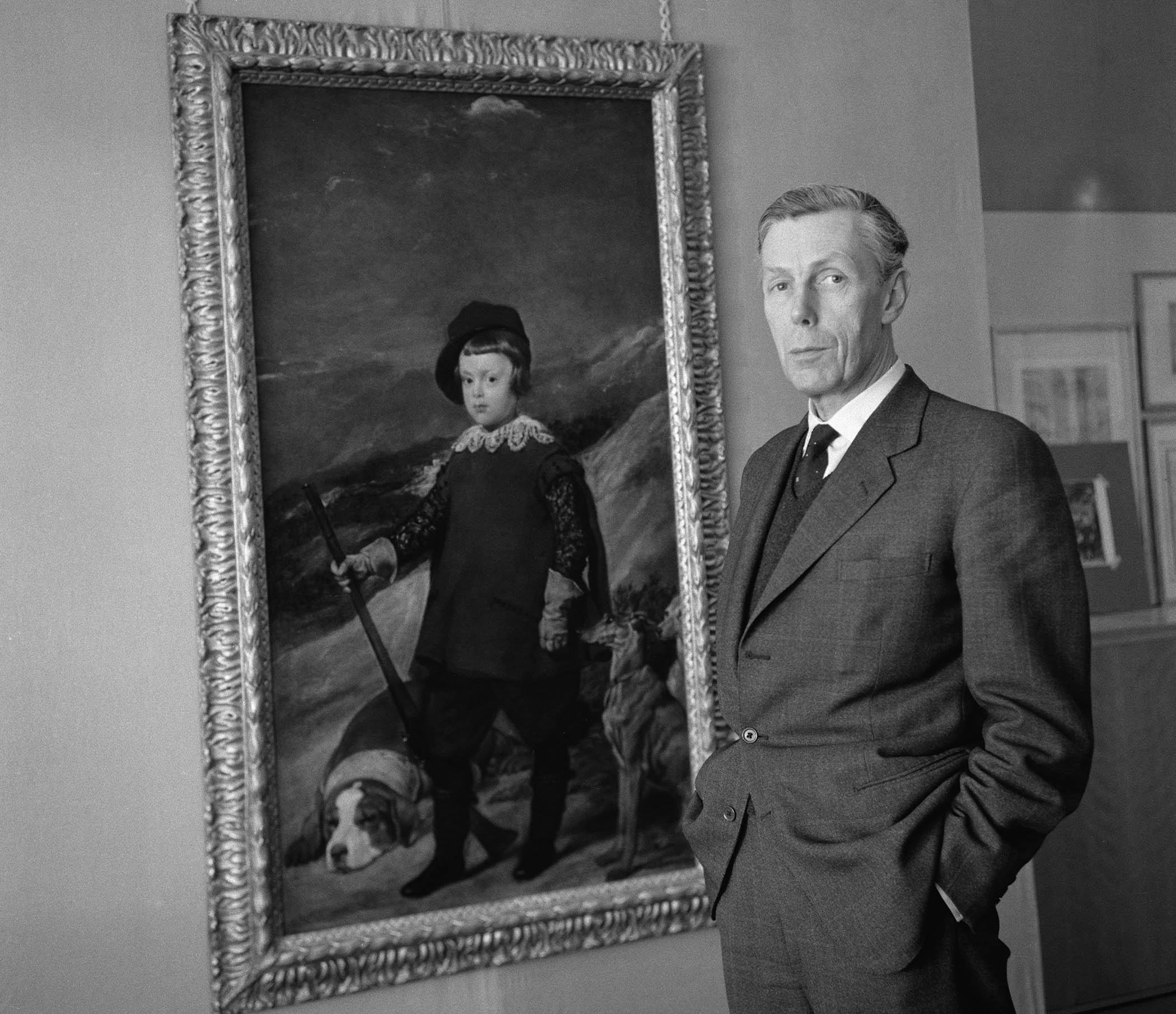

I vividly remember Sir Anthony Blunt’s exposure as a Russian double agent by Margaret Thatcher in November 1979 as it played out on TV. It wasn’t Blunt’s 100-yard stare and his haunted, desiccated face that intrigued so much as the utterly preposterous patrician tones of his designated spokesperson who was dealing with the excited press, the late art critic Brian Sewell. Sewell’s grotesque, entirely affected upper-class accent made the queen sound demotic. Strangely enough, three decades later, I co-curated an art exhibition with Sewell, a watchful, aloof personality, and noted that the hilarious accent was unchanged – and that I was just one degree of separation from Anthony Blunt.
Piers Blofeld gives little space to Blunt’s 1979 career-ending outing in this fascinating book. He has bigger fish to fry. His analysis of the scale and scope of Blunt’s betrayal of his country is highly revisionist and, by and large, very compelling. Blunt was born in 1907, the youngest of three sons. His mother was a cousin of Mary of Teck, George V’s queen, and his father was an Anglican priest who was posted to Paris, where Blunt spent much of his bilingual, cosmopolitan childhood. He attended Marlborough and then Trinity College, Cambridge, became a professor of art history, a knight of the realm, director of the Courtauld Institute, a world expert on Poussin and surveyor of the Queen’s pictures. He was the paradigm of an entitled, establishment figure. The fact that he spied for Soviet Russia in the second world war seemed almost improbable. And, indeed, his role in the so-called “ring of five” Cambridge spies has always been seen as the least significant compared with Donald Maclean, Guy Burgess and Kim Philby – all of whom managed to defect to Russia. (The fifth, John Cairncross, was not publicly exposed until 1990.) The fact that Blunt confessed in 1964 and was allowed an amnesty to continue his life as an art-impresario-toff seemed to confirm the nugatory nature of his duplicity.
Not so, Blofeld argues, with forensic aplomb. According to Blofeld, Blunt was the greatest and most lethal of the Cambridge spies (and there were many more than just five). The damage that Blunt wrought throughout his career in MI5 during the war and after makes even Philby’s betrayals seem less consequential. Like all the bourgeois, well-educated, privileged young men who decided that Communist Russia was the only bulwark against the spread of fascism in 1930s Europe, Blunt’s initial zeal was ideological. He was recruited to work with the NKVD and dutifully fed secrets and information to his Russian handlers. The “chiselled permanence of myth” of the Cambridge double agents, so Blofeld contends, has been a form of cover-up by the British security establishment. Blunt’s perfidy was extraordinary, Blofeld claims. In the war he identified targets for German bombers in the blitz. He spied not only for Russia but also for Nazi Germany when it appeared that supplying secrets to the Nazis might forward the Soviet cause.
The most shocking assertion in the book is that, in 1944, Blunt leaked information to the Germans about the order of battle of Operation Market Garden, the huge airborne assault on the key bridges over the Rhine. He was therefore, so Blofeld avers, indirectly responsible for the debacle that was the Battle of Arnhem. Had the bridges been seized then, the war might have been over six months earlier. But an early end to the war didn’t suit Stalin’s expansionist dreams in eastern Europe. So Blunt’s opportune betrayal extended the length of the war and allowed the Red Army time to capture Berlin.
Blofeld writes with a fluent, somewhat cliche-roughaged colloquialism. Here he is on Burgess: “[His] dauntless and unashamed pursuit of a shag seemed heroic.” And Maclean: “Tall, handsome and reserved, Donald was a perfect fit for the snooty Diplomatic Service, overseeing an empire on which the sun had yet to set, in a dress code of Homburg hats and spongebag trousers.”
Blofeld’s research is impressively thorough but he admits that the evidence he presents is, finally, circumstantial. The reason for this, he claims, is that since Blunt’s confession in 1964 there has been a massive cover-up of his treachery, of the precise and devastating nature of the damage that Blunt engendered. In the 1960s, Dick White, head of MI6, and Roger Hollis, head of MI5, both conspired to make Blunt seem like a minor player amongst the Cambridge spies, Blofeld alleges.
Despite the awfulness of what he did, it is hard not to feel in awe at the brilliance of it all
Despite the awfulness of what he did, it is hard not to feel in awe at the brilliance of it all
Blunt, in this concocted official version, “did no real harm”; his cover as a cultured, sensitive, gay, donnish charmer was to be the portrait painted. Many of the relevant files that might point to the brute facts of Blunt’s treachery are still secret; his role in the released MI5 files has been heavily redacted or is missing. It suited White and Hollis – as well as the government back then and those since – that the fact there was an undiscovered, enormously successful Soviet mole at the heart of the British Secret Intelligence Services for 20-odd years was swept far under the carpet.
“As the war ended,” Blofeld writes, “[Blunt] was in the incredible position of having run two of the Nazis’ four most important agents of the war in the west at the same time as writing Churchill’s personal security briefings, being the liaison between MI5 and MI6 and playing an integral role in Britain’s own deception operations. It is a phenomenal achievement, and despite the awfulness of what he did, it is hard not to feel a little bit in awe at the brilliance of it all.” A super spy indeed.
Blunt’s secret role continued postwar and extended further than anyone might imagine, Blofeld contends. In 1951, he was instrumental in burying the fact that three of Prince Philip’s sisters had married eminent Nazis. Nothing of this unsavoury connection was to sully the nuptials of Princess Elizabeth and the man she loved. Philip’s sisters were not invited to the royal wedding to their abiding fury and chagrin. Hence the knighthood and the continued regal favour and patronage. Blunt’s clever manipulations made sure the marriage would go ahead and that there would be no breath of scandal.
The depiction of Anthony Blunt that emerges in this account is both revelatory and contentious. Furthermore, Master of Lies is also an excellent conspectus of the whole “myth” of the Cambridge spies and the social and intellectual milieu from which they emerged. Alongside the five, a host of peripheral figures are deftly analysed in the process of outlining Blunt’s treachery. Characters such as Victor Rothschild of the banking dynasty, the journalist Goronwy Rees, the economist John Maynard Keynes, the scholar and director “Dadie” Rylands, the senior MI5 officer Guy Liddell and many others are included in the gallery, and Blofeld’s summation of the class-saturated world of the secret service is very acute. “The harsh hierarchies of British society in the 1930s,” Blofeld writes, “are so remote to us now that it can be shocking to be brought face to face with them… If you were a member of this group, it was almost impossible for you to be thrown out – and if you were an outsider, it was almost as impossible to be fully accepted.” I’m not so sure much has changed.
Newsletters
Choose the newsletters you want to receive
View more
For information about how The Observer protects your data, read our Privacy Policy
My fascination with the Cambridge spies has a lot to do with the psychology of betrayal. What makes someone become a traitor? My own theory is that there are three basic reasons: a need for money, being blackmailed, or a deep hatred of your country and its values. Blofeld’s book makes me inclined to add a fourth. When Blunt was asked, during his interrogation in 1964, why he became a traitor, he replied, “cowboys and indians”. It sounds facetious but I think there’s a truth there. Spying, being a double agent and living that life of permanent subterfuge becomes a kind of dangerous, exciting game, and it’s intoxicating, highly addictive. It applies to Blunt – and Philby, also, I believe. At the end of the day, they simply relished the secret that they had outsmarted everyone.
Somewhat bizarrely, one of Blunt’s closest friends at his public school was the future poet Louis MacNeice. It’s hard to imagine two more opposing personalities, though their intellects connected. Their relationship cooled as they matured but MacNeice knew Blunt perhaps as well as anyone and, significantly, knew him before the spying began. In his roman à clef novel Roundabout Way, MacNiece describes the Blunt character as having “no index to the soul”. It’s a telling epithet on an individual, and goes a long way to explaining how easy it was for Blunt to betray.
Master of Lies: How Anthony Blunt’s Treachery Changed Our World by Piers Blofeld is published by Quercus (£25). Order a copy from The Observer Shop for £22.50 (10% off RRP). Delivery charges may apply,
William Boyd’s cold war spy novel The Predicament is out now in paperback.
Photograph by Getty Images