



Kenneth Branagh may be regretting snapping his conductor’s baton when he was last on this stage, in a production of The Tempest, whose revels ended last month. He now finds himself bowing out at the end of his double-bill return to the RSC, after a 30-year hiatus, in a production of The Cherry Orchard that lacks tempo and vivacity.
As you might expect from the finale of Branagh’s back-to-back season, distinguished guests join him for the occasion. Fellow veterans Helen Hunt and Bill Pullman play Madame Ranyevskaya and Gaev, the bankrupt siblings who return to their grand Russian estate to find it’s due to be auctioned off. Yet there is fustiness rather than frisson in the air. Benedict Andrews bracingly reupholstered the 1903 play at the Donmar Warehouse two years ago, staging the characters’ heady tussle for their future on an expanse of carpet that allowed for a real pulling of the rug. But Tamara Harvey’s more pedestrian RSC production is saddled with a tepid and starchy new adaptation from Laura Wade, where characters remark: “How cripplingly banal!”
British stagings have become famed for sentimentalising Chekhov, and particularly this play, which he designated a comedy. But Wade and Harvey overcorrect. Just as Ranyevskaya refuses to confront reality, this version constantly retreats into humour, sheepishly giggly about addressing the tragedy. Andy Rush’s Yepikhodov is used as the principal distraction in this awkward game of hot potato, dialling up his clumsy slapstick mishaps and clowning around in squeaky shoes. The jaunty vaudeville music that plays over most of the second half only amplifies the skewwhiff tone.
We see the family’s final hurrah as they dance blithely in the face of ruin, but there isn’t enough standoff tension between them and Branagh’s Lopakhin, who represents the oncoming Russian revolution sweeping their landed gentry aside. This is a man who’s waited patiently to avenge his father and grandfather’s enslavement on this estate, underscored here by Branagh’s age: at 65, he is older than most actors who play the character (Ian McKellen was 46 when he took the role at the National Theatre in 1985; Adeel Akhtar 43 in Andrews’s Donmar production).
Speaking in his native Northern Irish accent, Branagh first shows Lopakhin trying to resist his lowly image as “a bear in a ballgown”, sucking in his brutish, puffed-out chest. He is instead so boyish and buoyant about his scheme to save the estate by selling off the beloved orchard that you half-expect him to start climbing one of the trees. We see the first streak of menace when he punches the beggar who startles the family. And when he eventually announces his purchase of the orchard he intends to destroy, Branagh transitions from slur to snarl as a tempest of resentment rises, waving a guitar around as if it were a chainsaw.
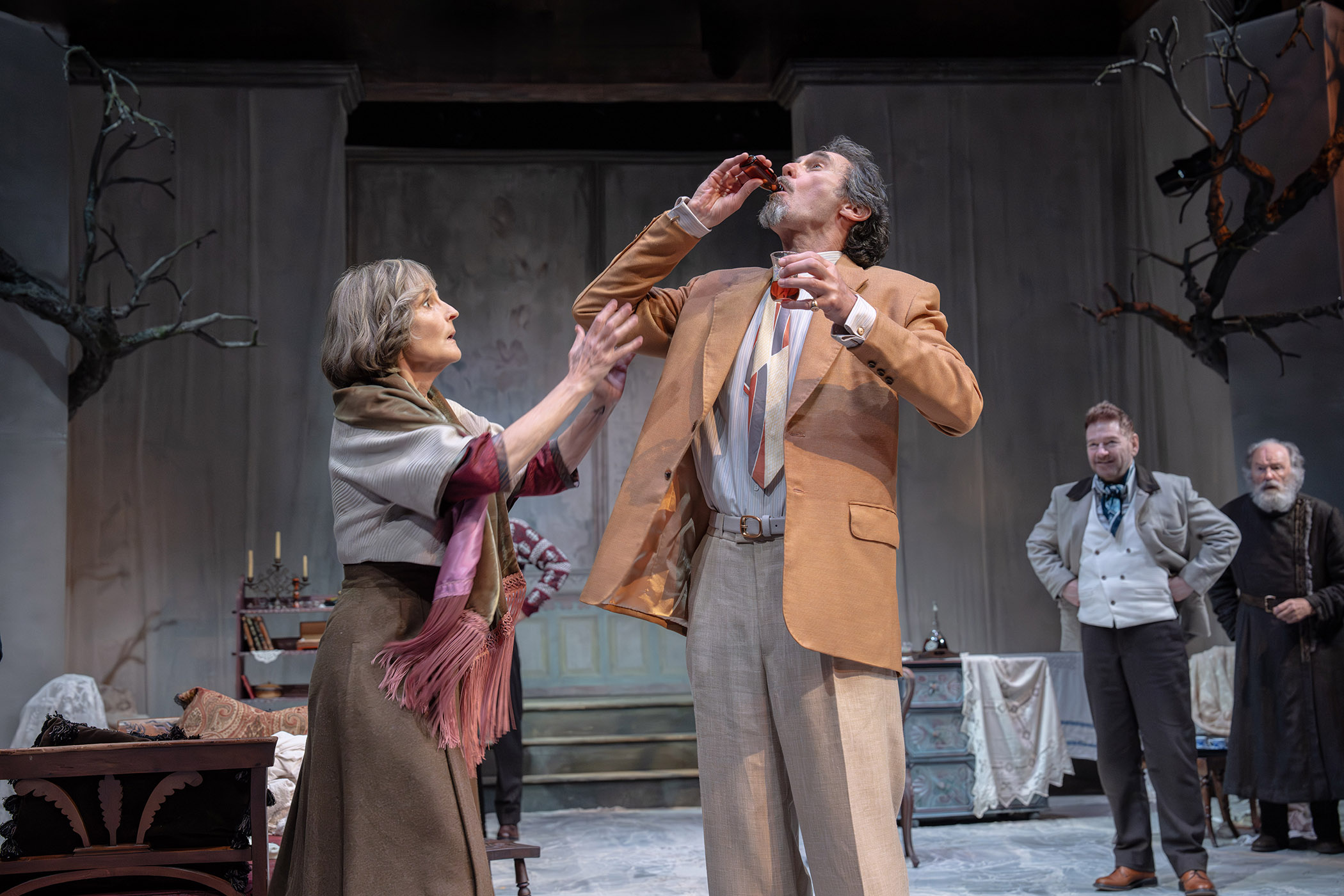
‘Constantly retreats into humour’: Helen Hunt, Bill Pullman, and right, Kenneth Branagh in the RSC’s The Cherry Orchard
Ranyevskaya should be an equally formidable presence, but Hunt cowers to become a woman who appears emotionally, as well as financially, spent. She is too resigned and aloof from the start. When she talks of losing her heart, she doesn’t convince you she had one to begin with. She laments “God help me, haven’t I been punished enough?” with the stumped tone of someone who’s lost their keys. Furrows and frowns work overtime to persuade us she cares. But we can’t access the instincts driving her, so her refusal to rescue the estate becomes clueless mismanagement instead of defiant idealism.
What does come through in place of precarity and peril is obsolescence and mortality. Michael Elwyn, playing the servant Firs, withers slowly, his beard resembling a clump of moss, in a grey-brown sack as if ready to be slung out. Pullman’s windbag Gaev squeezes out lines from his drowsy, dry-wheeze voice like the splutters of an old engine struggling to start. Alfred Enoch beams all the more strongly with youth and hope as earnest scholar Trofimov.
If Anna Fleischle’s set doesn’t convey the orchard’s renowned grandeur, it is wonderfully freighted with memory. Blots of watercolour create a suggestive outline on a gauzy back wall. It is faded and fading; a vision wrenched from and dissolving into the past. Either side, trees wrap around columns like children clinging to their mother’s leg, willing her not to leave them.
But where Zoë Wanamaker’s Ranyevskaya at the National in 2011 moved through the space as if every step sent a shudder of heartbreak through her, remembering her young son who drowned in the orchard’s nearby river, Hunt doesn’t convey the pull of meaning and attachment. Instead, both the orchard and this production will be lost to time. And you leave feeling the woman at the centre could have done more to save them.
The Cherry Orchard is at the Swan theatre, Stratford-upon-Avon, until 29 August
Newsletters
Choose the newsletters you want to receive
View more
For information about how The Observer protects your data, read our Privacy Policy
Photographs by Johan Persson