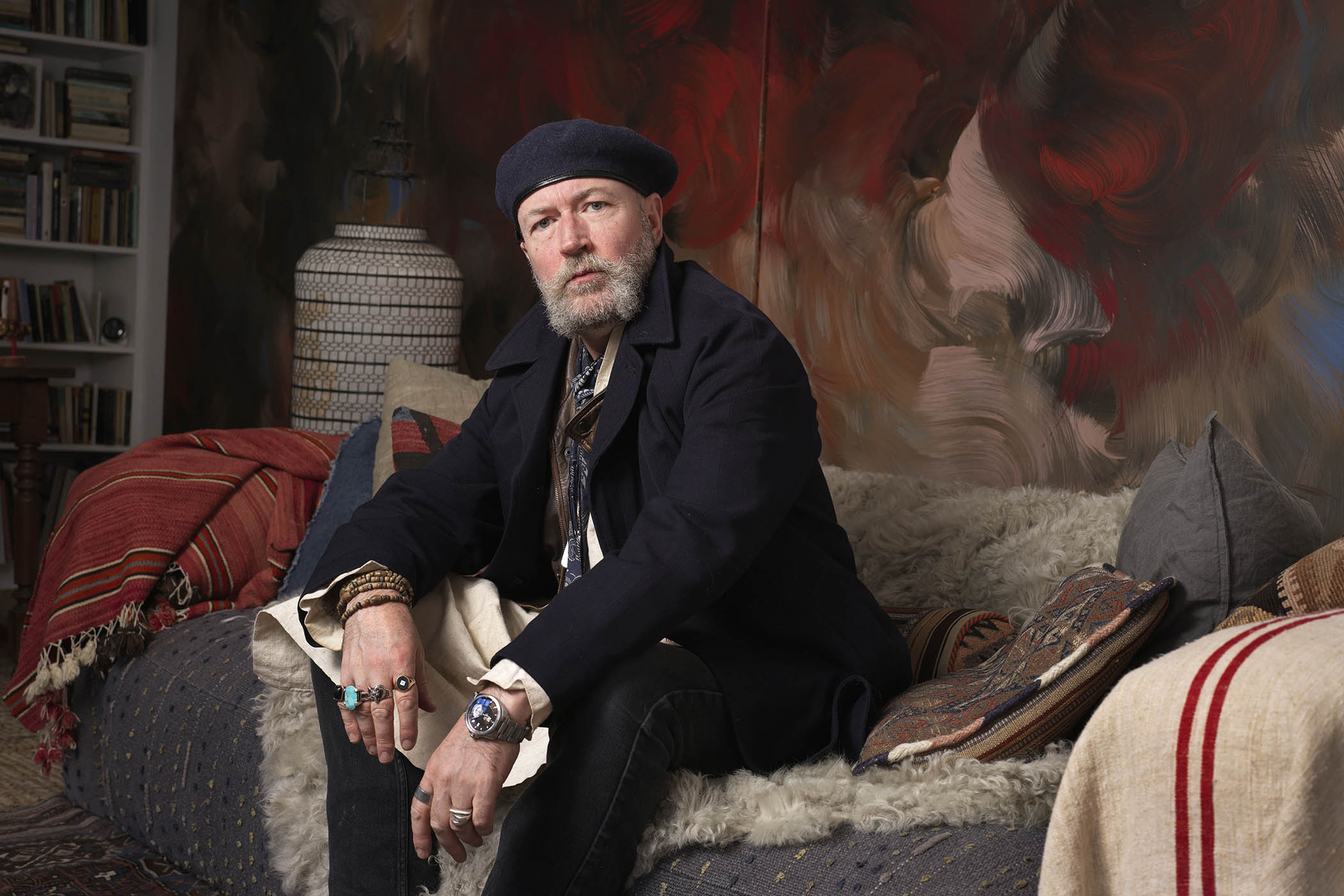
Portrait by Karen Robinson for The Observer
David Keenan was born in Glasgow in 1971 and raised by adoptive parents in nearby Airdrie. He made his name as a music journalist for The Wire and published his first novel This Is Memorial Device in 2017, winning the Gordon Burn prize two years later with his followup, For the Good Times. Keenan’s latest novel, Boyhood, circles around a young boy’s disappearance in 1980s Glasgow, taking in such esoteric subjects as remote viewing, angels, Mayan sacrifice and the writings of Xenophon. Keenan left Glasgow last year and now lives in London.
What sparked this new novel?
For a start, I always knew I would write a book with the title Boyhood. That’s my favourite word in the English language. [The book] ties in with my family history. I was adopted quite early on and my parents rescued me from a life of institutionalisation. There was always something quite angelic about them. So I think that idea of boyhood, the magic of Glasgow, being watched over by angels, all of these things are tied up with it.
Why is ‘boyhood’ your favourite word?
There’s something so pure and innocent and naive about that moment in a boy’s life that I feel supremely protective of. I remember walking through the botanical gardens in Glasgow and there was an exhibition of children’s art on a fence – the theme was environmental collapse. There was a beautiful, tragic child’s drawing of a world in flames and of a dolphin dying upside down. I was like: “This is fucking child abuse.” I believe in protecting childhood completely. I believe it’s holy.
Some very dark things happen in the novel – killings of animals and children – but it still manages to feel hopeful.
One of the big themes for me is: is it possible to redeem suffering through art and storytelling? One of the places I got that from is my father and his brothers, who grew up during the Troubles in Northern Ireland and who couldn’t read or write, but they had such faith in language and storytelling. They would tell you about the most horrific things they’d seen in Belfast and they’d be competing to tell the funniest version. They could see that there was a way of redeeming suffering through storytelling. For me to see illiterate men with that faith in language, I think that might be what made me a writer.
One of your characters says that, beneath all the violence and depravity, love is the most fundamental thing in life. Is that your own view?
Yes, I think love is the greatest thing. For instance, I can’t stand protest music, protest art. I fucking hate it. I hate whiny art. It is really easy to say “no”. It is really fucking hard to say “yes”. But guess what? That’s what life asks of you. And so I believe that the greatest art, simply, is the love song. They are the heaviest songs. They are the deepest.
Tell me a love song that you hold in high regard.
Let Her Dance by the Bobby Fuller Four. Dance is so big for me as well. I always thought that old chestnut, that writing about music is like dancing about architecture, is idiotic. I think dancing about architecture is a wonderful, amazing, inspired thing to do. The biggest compliment you could give to my books is to dance about it. I would love that.
You write about sex in a very unrestrained way – like you’re writing about what turns you on without worrying what anyone thinks.
Yes, that’s absolutely true. I think that’s the thing that makes people most uncomfortable in my books. But I love that sort of lustiness. I want my books to be horny and exciting, and I’m always surprised that people feel weird about fucking – in this day and age! It seems mad.
Irvine Welsh says Boyhood ‘slaps our dull, sterile culture hard across the face’. Were you happy with that blurb?
Well, it’s not something that I set out to do. I love what Irvine said, but I don’t think of myself as a transgressive novelist who wants to fuck everyone up. That would be such a petty motivation to make art. My books are extended love letters to life and creation. I’m not really out to appal anyone.
What’s your writing day like?
I write every day. But I had a period in my career, probably when writing [2021 novel] Monument Maker, when it was affecting my sanity a little bit. So I’ve had to come up with a rule that I never take notes, and if I’m not physically sitting down at the keyboard working on a novel, I’m not interested in listening to any of its demands. I have to be able to go about my day unmolested by these demons.
There’s so much esoteric detail in your books. Are you researching as you go?
Never! I don’t do research. I would never reach for a book during a book – it’s just the wrong thing to do, because then something is speaking that’s not the book in itself. Obviously, at the end, I will go through and check some details – but even then I’m not too concerned about historical fealty. And if my character says something that’s wrong, well, guess what? People say things that are wrong all the fucking time. So I let those faulty ideas stand.
Are you working on a new book?
Yes, it’s called This Flower’s for Never Returning. What happens is, on a tourist visit to Auschwitz, a young man waits till the guide goes away, then climbs under the bottom of one of the punishment cells, leans on the back of the wall. The wall opens, he walks into the dark and sees a pair of hairy legs. He realises it’s Moses. Moses leads him into an underworld where every Jew that died in the Holocaust is alive. Then he becomes part of a group of painters who call themselves the League of Banished Animals, who paint extinct species. I mean, fuck me, I didn’t [consciously] think this shit up. Why would I? But here I am. It’s been a really incredible experience. I’m completely enamoured with it.
Do you feel ever nervous about tackling big subjects like the Holocaust?
No, I never think twice. Maybe it’s naive. When I wrote [2019’s] For the Good Times, set during the Troubles, it’s a pretty sensitive area. There were some really sick jokes in there and some really flippant humour about ghastly things. But I never considered it. It was only once it was published, I thought: ‘“Oh, fuck, I’ve written a book about the Troubles. It could all go tits up.” But my naivety got me through.
And if that self-consciousness suddenly kicked in, it would break the spell.
Absolutely, because it’s like you’re in a trance. One of the weirdest things about writing books is, I don’t really remember thinking them up. You become so absorbed that the ego, the individual you, disappears. There’s actually no one there to remember the writing when you’re deep in the process like that. I resent it a little bit, because I’d like to remember writing these books, but [the memory] is not there to access.
There’s a class in Boyhood, led by someone who might be a serial killer, that must be the most terrifying creative writing class in all of literature.
The lesson that he teaches there is so key, because he’s basically saying: “Write hopelessly.” That was the biggest lesson I learned when I started to become a novelist. In my 30s, I began writing a first novel and it was so cringe-inducing. I thought: “I’m never going to be a novelist because this is the worst shit of all time.” But then I thought: “Well, this is where everyone gives up.” So I made a vow that I would finish this shit novel, but at the end I would destroy it. So I smashed my laptop to pieces as part of a ritual and then started again. I’d proven to myself that I could write hopelessly, and after that I was a liberated writer. I found my voice immediately. It was remarkable.
Boyhood by David Keenan is published by White Rabbit (£23). Order a copy from The Observer Shop for £20.70. Delivery charges may apply
Newsletters
Choose the newsletters you want to receive
View more
For information about how The Observer protects your data, read our Privacy Policy