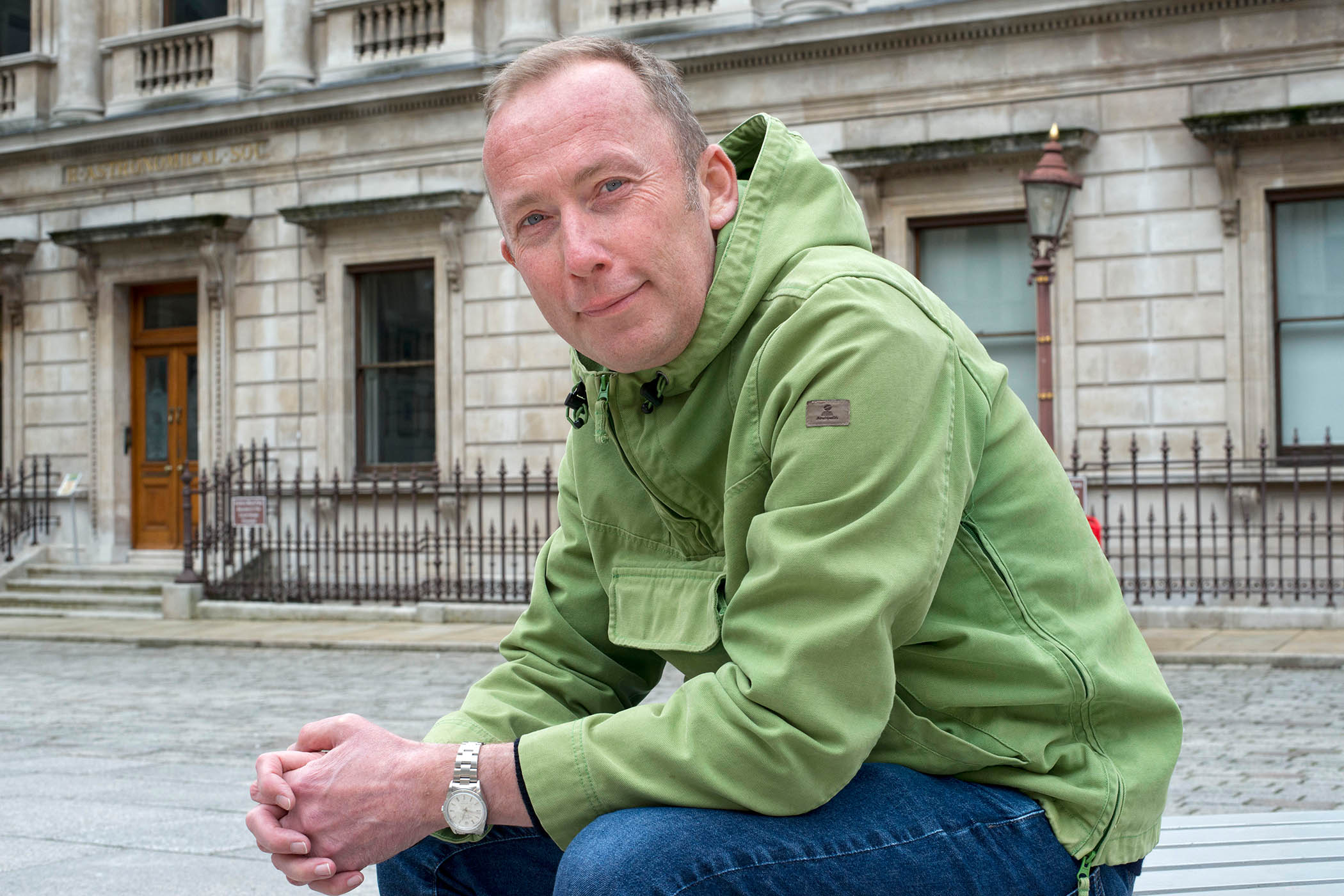
Portait by Sophia Evans for The Observer
Born in North Yorkshire, Dominic Gregory moved to Dungeness in Kent 20 years ago and became an RNLI (Royal National Lifeboat Institution) volunteer. Prior to that, he ran a literary festival and worked as a consultant to literary estates, including that of Roald Dahl. Now married, with a 14-year-old daughter, he divides his time between Dungeness and south-west London. Lifeboat at the End of the World, his first book, is a powerful and moving account of the realities of serving as part of a lifeboat crew.
The landscape and the town of Dungeness play a leading role in the book. You make it seem an otherworldly place.
The first draft contained a great deal more about Dungeness than ended up in the book. I think I needed to write it out of my system. If you’ve never been there, it is quite hard to get across just how bewitching it can be – and how divisive – because it’s not a conventionally pretty British place. It’s quite the opposite.
What drew you there?
I was newly single and I knew I wanted to live on the south coast but couldn’t afford to spend a great deal. So I went to look at the wooden houses on the beach, which were still relatively affordable then, and it just felt so completely different. You’re in the middle of Romney Marsh, and then suddenly the soil gives way to pebble and it’s just this very flat, huge expanse of shingle with a great big nuclear reactor looming over it, which only adds to the strangeness.
What ignited your passion for lifeboats?
When I was a child, my dad used to read a book to me at bedtime that I loved – The Life-Boat Men, which was part of Ladybird’s People at Work series. He also took me on lots of boating trips. So the sea got into my imagination growing up.
You held back for quite a while after moving to Dungeness before volunteering to join the lifeboat crew...
I simply didn’t think they’d have me. I’m not from a seafaring background, and I had assumed the crew were people who worked on the beach or on boats or on the fishing fleet, which was on its last legs even then. So the lifeboat felt like something I couldn’t do. But then I got to know people locally and they said: “You should, you should.” So I did.
You keep your own biography at bay to focus on the wider crew. Why?
I’m not very interesting! The rest of the crew have far better stories to tell. And I wanted to write about people who would otherwise go unwritten about – many of them from families who have crewed the lifeboat for generations.
The boat’s coxswain, Stuart ‘Steady’ Adams, stands out as a quietly spoken hero.
I’m hoping he gives the book its moral compass – and that’s very much his role on the boat as well. He’s humble, unassuming, not an alpha male. He doesn’t shout, there is no grandstanding. But there is this quiet assurance. He’d been working on that beach since he was a boy. He knew it blindfold and because he knew it, we knew it too. There’s an incident in the book where we go out into a really heavy sea, and at no point did it cross my mind that we wouldn’t get home. That was entirely down to Stu.
That’s a real heart-in-mouth moment: the lifeboat launches into treacherous waters in the dead of night to rescue a dinghy lethally overloaded with people trying to make it from France to England. How did that feel?
It was the job we’d been dreading. Our first mass casualty event in the Channel. Only 39 survived out of as many as 50 who left France. It was horrendous. Amid all of that, I wanted to tell the story from the perspective of the volunteers on the lifeboat, how it was affecting us. That story hadn’t been told. There have been acres of comment about this crisis from people who’ve never pulled a body from the sea, but nothing from the point of view of those actually dealing with it. On a lifeboat there is a crew of just six or seven, and there’s only a handful of lifeboats on the south coast. It’s a huge responsibility.
What kind of a toll did this take on you and the crew?
At the end of the rescue my legs buckled under me. I didn’t go back to sea for about a month afterwards, whereas Stu and his son [also one of the lifeboat crew] were back the same day, searching for bodies. I think they were on service that day for 21 hours. We dealt with it by talking about it. We still refer to it as “that December job”. It never goes away. But you support one another.
The book is full of similar, if less tragic, moments: a small boy drifting far from the shore in a tiny inflatable; a downed kitesurfer tangled in his cords…
Those were joyous rescues, frightening in the moment, anxiety-making at the time, but the outcome couldn’t be bettered. We saved lives when we could.
In the opening chapter you encounter a journalist on the beach who asks: ‘Do you really think all lives are worth saving?’ You couldn’t bring yourself to answer him. What would be your reply now?
It comes down to this: if you want to be crew on a lifeboat, you have to want to go and save lives – as many as possible. We’re not there to judge. Most people set out with the very best intentions: to have a day at the beach, to get to the other side, to catch a day’s fish. Nobody sets out to get into distress. Our job is to save them if they do.
Who are your literary heroes?
When I was writing the book I had three writers on my desk as touchstones. The first was Derek Jarman. His gravitational pull is very strong, and it’s hard to write about Dungeness in a way that doesn’t evoke Jarman and his concept of post-industrial modern nature. He threaded his way through people’s stories, not least because he lived in the house that some crew members’ grandparents had built. The others, for their ability to evoke a particular place, are Ronald Blythe, who wrote Akenfield, and Italo Calvino, whose Invisible Cities I’ve loved since I was a teenager.
Can you write any time, any place?
My wife would say I get very grumpy if I don’t have a quiet room.
Lifeboat at the End of the World: A Volunteer’s Story is published by William Collins (£18.99). Order a copy from The Observer Shop for £17.09. Delivery charges may apply
Newsletters
Choose the newsletters you want to receive
View more
For information about how The Observer protects your data, read our Privacy Policy
Related articles: