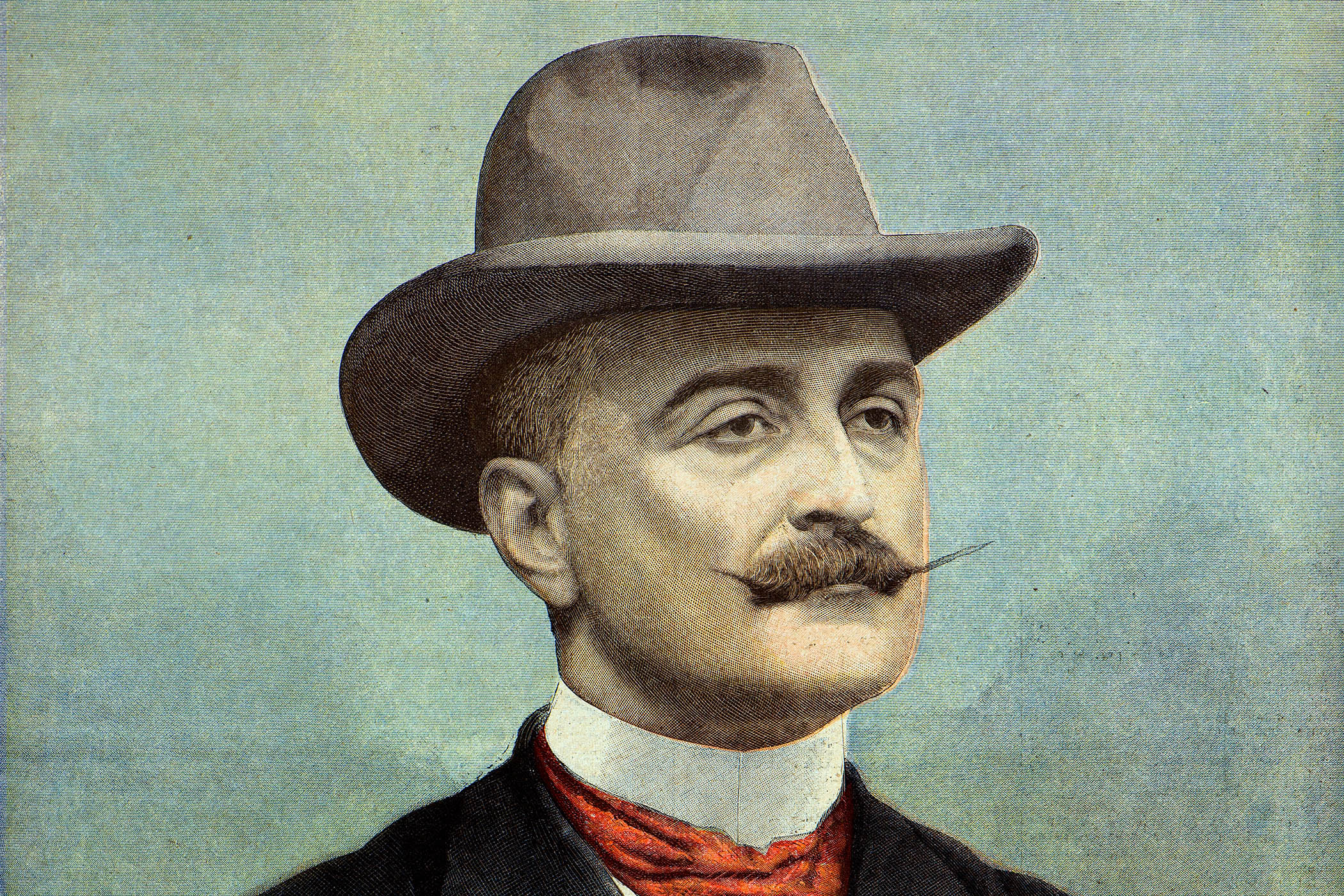



The history of fascism is as much a cultural issue as it is a political one. This is clearly demonstrated in this dense but never less than gripping biography of the Marquis de Morès by the academic Sergio Luzzato. Today, Morès is a half-forgotten figure, a footnote in the history of the French far right, and indeed often neglected even by rightwing historians who might be expected to have some sympathy for his politics. This is mainly because, as Luzzatto points out more than once, the only real legacy of Morès’s short and colourful life was a series of failures.
Morès was murdered in 1896 at the age of 37 by Touareg “guides” in the Sahara, while allegedly plotting a coup. His wife claimed it was a political assassination by the French government, who feared his charisma and growing political prominence. By then, Morès had already pursued a chequered career that took him from the heights of French military and political life to the jungles of the far east.
In 1876, at 18 years old, he studied the art of war at Saint-Cyr, the most prestigious military academy in France, alongside Philippe Pétain – later commander of the French army in the first world war – and began his military career helping to put down insurrections in Algeria. Ever restless and in pursuit of a challenge, Morès tried his hand at ranching in the badlands of North Dakota, where he was arrested for murder, and acquitted. Despite the fact that his businesses all failed, he was asked by the French government to help build a railway in Vietnam.
Morès was a schemer and adventurer, a keen fan of duelling with more than a touch of George MacDonald Fraser’s Harry Flashman about him. To this extent he is a recognisable type, a soldier whose sense of military honour is always contradicted by his quixotic plans, and the ruses he employs to avoid consequences when they collapse. His was a life belonging to the French 19th century, with Morès’s faith in the destiny of a great nation driving him ever onward and his worldview shaped by the ebb and flow of his era.
Chief among these currents was anti-Semitism. Morès blamed most of the failures of his operations on shadowy cabals that he called “the Jews”, usually in league with the never-to-be-trusted Anglo-Saxon. It was Jew-hatred that propelled Morès into politics, when, in 1890 and back in France, he challenged a Jewish member of the chamber of deputies, Camille Dreyfus, to a duel, on the grounds that Dreyfus had insulted him in a newspaper article. Morès declared that he wanted “Gaul for the Gauls”. (The encounter passed without fatality, though another duel two years later resulted in Morès killing a Jewish captain, Armand Mayer.)
Morès was a schemer and adventurer, a keen fan of duelling with more than a touch of Harry Flashman about him
Morès was a schemer and adventurer, a keen fan of duelling with more than a touch of Harry Flashman about him
It was another a different Dreyfus who brought Morès to a wider public prominence. This was during the so-called Dreyfus affair that began to unfold in 1894, when an unsigned letter containing French military secrets was intercepted by French intelligence on its way to the German military attache in Paris. The letter was attributed to Captain Alfred Dreyfus, a hitherto blameless Jewish officer in the French army. When it later emerged, in 1896, that the letter had been written by Major Ferdinand Walsin Esterhazy, the French war office suppressed the information. In the meantime France was engulfed in a crisis that revealed the deep divisions between those who believed in the infallibility of the French government, and those who saw it as irreparably flawed and corrupt.
Morès had been radicalised in his anti-Semitism in Algiers, where he frequented the circles around Édouard Drumont, founder of the Anti-Semitic League of France and editor of La Libre Parole, a ferociously anti-Jewish newspaper, and by his own theories of Jewish conspiracies. Morès was posthumously accused of meddling in the Dreyfus affair by a journalist called Henri Strauss. The evidence for direct involvement, such as forgery, is thin, but there is no doubt, as Luzzatto points out, that Morès contributed vigorously to the climate of anti-Jewish feeling that martyred poor Dreyfus.
The Dreyfus affair had long-term repercussions that still resonate today, dividing those who believe in the necessity of a rightwing Catholic authority preserving the sacred nature of France at all costs, and those on the left who believe in a modern democracy where truth trumps lies. In this case, Morès was firmly on the side of the French establishment. But does this, as Luzzatto boldly declares in the title of his book, make Morès not just a fascist but the first fascist?
The answer is not clearcut. It is true that Morès neatly fits the model of a proto-fascist, with his loudly broadcast anti-Semitism, his trust in order based on religious power and his formation of a uniformed vigilante militia. But can he be described as a fascist in the modern sense? Again the answer is probably yes, but with the caveat that present-day fascism, with its avatars in Russia and the United States, is a hi-tech business that employs sophisticated propaganda techniques to warp or distort elections and above all seeks to undermine democracy as a useless burden on humanity. Morès would no doubt have subscribed to all of these views, but he was also a man of his time, whose views found a willing audience because they were already so widely embedded in the French collective consciousness. Despite Luzzatto’s best attempts to bring him to life, Morès remains trapped in his era, a doomed romantic and prisoner of a hateful ideology.
Luzzatto is right, however, to identify France as one of the original homes of fascism (a point made by Hannah Arendt, as he indicates). Although Luzzatto does not extend his analysis to the present, it is not too much to argue that Marine Le Pen’s Rassemblement National has its origins in the anti-Dreyfusard ferment in early 20th-century France, so adeptly described in this compelling and instructive book.
The First Fascist: The Life and Legacy of the Marquis de Morès by Sergio Luzzatto is published by Allen Lane (£30). Order a copy from The Observer Shop for £27 with free delivery
Photography by Bridgeman Images
Newsletters
Choose the newsletters you want to receive
View more
For information about how The Observer protects your data, read our Privacy Policy