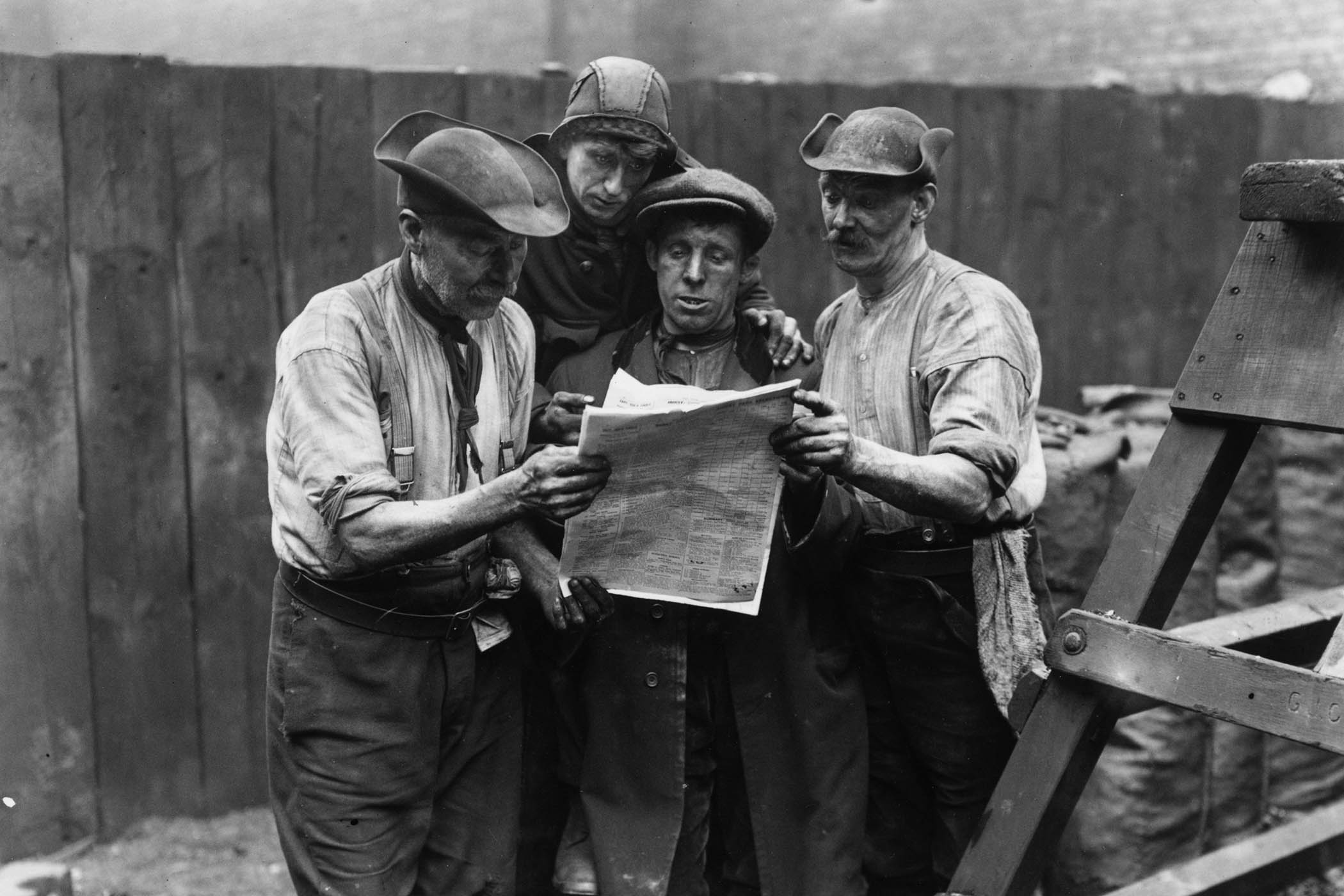



The adage that history is written by the winners is of limited applicability in Britain, the land that loves the underdog – and understatement. Excessive glorying in victory is bad form, so we have tended just as often to commemorate valiant rearguard actions, Dunkirk most famously. The General Strike of May 1926 fits the pattern, a heroic defeat for the trade unions notwithstanding the mass solidarity of almost 3 million workers.
There are, however, two different versions of this story on the left. The mainstream of the trade union movement celebrates the centenary of the General Strike as a short-term defeat that led in the longer run to major improvements in working conditions and pay. On the radical left, by contrast, the strike figures as a moment of betrayal: nine days in, its vacillating leaders decided to call off what remained a solid walkout because the risks of escalation seemed vastly more worrying than the humiliating prospect of caving in to Stanley Baldwin’s Conservative government.
For decades, a counter-tradition also persisted on the right, which recognised the role of between 300,000 and 500,000 enthusiastic volunteers – many of them university students on a jolly jape – who assisted the authorities in seeing off what they identified as the subversive extra-parliamentary challenge of trade unionism to constitutional government. But that memory – an embarrassment nowadays for students and the universities that indulged their absence – has faded.
Popular memory fails to capture the shades of grey predominating in the most sophisticated and persuasive accounts of the strike. The main argument of Jonathan Schneer’s Nine Days in May is that the trade unions did not want a general strike, but assumed that the mere threat of one would apply sufficient pressure on the government to bring about an acceptable resolution of a crisis in the mining industry. This sector of the British economy was badly run, with around 1,400 separate firms owning nearly 2,500 collieries. Many of these were small enterprises, with 95% of the coal produced by a mere 600 collieries. Moreover, it is clear from the various books under review that nobody – not even the most excitably reactionary of Conservative politicians – had a good word for the mine owners, who were widely seen as blinkered and obtuse: “They are about the stupidest and most narrow-minded employers I know,” said one Tory cabinet minister. The other villain of the piece is Winston Churchill, Baldwin’s chancellor of the exchequer, who had taken the country back on to the gold standard in 1925 at its pre-first world war parity of $4.86 to the pound, which was reassuring for the City, but excessively high for exporters. The only way the mine owners saw of making their coal competitive on international markets was to cut the wages of their employees and extend their hours of work.
Schneer provides a compelling picture of the miners’ working conditions a century ago. They were paid for their shifts of seven hours at the coalface, but it took them sometimes a couple of hours of crawling on hands and knees along tiny tunnels to get to and from the seams. The proposal to extend miners’ working days by a single extra hour might sound like a bearable imposition to an office clerk, but it was a matter of life and death deep underground: it was at the tired end of the working day – dubbed the “murder hour” – that most industrial accidents occurred. On average, during the first half of the 1920s, three miners were killed in accidents every day across Britain. In addition, there were on average about 500 injuries a day, at least 10 of which were serious. Herbert Smith, the president of the Miners’ Federation of Great Britain, had lost his father in a mining accident, and the union’s secretary, Arthur Cook, had seen a fellow worker killed beside him in a rockfall during his very first day underground. Emotions were understandably raw.
When, in the early summer of 1925, the mine owners proposed to cut wages and change conditions, Baldwin stepped in with a compromise: a nine-month government subsidy to the industry to maintain the status quo. Its expiry at the end of April 1926 led to extensive talks – intricately narrated by Schneer – between government and unions. The main unresolved sticking point was that the miners’ union insisted that accepting a cut in wages could not be a precondition for negotiations, and eventually the government – its patience running dry – broke off discussions, leaving the Trades Union Congress (TUC) no option but to proceed with an unwanted national strike.
General strikes occupied a prominent place in the strategy of syndicalism, a revolutionary ideology popular around the turn of the century in France and Spain, envisaging mass action by labour unions as a way of overturning the capitalist state. Britain’s so-called General Strike was not, however, a general strike of the syndicalist type. It was rather, as Schneer describes it, “an enormous sympathy strike”: a different beast entirely, for the objective of the General Council of the TUC was not to overthrow the state, but merely to force the government to reopen negotiations.
The ‘will to unity’ seen in 1926 has long since evaporated, even among moderate trade union leaders
The ‘will to unity’ seen in 1926 has long since evaporated, even among moderate trade union leaders
The government, on the other hand, was much clearer about its aims – the defeat of what it saw as a defiantly anti-constitutional strike – and how it would achieve them. Whereas it had made strenuous and detailed contingency plans well in advance of the rupture in talks, the General Council of the TUC had not strategised how to win a general strike, having “never wanted to be involved in one” in the first place, as Schneer notes. When the government called its bluff, the trade union movement launched its campaign with one hand tied behind its back; for its leadership did not mobilise the entirety of the unionised workforce and maintained some provision for certain essential needs. The central organisation of the strike included a Food and Essential Services Committee, while its Building Committee permitted construction work to continue for ordinary housing and for hospitals.
The historian of the General Strike needs to be a pointilliste, capturing myriad micro-interactions between employers and striking employees, between strikers and the authorities, between strikers and blackleg volunteers. These were generally peaceful, though sometimes threatening, with simmering hostility rising in certain places to brawling, stone-throwing and industrial vandalism. Among employers, especially in the strike’s aftermath, attitudes were frequently tinged with vindictiveness. “A full picture of the General Strike must display the well-known and popular image, but also its mirror opposite,” Schneer remarks, “for both were true.”
Famously, strikers and police played a good-natured football match at Plymouth. However, there was also plenty of bad feeling and a certain amount of violence and sabotage. A group of miners at Cramlington in Northumberland removed rails from the track ahead of a train, which caused its engine to overturn and the derailment of five coaches; miraculously, only one person was injured. The General Strike came a mere nine years after Russia’s Bolshevik revolution of 1917; a source of anxiety for many, and not only on the government side. However, Schneer argues that most participants – volunteer strikebreakers, as we might expect, but also strikers too – viewed the events of May 1926 through the prism of the mass patriotism of 1914; and some trade union leaders advised strikers to wear their medals while on picket duty.
Newsletters
Choose the newsletters you want to receive
View more
For information about how The Observer protects your data, read our Privacy Policy
In The Edge of Revolution, David Torrance shows how London’s stranded commuters treated getting to work as a great adventure. Similarly, for many of the pro-government volunteers, the General Strike was a jamboree – but it came at a sad cost in lives. Untrained volunteers were ill-equipped to handle buses and trains. Sometimes the results were farcical – such as the 37 hours it took for a mishandled steam train to get from King’s Cross to Edinburgh; but there were also several deaths in train collisions and bus crashes that were attributable to the incompetence of volunteer drivers. In Britain’s Revolutionary Summer, Edd Mustill rightly debunks the claim that the strike was a peculiarly sedate affair in which nobody was killed.The media played a central role in the strike. It was a printers’ walkout at the Daily Mail on 3 May, immediately before the strike itself, which had given Baldwin’s government a point of principle – press freedom – on which to end negotiations. The printers were protesting against an editorial in the Mail that condemned the threatened General Strike as a “revolutionary movement” operating under the guise of an industrial dispute. Churchill took command of the state’s media operation, for the strike’s duration cosplaying a press baron in charge of a government newspaper, the British Gazette. The government had no need to stifle the new medium of broadcasting, because the managing director of the then British Broadcasting Company, John Reith, prudently self-censored out of a fear that diehards like Churchill might requisition the service. When Randall Davidson, the archbishop of Canterbury, wished to issue a conciliatory message on the BBC, Reith kept him off the airwaves.
The longer the strike continued, trade union leaders reckoned, the greater the danger of civil strife or an authoritarian clampdown. That’s why they invested hopes in a possible peace plan devised by the Liberal politician Herbert Samuel, which they invoked to bring the General Strike to a conclusion. But there was no reciprocal thaw on the Conservative side, notwithstanding some differences within factions of the cabinet. King George V, one of the era’s centrists, recorded in his diary that the country could be “well proud of itself”; a contentious event involving millions was now over, and “not a shot has been fired”. Nevertheless, the strike within the mining industry continued until November, though the Nottinghamshire miners – in a move foreshadowing divisions that would emerge in the miners’ strike of 1984-5 – settled beforehand in a separate agreement with local owners.
As Torrance observes, Churchill managed to endear himself to his trade union foes a mere two months after the strike ended. Poking fun at his role in the recent crisis during a Commons debate on 7 July 1926, he warned that if the TUC ever launched another general strike, “we will loose upon you another British Gazette”; the cross-party laughter that ensued signalled a surprisingly snug measure of reconciliation. Mustill also draws attention to the incongruous afterlives of the other main protagonists of 1926.
Five years on, Ramsay MacDonald, a Labour prime minister now detached from his party, and Jimmy Thomas, the equivocating leader of the railwaymen’s union during the strike, would find themselves in a national government alongside Baldwin and the Tories; and a further decade on, Ernest Bevin, the leader of the Transport and General Workers Union, would serve in the wartime coalition under Churchill, the rightwing “hothead” of 1926. Cohabitation of this sort was, of course, a consequence of drastically changed circumstances; but had the leaders of the Labour movement been too cosy all along with their ostensible Conservative opponents? The radical left believes that we live with the consequences of the 1926 sellout. Callum Cant and Matthew Lee’s book, The Future in Our Past, traces the plight of today’s precariat to the might-have-beens of 1926: we live now in a future that could – perhaps should – have turned out differently. By the same token, Mustill dwells on the squandered solidarity of 1926, the “unfulfilled promise of working-class power” betrayed by a supine union leadership.
Instead, British industrial relations continued on a very different footing: more pragmatic and corporatist, less fixated on class warfare, with the ultimate weapon of a general strike now off the table. Notwithstanding the current chaos of strikes on the Tube and among doctors, the “will to unity” seen in 1926, Mustill notes, has long since evaporated even among moderate trade union leaders.
Torrance addresses the hypocrisy inherent in the Conservative objection to the General Strike as an unconstitutional challenge to parliamentary democracy. This is because, little more than a decade before, several of these same Conservative diehards had aligned themselves with militant extra-parliamentary opposition in Ulster to Irish home rule. Such actions prefigured a later ironic conjunction between trade union activism and the Northern Irish Troubles; for, surprisingly, the most successful general strike in British history was the provincewide standstill in Northern Ireland between 15-28 May 1974.
Based on an alliance between Protestant workers and loyalist paramilitaries, this strange anomaly – a rightwing strike – ruthlessly attained its clear objective: the abolition of a recently negotiated power-sharing arrangement that had brought Catholic politicians into the government of Northern Ireland. The Ulster Workers’ Council, it transpired, possessed none of the squeamishness about means and ends which, in a diffidently English way, had constrained the General Strike’s centrist leadership.
Nine Days in May: The General Strike of 1926 by Jonathan Schneer is published by Oxford University Press (£25).
The Edge of Revolution: The General Strike That Shook Britain by David Torrance is published by Bloomsbury Continuum (£20).
Britain’s Revolutionary Summer: The General Strike of 1926 by Edd Mustill is published by Oneworld Publications (£16.99)
The Future in Our Past: The General Strike 1926/2026 by Callum Cant & Matthew Lee is published by Verso Books (£11.99)
Order any of the books from The Observer Shop to receive a 10% discount. Delivery charges may apply
Photography by Getty Images