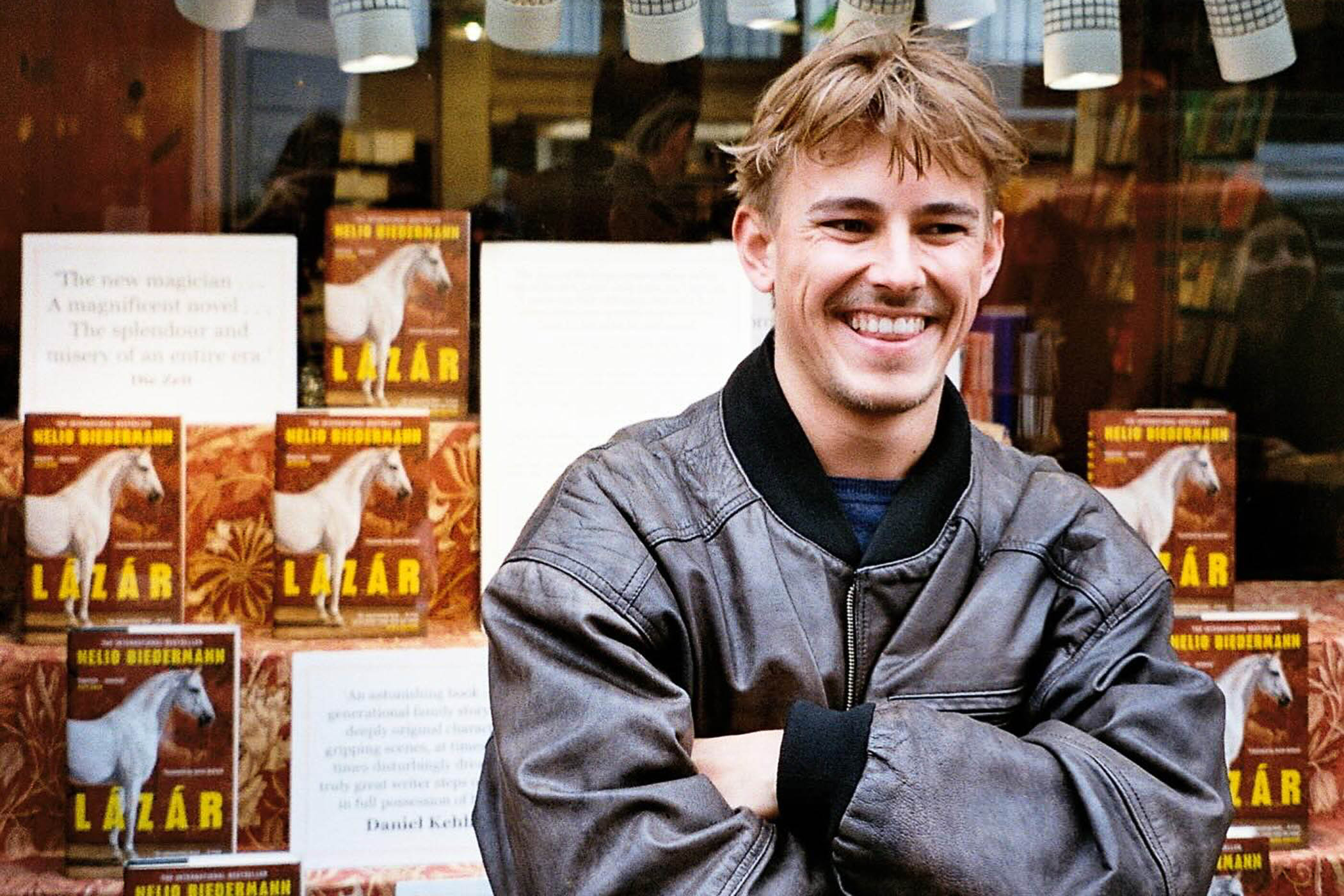



Before you hear about how shockingly young Nelio Biedermann is, how extraordinarily successful he is, both critically and financially; before you look in the mirror and curse him for your own choices, which you now realise are all failures, because they did not lead you to start writing a bestselling, globe-dominating novel at just 16 years old – just know one thing: his book really is very good. Annoyingly, incontrovertibly good.
His prose is so delicate and delicious, if only occasionally immature, that any critic who reads it feels compelled to compare him to the greats. So far, he’s got Thomas Mann, Gabriel García Márquez and Joseph Roth. I’d add in a bit of Emily Brontë with Dostoevsky’s romantic airiness. Biedermann’s novel, Lázár, is a sweeping historical epic, not mining particularly new material, but drawing from his own family legend. It follows the Lázár family, Hungarian aristocracy, across three generations and two world wars. We begin as the “snow of a dying century” falls on the birth of a baby, Lajos, who emerges from his mother with “translucent” skin. The baby glimpses the man “he would believe to be his father for his whole life and beyond”. The scene sets up all that is to come: infidelity, magical realism, love, the shockwaves of history, the brutal cold of winter and war, the fact that, like the translucent baby, Biedermann will show us the beating heart below the surface of the skin.
Biedermann is now 22, calling from the apartment he shares with his younger sister in Zurich. It’s the morning after he returned from an American press tour and he’s jetlagged, but graciously happy to be up before he returns to his college classes this afternoon. He’s been on and off press tours since his book was first published in Germany six months ago, selling 200,000 copies in its first few months alone, but this was the first crowd that properly cheered. “The Americans were so much more excited than anywhere else. It's nothing like the UK, or Switzerland, where we hold back our feelings,” he tells me. “They actually know how to express themselves.” In New York, he was hanging out with the rock star Patti Smith, who had been sent a proof of his book by his publishers and then reached out to him to tell him how much she loved it. Sharing a photo of the two of them in New York this week, she wrote: “Writers, readers, now friends.”
Biederman is bleary-eyed but gentle about all this fame. “When I’m in Zurich, my life hasn’t changed that much actually. I don’t have as much time as I did before, but that’s OK.”
He grew up in Switzerland, having a “pretty normal” childhood. “It was so normal that the first journalist I talked to from a German newspaper wrote, ‘There would be literally nothing to say about Nelio’s life, if he hadn’t written this book,’” he says with a grin. “I don’t think he was trying to be mean. It’s just true.”
Both his parents worked in tourism. “They couldn’t understand why I was doing it – nobody got it.” But he knew “there was something special in my ancestors; even if my life wasn’t that special”. His grandmother, Nikolett, whom Nelio lights up talking about, was the book’s inspiration. She had escaped brutal Soviet rule in Hungary in the 1950s, traversing a frozen river into Switzerland. The final generation of Lázárs in the books follows a similar plot.
By the time Biedermann was a teenager, Nikolett had dementia, “so her reality was so different”. She talked more. More about the past and her childhood. And Biedermann listened, though, he says, her stories “felt like fairytales or adventurous stories that she would make up and kind of put herself in them”. She’d tell him she was having coffee with his dead grandfather, before launching into an extraordinary tale of hiding from the Red Army. Until he was older, and she was gone, he “couldn’t really grasp that she actually went through all of this”.
That’s why he made his historical book a bit magical, because he wanted to recreate her grasp over many realities. “In a way, with her dementia, she didn’t just show me the story, but showed me how the story could work,” he says. “It almost felt like I didn’t choose to write it… the story was just there and so I wrote it down.” He shows me one of his lined, handwritten pages, cursive scrawled over with marks.
In the later part of the book, a young woman called Eva – who is fascinated by Woolf and Kafka – thinks about how writers write women: “She was less interested in women writers per se and more in the relationship between writers and their female characters.”
It’s a question the novel itself cannot quite answer. Biedermann writes his women sliced with trauma, and in true teenage boy fashion, fixates on sex, and rather gratuitously on rape. Female characters are described as “pillaged”, “wet”, “panting”. They return from the “woods” with blood on their thighs. One scene, in which the Red Army demands a girl for the soldiers’ pleasure, and the children sit and listen to the “whimper” of the maid their mother offers, is impossible to clear from your mind.
I ask Biedermann what drove him to write so much sexual assault, and he pauses to consider. “I’ve been thinking about it a lot, because at university, we just had this course on flashbacks and trauma in film, and how nowadays a lot of movies are kind of focused around traumatic events.
“I didn't want to include all of this just for entertainment, like A Little Life," he says, referring to the 2015 novel often referred to as “trauma porn”. “I felt a great responsibility when including this, because it was part of the truth.” When one of the book’s main characters is assaulted by a friend, she thinks of herself among the collective victims of this war: “It was said that millions of women and girls had been raped during the advance westwards, fifty thousand in Budapest alone.”
“I had to make a shift in my tone,” Biedermann says. “The other sexual encounters are often described in detail, but I felt like that wasn't appropriate for these situations. I knew I couldn’t.”
A recent, critical review of Lázár in the New Yorker pointed to these assaults, and the novel’s other violence, as evidence that any “lasting effects” of trauma in the novel “are impersonal and clichéd”. Grief-stricken mothers and wounded girl victims just sleep for days on end and wake up anew. “One of the worst things that can happen to a young and evidently talented author is to be lauded too enthusiastically too soon,” the critic Becca Rothfeld wrote. “Hopefully, Biedermann will not be spoiled by his plaudits. He has plenty of writing ahead of him and, God willing, plenty of time to make some of it genuinely new.”
But the fact that such a young writer has chosen to write fiction of such an epic scope is something genuinely new. As literary scout Martha French put it to me: “Most young writers, when they’re starting out, write something close to their own lives, about what it is to be young.” Biedermann’s age, she suggests, is great for marketing, but the achievement is something else entirely. It’s not just a “young guy writing about being a young guy”, like most debut fiction is. “And he’s not just having a go at a sweeping epic,” she says. “He’s actually done it – written a potentially quite enduring modern classic.”
The author of this potentially quite enduring modern classic has to run off to a linguistics class, so he bids me goodbye. His next book, he says, is set in the present, because he thinks he “can handle it now”. His own present, though, is stranger: a class to get to, the problem of being newly recognisable, and the dual pressure and privilege of having written something that might outlast him before he has even worked out who he is.
Photograph by Nelio Biedermann/Instagram
Newsletters
Choose the newsletters you want to receive
View more
For information about how The Observer protects your data, read our Privacy Policy