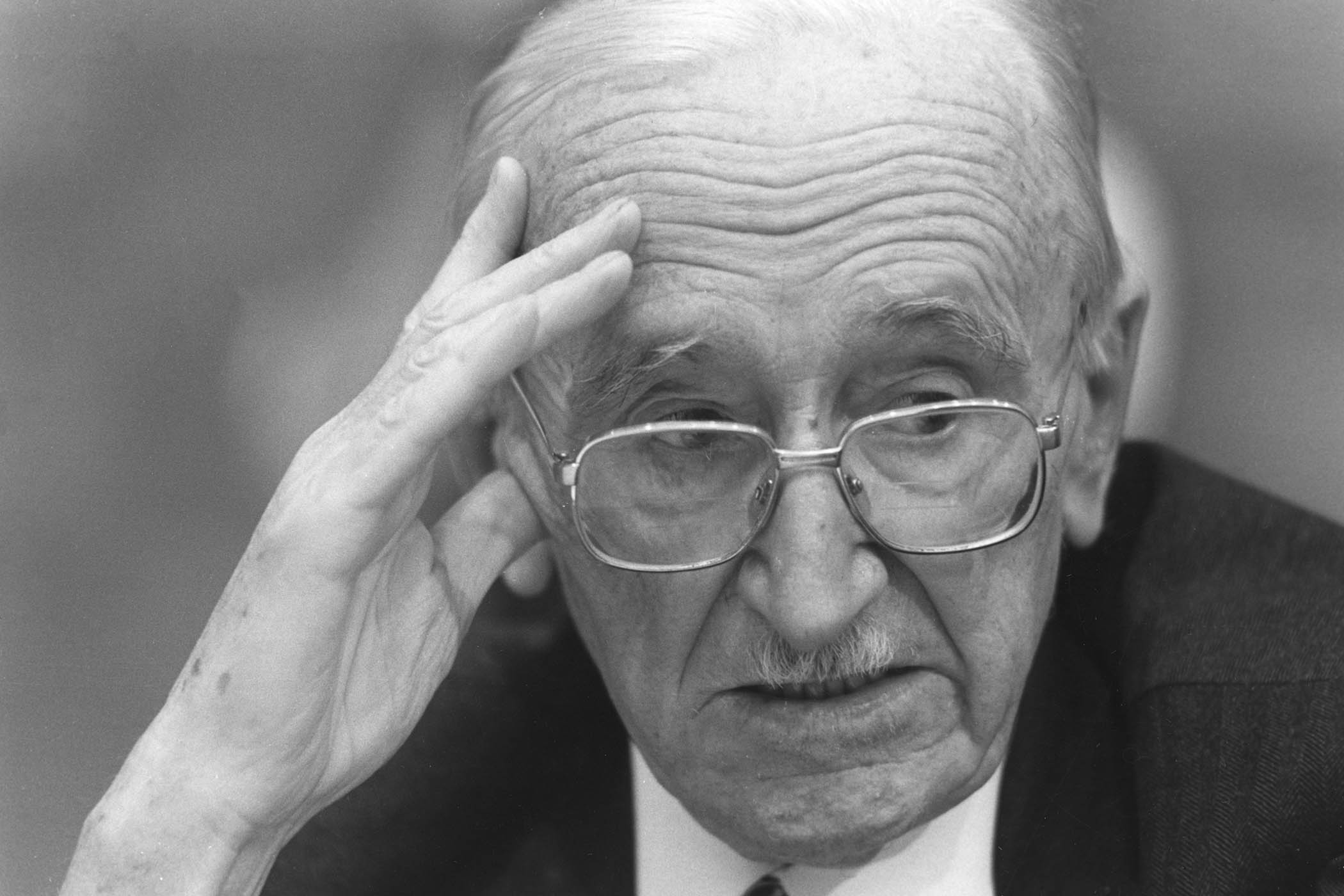



In his 1944 book The Road to Serfdom, the Austrian economist and political philosopher Friedrich Hayek argued that centrally planned economies, of the sort that were about to create Britain’s welfare state and the NHS, inevitably lead to totalitarianism. That this became the foundational text of the neoconservative movement is a familiar story. What’s new about the Canadian historian Quinn Slobodian’s take on Hayek’s influence is his assertion that today’s alt-right represents not a revolt against this strand of conservatism but its continuation. He calls it “the new fusionism”.
But what is it, exactly, that makes this new wave of conservatives bastards? So many reasons, but here is Slobodian’s: “I dub my cast of characters Hayek’s bastards because so many lapse into the very intellectual errors that Hayek himself diagnosed. Above all is the danger of what Hayek called ‘scientism’ and the ‘pretence of knowledge’. Both intentionally and not, these thinkers paid poor tribute to their master.”
His cast, as he calls it – bad actors to a man – includes the anarcho-capitalists Murray Rothbard and Hans-Hermann Hoppe; political scientists Richard Herrnstein and Charles Murray, whose 1994 junk science book The Bell Curve, in the words of a New York Times column published at the time, sought to drape “the cloak of respectability over the obscene and long-discredited views of the world’s most rabid racists”; Thilo Sarrazin, a once centre-left German politician whose bestselling Germany Abolishes Itself (2010) formed the intellectual core of the increasingly popular far-right AfD party; and the neo-Nazi and white supremacist Richard Spencer.
The book could have benefited from extra room to untangle its findings, but it’s undoubtedly a useful primer on the alt-right
The book could have benefited from extra room to untangle its findings, but it’s undoubtedly a useful primer on the alt-right
In his often thrilling account, Slobodian proposes the causes common to this disparate group can be boiled down to the “three hards”: hardwired human nature (racial determinism, as per The Bell Curve), hard borders (free trade yes, the free movement of people no), and hard money (Slobodian devotes a chapter to so-called “goldbugs”, noting that the history of US libertarianism “cannot be separated from the business of selling collectible coins”). They consider the state not something to be shored up but destroyed, although the second Trump presidency – its trade and shooting wars aside – is making the case for a stay of execution.
Up until the mid-1990s the breeding grounds for these ideas were found in a network of newsletters such as The Ron Paul Survival Report (“If Europe is united, a world government cannot be far behind,” serves to give the flavour), and advice manuals that promised to unlock the secrets of how to profit from the permanently imminent stock market crash. Slobodian doesn’t mention it, but Blood in the Streets: Investment Profits in a World Gone Mad, the 1987 book co-authored by William Rees-Mogg, father of Jacob, very much belongs in this category.
Despite the zealousness of those producing and consuming this literature, and the various groups and institutes that spread its teachings bankrolled by rich libertarians such as the billionaire Charles Koch, this more extreme strain of conservatism remained well outside the mainstream. Until, that is, the advent of the internet. Before its possibilities became available to him, a Thatcherite financial journalist turned white supremacist such as Peter Brimelow was, relatively speaking, a lone voice in the wilderness. But in 1999, with the launch of his radical anti-immigration website VDARE, his potential audience grew exponentially, allowing a community – and then a movement – to form. “What was once the world of niche magazines and newsletters,” Slobodian writes, “has grown over time to news aggregator websites, blogs, video streams, and social media feeds.”
Slobodian builds a case more than he tells a story, and Hayek’s Bastards, short and punchy as it is, could have benefited from some extra room in which to untangle its findings. But it’s undoubtedly a useful primer on the alt-right, and one that identifies a significant omission from most other critiques. To quote Horkheimer, as Slobodian does: “Whoever is not willing to talk about capitalism should also keep quiet about fascism.”
Hayek’s Bastards: The Neoliberal Roots of the Populist Right by Quinn Slobodian is published by Penguin (£12.99). Order a copy from The Observer Shop for £11.69. Delivery charges may apply
Photograph of Friedrich Hayek in 1980 by Laurent MAOUS/Gamma-Rapho via Getty Images
Newsletters
Choose the newsletters you want to receive
View more
For information about how The Observer protects your data, read our Privacy Policy