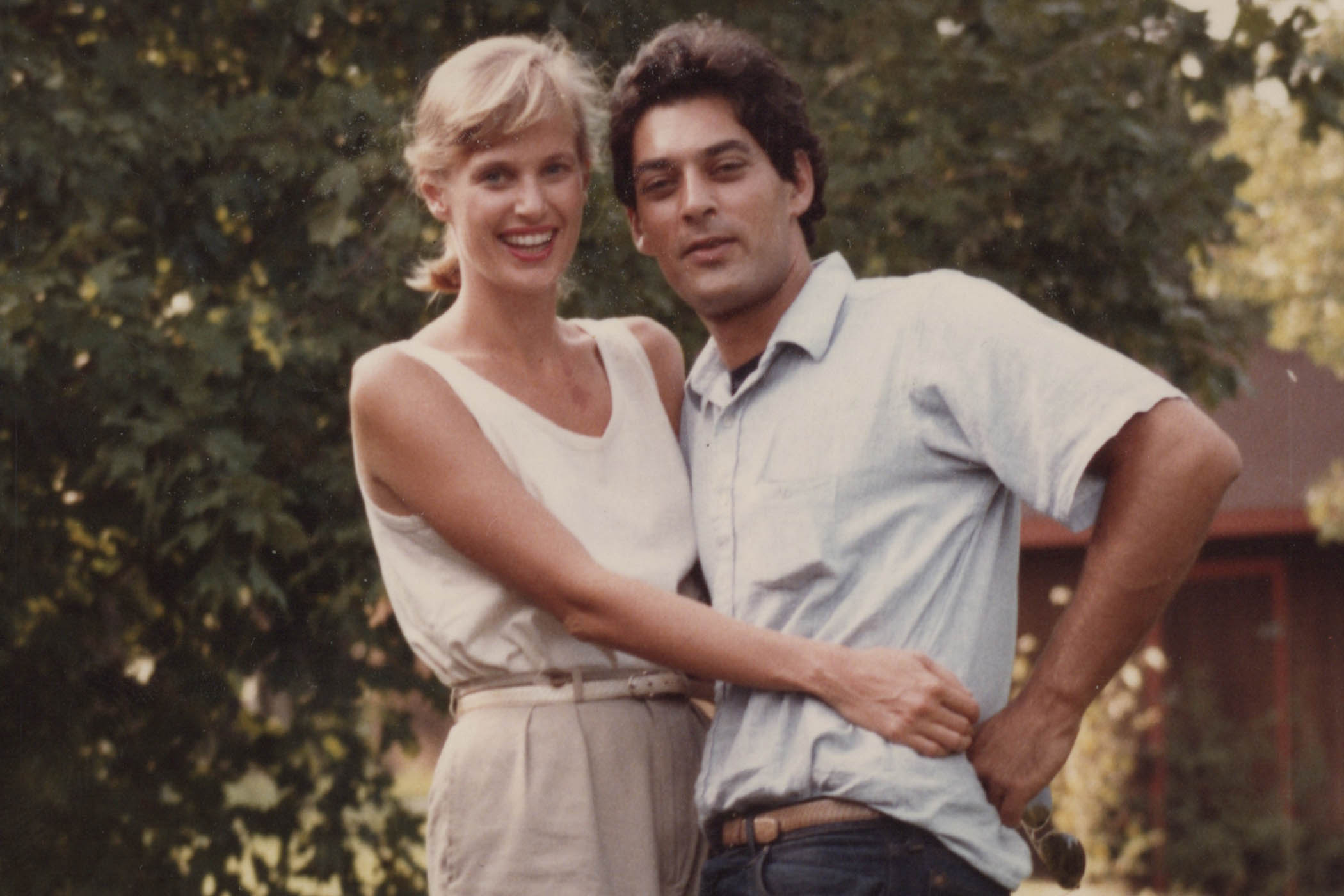

3 February 1981: Siri, a few days past her 26th birthday, attends the 92nd Street Y in Manhattan to hear the poet Ann Lauterbach read. Walking out of the theatre into the lobby with a friend, she later recalls: “I saw a beautiful man in a black leather jacket, his shoulders hunched, his expression inward, standing near the exit to the street. In memory, he has a cigar or a cigarette between his fingers. I can’t remember which. My attraction to him felt like a blow to the back of my neck.”
Luckily, Siri’s friend knew the beautiful man and could introduce them – he was Paul, eight years older, and, like the smitten Siri, at the outset of a quest to make a way in the world as a writer. “Later, Paul told me he had no idea what to make of the tall blonde in a jumpsuit, not at first, anyway.” In her beautiful memoir, Ghost Stories, Siri Hustvedt shares these shards of recollection as she reckons with the loss of her beloved husband, Paul Auster, who died following complications from lung cancer in the spring of 2024 at the age of 77.
A third of the way through this book – which is something of a diary, something of a meditation, something that allows a glimpse of Auster’s final and most personal work – Hustvedt gives the reader a moment that seems to turn back time, and not just because of the jumpsuit (“a gift from my ex-boyfriend – I felt chic in it”) or the huddled shared cab ride downtown to another party. Her impressions are fresh and precise yet utterly fragmented: she shows what it means when one half of a shared memory is devoured by death’s maw. “I don’t remember whose party. Grace Glueck pops into my head, but I could be wrong. Paul would have remembered.” There is nothing that feels retrospective in the conjuring of two young people on the cusp of who they would become. Fresh too is the raw sorrow of the widow as time switchbacks on itself, the present intruding into the bliss of the past.
These young people would go on to find great literary acclaim. Auster’s debut would be published the year after they met: The Invention of Solitude might also be said to be a memoir of loss, as it grapples with the death of the author’s father; up ahead was the New York Trilogy (first published collectively in 1987), the books that brought him wide renown. Hustvedt’s first published work, the poetry collection Reading to You, would appear in 1983; her first novel, The Blindfold, in 1992. She is a writer of astonishing range and depth: a memoirist and a novelist, a philosopher of experience of the kind more generally found in Europe than the United States. Her book The Shaking Woman Or a History of My Nerves (2010) is a scholarly and accessible exploration of the mind-body problem: five years after its publication, she was appointed a lecturer in psychiatry at Weill Cornell Medical College.
Hustvedt shows what it means when one half of a shared memory is devoured by death’s maw
Hustvedt shows what it means when one half of a shared memory is devoured by death’s maw
It seems necessary to give something of the background of these two writers, yet there is no need to know any of this to find solace and deep delight from the intelligence and humanity of Ghost Stories, its portrait of a marriage of true minds. Auster comes across here perfectly as he was: smart, funny, caustic, loving, idealistic – exasperated to the last by the politics of his native land. Hustvedt (who always looks so cool in her photographs, even when not dressed in a jumpsuit) reveals the nerves that co-exist with her grit and wisdom. The pair were married for 42 years: in Ghost Stories she paints both individuality and “intercorporeality” as the French philosopher Maurice Merleau-Ponty put it. (Hustvedt is the kind of writer who can confidently quote folks like Merleau-Ponty.)
CS Lewis wrote in A Grief Observed: “Sorrow … turns out to be not a state but a process. It needs not a map but a history, and if I don’t stop writing that history at some quite arbitrary point, there’s no reason why I should ever stop. There is something new to be chronicled every day. Grief is like a long valley, a winding valley where any bend may reveal a totally new landscape.” The delight to be found in Hustvedt’s book arises because so much of the landscape revealed is one of love. Love of life, love of the world, love of family.
Not long before Auster dies, his and Siri’s daughter, Sophie – an acclaimed singer-songwriter – and her husband, the photographer Spencer Ostrander, have a baby, Miles, and his grandfather is able to know Miles for the first few months of his life. Scattered throughout the pages are the “letters to Miles” that Auster planned to turn into a book; an effort cut short as his health deteriorated. They are family histories, written in an endearingly simple style. (“When you are old enough to talk, or at least old enough to understand a good part of what grownups and big children are saying to you…”) The letters act as a counterpoint to the tragedy that overshadowed Auster’s final years. Daniel Auster, Paul Auster’s son from his first marriage, struggled with drug addiction. Tragically, Daniel’s 10-month daughter Ruby died from ingesting heroin and fentanyl in November 2021, and he himself would die of an overdose while awaiting trial on charges of manslaughter and criminally negligent homicide.
Newsletters
Choose the newsletters you want to receive
View more
For information about how The Observer protects your data, read our Privacy Policy
“Love is not enough,” Hustvedt writes towards the end of her book. “Paul and I said this to each other often. We like to think love sews up every wound, but it doesn’t, not always. Paul doted, fretted, and prescribed warnings. He loved his son, and he hoped for his son, and he lived in fear for his son, but he lost all trust in his son … He held on for as long as he could.” Hustvedt has long considered how the physical and the spiritual can never be separate; it is not surprising that she wonders whether this grief at least accelerated her husband’s illness.
Hustvedt grew up in Minnesota, speaking both Norwegian and English: she notes that the Norwegian word for Christmas is Jul, “wheel”: “It doesn’t have a damned thing to do with Christianity,” her father used to say. She finds herself returning to the “two versions of time: time as the line of a single human life that ends in death, and time as a wheel that turns and includes the cycles of births and deaths. Bakhtin called these circling repetitions idyllic time.”
This notion of an idyll is one that encompasses loss as much as gain, grief as much as joy. Hustvedt, greatly to her cost and credit, gives the reader such an idyll. Ghost Stories deserves its place among the enduring accounts of sorrow and survival. It will console you for the losses you have suffered, and for the ones you know – we all know – are yet to come.
Ghost Stories: A Memoir is published by Sceptre (£22). Order a copy from The Observer Shop for £19.80 (10% off RRP). Delivery charges may apply
Photograph by Siri Hustvedt