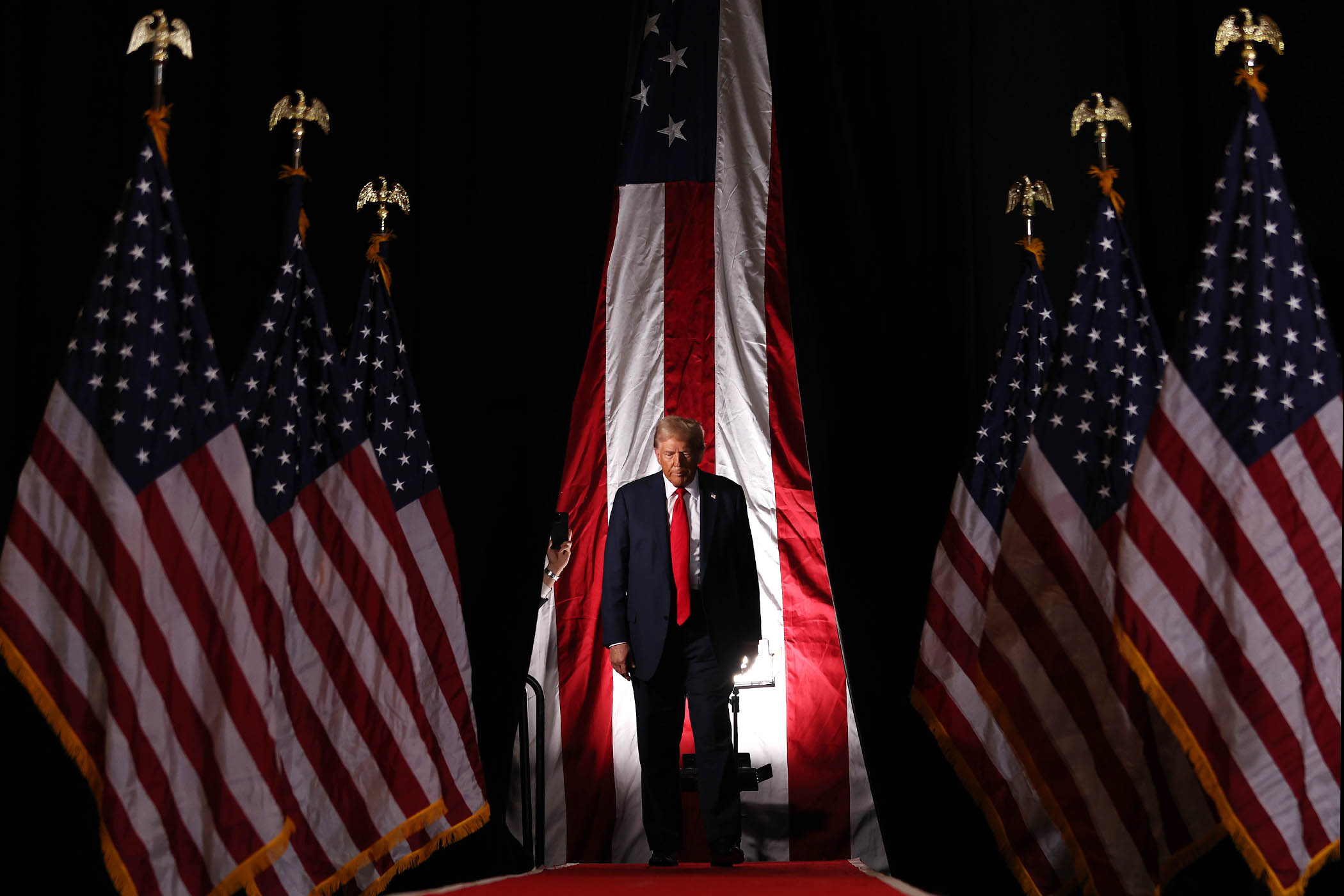



Edward Stourton is correct in noting, as he does in the introduction to his useful new book, that there is a unique excitement in studying American history and politics – and that’s even before we get to our immediate and volatile circumstances. “American history is the history of an Idea as well as a nation.” That idea (let’s leave aside whether it needs the capital letter Stourton gives it) has been examined explicitly since its founding: by the Americans of European descent who wrote the Declaration and the constitution and the generations who came after. At the dedication of the civil war cemetery in Gettysburg, Pennsylvania, in 1863, Abraham Lincoln acknowledged the ongoing and extreme nature of the experiment.
What did the founders mean when they wrote that “all men are created equal”? The answer has never been clear; in the 19th century, around 600,000 people were killed (an equivalent proportion of the US population today would mean 13 million dead) in asking the question. “We are now engaged in a great civil war,” Lincoln said, “testing whether that nation, or any nation so conceived and so dedicated, can long endure.”
As the “Donroe Doctrine” is enacted in Venezuela, we now seem to be at another inflection point of that test. (“We” as in we, the people of the US – but also of the world, as we are all affected by what goes on in America.) This is Donald Trump’s second presidency, and its character differs greatly from his first. From 2016 to 2020, Trump was still surrounded by much of the normal apparatus of government and was held somewhat in check. Project 2025, authored by at least 140 former Trump staffers and published in 2023 by the Heritage Foundation, a conservative-leaning thinktank, demonstrated an intention to replace what we perhaps naively think of as the rule of law with a new vision of government shaped by rightwing, authoritarian ideals.
And so, since his second inauguration, the president has ensured that those around him are loyal soldiers with little or no experience of government: Pete Hegseth, the secretary of defense, is a former television personality; Steve Witkoff, currently dealing with Vladimir Putin without the benefit of any advice from the CIA or even his own translator, is a real-estate developer. Since Trump’s second inauguration, US aid to countries around the world has been completely gutted at the price of hundreds of thousands of lives; universities have been threatened or blackmailed for maintaining independent academic curricula; ICE agents have stalked the streets of American cities, detaining and disappearing not only the “illegals” the president has in his sights but American citizens too. The list goes on.
Even if you know much of the history Stourton relates, you may be shocked to have it all set out for you so efficiently
Even if you know much of the history Stourton relates, you may be shocked to have it all set out for you so efficiently
The Trumpian revolution has been so swift and shocking as to seem unprecedented. Stourton, who has worked for more than 40 years in broadcast journalism for the BBC as well as Channel 4 and ITN, offers a slim guide aiming to show that much of this overreach is baked into the American project, or at least has been seen before. In little more than 200 pages, Stourton covers the Christian nationalist history of the US; the country’s imperial ambitions; its attitudes towards immigration and who gets to be “an American”; tariffs and trade; the politics of shutting down free speech and enacting revenge; and how the presidency sits within the framework of the law.
Even if you know much of the history Stourton relates, you may be shocked to have it all set out for you so efficiently. There is nothing new under the sun, alas. The Christian nationalism driving vice-president JD Vance finds its genesis in the fierce puritanism of the country’s earliest European settlers. If you are shocked by Trump’s designs on Greenland, recall Thomas Jefferson’s 1803 acquisition from France – for the bargain price of $15m – of 827,000 square miles of land west of the Mississippi River; the great historian Henry Adams said of Jefferson that he “made himself a monarch” of this new territory, which had been bought “without its consent and against its will”.
As Stourton writes, “the opening up of new lands allowed for the pursuit of early America’s two most objectionable addictions: the expansion of slave economies, a preoccupation of the south; and the ethnic cleansing of Native Americans, an enterprise for which most Americans seem to have shared an enthusiasm.” As to who gets to be an American: the country’s native inhabitants were treated as foreigners in the constitution, and were only granted US citizenship in 1924.
The tariffs imposed by President William McKinley in the 1890s (a great hero of Trump’s, along with the bloodthirsty and relentlessly violent Andrew Jackson, whose portrait now hangs in the Oval Office) and those of the Smoot-Hawley Tariff Act of 1930 prefigure Trump’s quixotic penalties levied on foreign imports to the detriment of the US economy; the McCarthyite witch-hunts of the 1950s offer an example for the shutting down of free speech – as guaranteed by the First Amendment – across the land. In essence, Stourton asserts that we may castigate Trump and be shocked by his administration’s actions, but there is nothing novel about them. We have been warned.
One might offer the criticism that in focusing on Trump, the author says nothing of the people who are driving this backward-looking agenda: his close advisers such as Stephen Miller and Russell Vought. But that, perhaps, would be a different book.
In closing, Stourton quotes the great American broadcast journalist Edward R Murrow, who reflected on the public mood at the end of his powerful 1954 broadcast aimed at the actions of Senator Joe McCarthy, his reds-under-the-bed witch-hunts casting a long shadow over the postwar period. “The actions of the junior senator from Wisconsin have caused alarm and dismay among our allies abroad and given considerable comfort to our enemies,” Murrow said. “And whose fault is that? Not really his. He didn’t create this situation of fear; he merely exploited it – and rather successfully. Cassius was right. ‘The fault, dear Brutus, is not in our stars, but in ourselves.’” He closed with his now famous signoff: “Good night and good luck.”
We may remember that McCarthy was, in the end, toppled by his own hubris and overreach. Good luck to us all.
Made in America: The Dark History That Led to Donald Trump by Edward Stourton is published by Torva (£20). Order a copy from The Observer Shop for £17. Delivery charges may apply
Photograph by Justin Sullivan/Getty Images
Newsletters
Choose the newsletters you want to receive
View more
For information about how The Observer protects your data, read our Privacy Policy