


In 2018, during the first presidential term of Donald J Trump, his secretary for defense, General Jim Mattis, is reported to have described the post-1945 international order as the “greatest gift of the greatest generation”. This invocation of history, Mattis was to conclude, ultimately fell on deaf ears. In stark contrast to many of his predecessors, the president and some of his political advisers had very little patience for this narrative about American leadership of the liberal world. It implied a burden that was no longer working for American interests, and was hindering its freedom of action on behalf of allies who had a far better part of the deal. By the end of the year, Mattis resigned – partly in dismay about Trump’s approach to the US-led alliance system – suggesting the president deserved someone in this position more aligned with his views.
There followed the presidency of Joe Biden, initially based around the theme of “build back better”, in which the story of the 1945 generation was understood. At the G7 summit in Cornwall in 2021, as No 10 foreign policy adviser and de facto house historian, I was tasked with talking the president through an original copy of the Atlantic Charter, agreed by Franklin D Roosevelt and Winston Churchill in 1941. Biden knew the story very well already. Among those present in the photographs of the meeting in Placentia Bay, Newfoundland, was the businessman, politician and diplomat William Averell Harriman, who served at Roosevelt’s side. Biden recalled how he had been mentored by Harriman when he first arrived in the Senate in the 1970s, giving him a direct personal connection to the creation of this postwar world. In hindsight, there is something almost quaint about these reminiscences. Whatever comes after Trump, this episode will never again play such a prominent role in the American strategic mind.
James Holland is a historian with a novelist’s skill in bringing the human elements of wartime experience alive, including feats of heroism and derring-do. He is also, with the “pub landlord” Al Murray, a popular podcaster with a democratic approach to the sharing of historical knowledge with a wider readership – a welcome corrective to the tendency towards atomisation and obscurity sometimes seen in the academy.
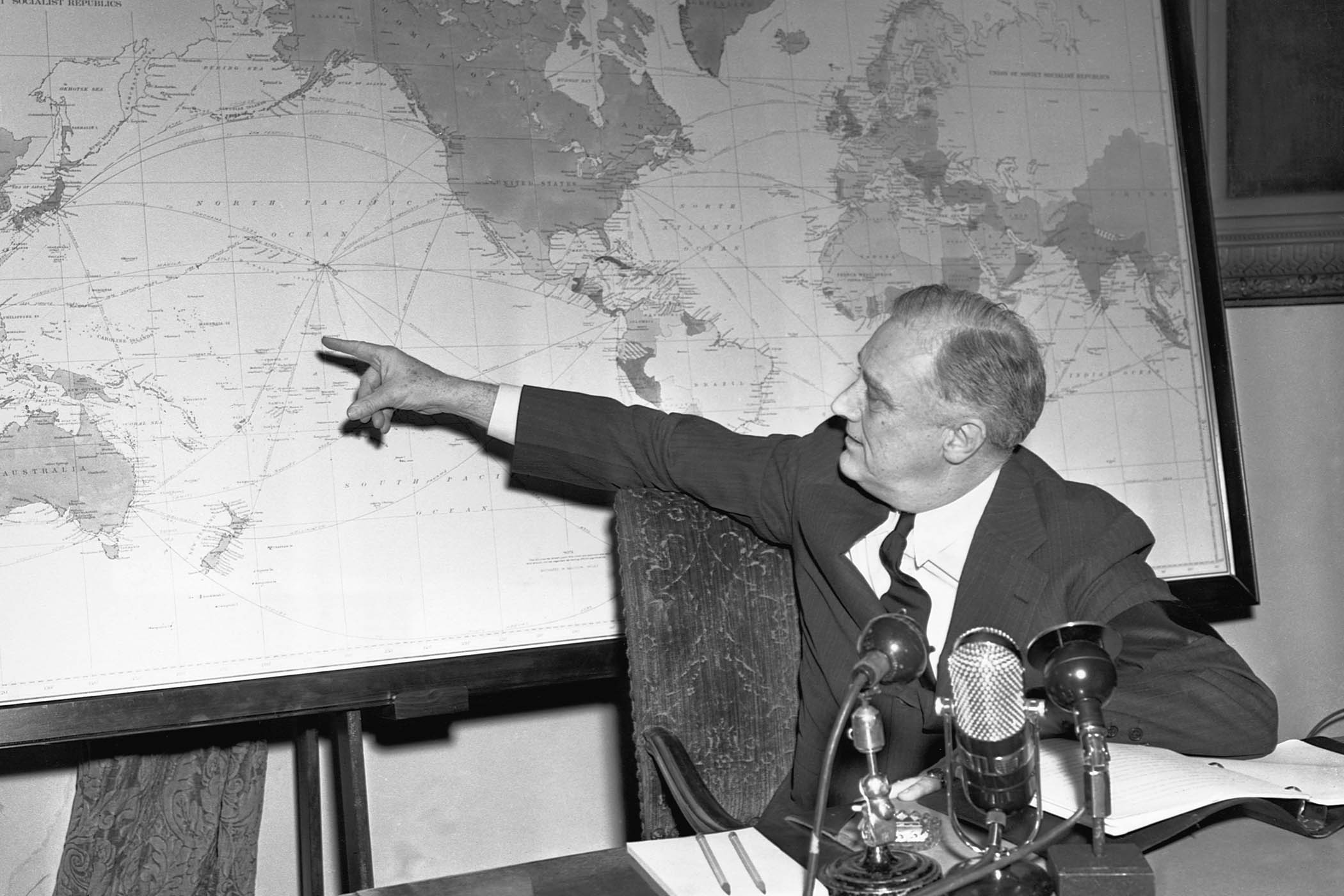
The book’s hero, Roosevelt, spoke of ‘unity, not division, of the good of man, not hatred’
The book’s hero, Roosevelt, spoke of ‘unity, not division, of the good of man, not hatred’
In this book, he charts the creation of the postwar international order, beginning with Woodrow Wilson’s visionary but flawed ideas at the time of the Paris peace conference following the first world war, working through the collapse of the League of Nations and then putting Roosevelt and Harry S Truman pride of place in the more successful attempt to create a new international system from the ashes of the second world war. Other visionaries praised by Holland include US treasury secretary Henry Morgenthau, secretary of state George Marshall and secretary of war Henry Stimson, with walk-on parts for political diplomats such as Harry Hopkins, Sumner Welles and Wendell Willkie.
As you would expect from Holland, the story is told with panache. It is a tribute to his skill as a writer that the book can be tackled in one sitting. It opens with a quote from Bernard Baruch, the financier and expert on wartime mobilisation who advised both Wilson and Roosevelt through the two world wars. “One of the errors that most frequently occurs,” Baruch wrote, “is failure to study and understand the records of the past.” In keeping with this, Holland’s book is unashamedly a plea for the west to rediscover the same “moral clarity” that animated these wartime internationalists. Right-thinking people of the world unite.
It is important to have order-makers given equal weight to the martial heroes through whom the story of the second world war is sometimes told. The painstaking diplomatic and technical work behind initiatives such as the 1944 Bretton Woods monetary agreement and America’s aid commitments to Europe in the 1948 Marshall Plan is no doubt less dramatic than Dunkirk or D-day, but their significance is arguably greater.
That said, as Holland is no doubt aware, the story here is one that will be familiar to most students and even amateur enthusiasts of 20th-century history. His book makes no attempt to challenge existing assumptions, explore new research or break new ground. Thus we get the familiar story of the harsh peace imposed on Germany in 1919 and the forward-looking intellectualism of Woodrow Wilson – a “man ahead of his time” and certainly ahead of the US Congress who refused to support American entry to the League of Nations. Just as the world seemed to be “moving forward” once again there followed the Wall Street Crash, rise of Hitler and descent into war. This sets the stage for the book’s hero, Roosevelt, who spoke of “unity, not division, of the good of man, not hatred”, and eventually coaxed America into saving the world.
Newsletters
Choose the newsletters you want to receive
View more
For information about how The Observer protects your data, read our Privacy Policy
The downside of this fluid but rather too neat account is that the story of the building of the postwar order comes across as less heroic, less visionary and less of a near-run thing. The Atlantic Declaration, a central pillar to the story, is only given a page and a half. The vast technical scaffolding that underlay the Bretton Woods conference and the Marshall Plan are barely explored. The book would have been improved by incorporating more recent work by scholars such as Andrew Preston, whose Total Defense tells the story of how the New Dealers fused social and national security together to create a transformative form of political economy that changed America and much of the world.
British readers may also find it surprisingly tilted towards the American experience, with few Brits mentioned aside from Churchill and John Maynard Keynes. A quick survey of the British experience would reveal the immense burst of intellectual energy that the wartime experience generated, with a flurry of radical ideas about how to reorganise the state and even the world. It would show how the great scientists of the age, including Julian Huxley, brought the world to London to discuss the role of scientific humanism at a perilous time in the war in September 1941, giving rise to the creation of Unesco, of which he was the first director general. It would show how the great historians of the era, including Arnold Toynbee, sought to mobilise the academic profession towards the challenge of creating a sustainable international order, learning from past efforts such as the treaties of Vienna and Versailles and feeding their ideas to the gnarly handed diplomats at the Foreign Office. It would show how fiction writers such as HG Wells and George Orwell envisaged both utopian and dystopian visions of the future, acting like a lighthouse for the political class.
A deeper exploration into this intellectual firmament would show how William Beveridge saw his war on poverty at home as perfectly synchronised with the campaign for the creation of a new world organisation. It may have mentioned that the Labour members of the wartime cabinet hijacked a copy of the Atlantic Charter telegrammed to London by Churchill to ensure that it was sufficiently forward-leaning on social welfare. Or that – in one of the best but lesser-known facts of the war – copies of the Beveridge report were found in Hitler’s bunker in 1945, having been dropped on occupied Europe to inform those under the Nazi spell that the allies were fighting for a better world for all.
Given the fraying of the international order today, this book is an important reminder of the vital role of political leadership and an all-too-rare form of statecraft based around certain immovable ethical goals. Ultimately, however, it provides only a partial view of the vast array of ingredients – from scientific knowledge to industrial production – that are required to complete the mosaic.
The Visionaries: The Making of the Post World War II Order in the West by James Holland is published by Bantam (£20). Order a copy from The Observer Shop for £18 (10% off RRP). Delivery charges may apply
Photography by Bettmann Archive/Getty Images