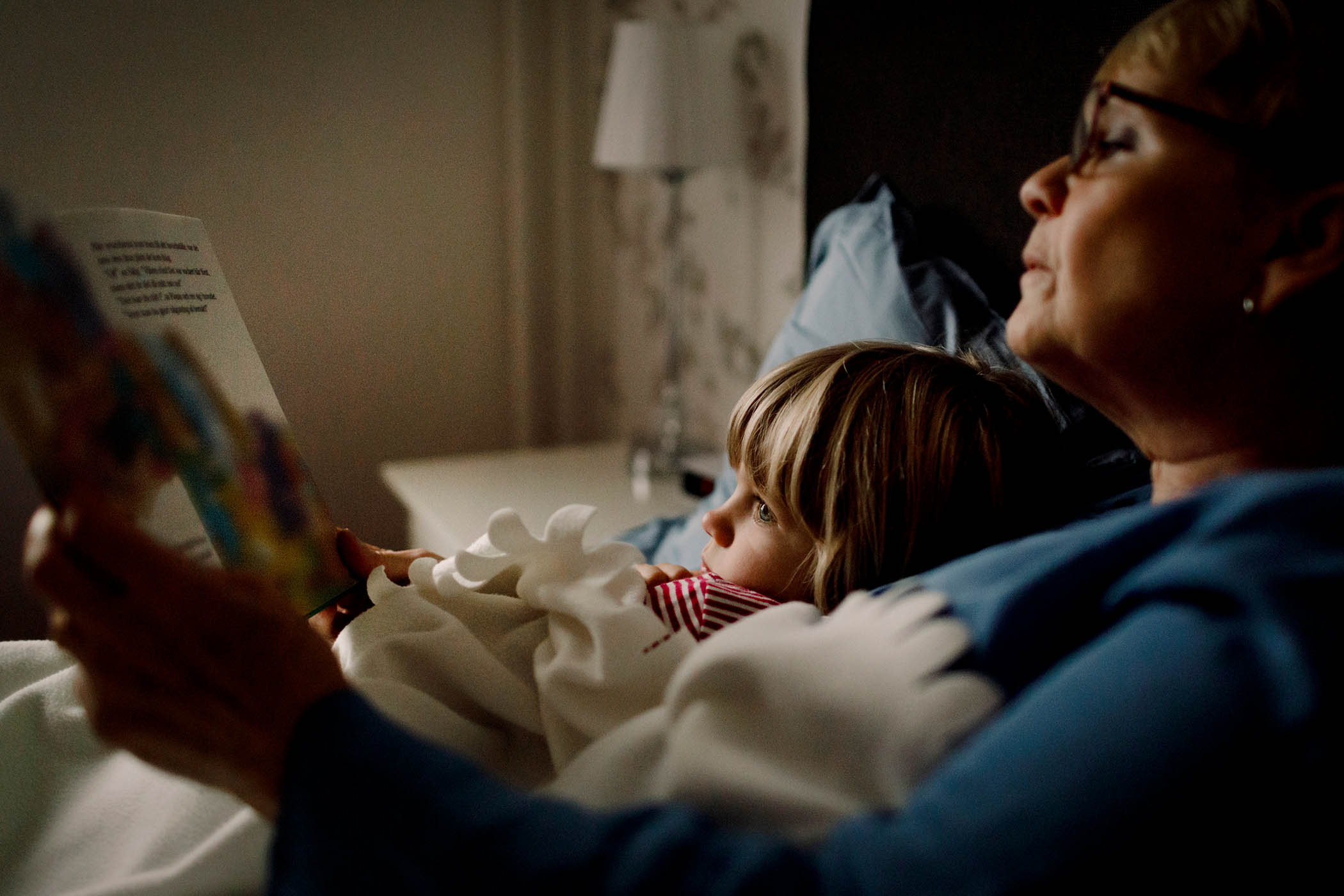

There was a time when my sister and I had only one request for bedtime reading: Judith Kerr’s The Tiger Who Came to Tea. Our dad gamely complied, recounting over and over again the same narrative of menace, charm, chaos, destruction, restoration of order and (crucially) chips and ice-cream for supper. After weeks of this, trying to keep things interesting, he began to disrupt his own readings by introducing bizarre and unexpected accents – my younger sister, with the sort of zero-tolerance outrage that only a four-year-old can muster, would quickly shut this down and insist he read “properly”. Eventually, he stuck a C-60 (look it up, kids) in the tape machine and recorded a reading – a homemade audiobook that would give us Tiger on tap, and allow him the occasional evening off.
Both of my parents read to us regularly, though my memory is that mum tended to opt for Kerr’s equally disturbing Mog in the Dark. I think of them every time I pick up a book and plonk myself down on the duvet next to my son or daughter.
The habit of bedtime reading is particularly on my mind today, World Book Day. Though for some it has come to resemble a nightmarish mass fancy dress party, built on the forced labour of parents and Amazon couriers, World Book Day is at heart a laudable initiative that puts books into the hands of kids. This year it has an added air of urgency: to reverse the decline in reading for pleasure among both children and adults, the government has designated 2026 the National Year of Reading.
Reading aloud to young children is agreed to be hugely beneficial in fostering a love of books, and it has been shown to increase not only literacy but empathy and creative thinking. It is, however, not a one-sided endeavour. As well as cherishing the one-on-one time with each of my kids, I admit I enjoy putting on a bit of a performance – with university drama days a distant memory and sellout readings of my bestselling novel a distant fantasy, there are few other opportunities to declaim to a captive audience.
The critic and editor part of me has also found it fascinating which texts withstand the pressures of repeated reads. At their best, they are indestructible. Take the magic of Max’s bedroom walls becoming “the world all around” and the wordless “wild rumpus” in the Where the Wild Things Are. Or the shattered Iron Man’s amputated hands scuttling around, finding his eyeballs. (Ted Hughes’s flinty prose is best enjoyed, we found, alongside Chris Mould’s beautifully rusty illustrations.) And let’s not forget Julia Donaldson’s gift to parents: with their polished rhyming couplets, her books practically read themselves.
At the other extreme, some “beloved” children’s books revealed themselves as essentially unreadable. I devoured the Famous Five books as a child and yet, reading them aloud to my daughter, I discovered the sentences were as mind-numbingly procedural as the action, and seemingly half of them consisted of lists of foodstuffs. “Lettuce, tomatoes, onions, radishes, mustard and cress, carrot grated up – that is carrot, isn’t it, Mrs Penruthlan?” (Penruthlan, a “plump little woman”, neglects to confirm, but for those worried about condiments we soon learn, reassuringly, that “There was a big bottle of home-made salad cream”.)
Once my children started reading by themselves, bedtime stories became less frequent. Other distractions began to take over our evenings. But, missing our sessions and bothered by all the great books I thought I’d get to share with them but hadn’t, I recently started to read aloud again: with my 10-year-old son, Michelle Paver’s Wolf Brother, and with my 12-year-old daughter, Philip Pullman’s Northern Lights. It is certainly not some sacrosanct daily ritual. Often I’m too late, or they’re too tired, or the time is sacrificed in favour of an episode of Stranger Things. Our progress with Pullman has at times been as slow as a glacier off the coast of Svalbard. But when we find that precious 15-minute window open, we eagerly clamber through it.
They are appreciating anew, I think, the concentration of the two of us, a text and a darkened room. I certainly am. We are there with the boy Torak and his wolf cub companion in the forests of the stone age, facing dark forces beyond his – or our – understanding. Paver’s writing is richly specific, and my son demands we stop occasionally to Google images of red ochre or pignuts. She also knows how to end a chapter. If it’s too exciting, my son demands we read the first paragraph of the next section, so he doesn’t have to go to sleep hanging over the cliff-edge. I first read Pullman’s His Dark Materials series as an adult, but it’s a joy to return to his extraordinary world of daemons and armoured bears with my daughter, though the dense thickets of explanation of the inner workings of the story’s religious authority, the Magisterium, is a reminder that these novels aren’t really children’s books in the conventional sense.
What I’ve realised is that although I know it’s good for my children, that’s not really why I’m doing it – or at least not the full reason. I’m doing it for the feeling of devoting my full attention to a story and losing myself in the rhythms of its language. I’m doing it to be, briefly, away from all the other demands on my attention and in a place of pure story.
We have stripped pleasure out of our school English curriculum and created a tech landscape engineered to pull children away from focused reading. Is it any wonder that young adults are turning up at university unable to finish books? Reading aloud is one way of arming children with the literary tools to survive in this hostile environment. But parents and adults are also at the mercy of the attention economy. We are equally in need of methods of resistance.
Newsletters
Choose the newsletters you want to receive
View more
For information about how The Observer protects your data, read our Privacy Policy
My parents still read aloud to their youngest granddaughter, my sister’s child. During the pandemic my dad read The Hobbit to my daughter every night over Zoom (I marvelled at his ability to give different voices to the 13 dwarves). It makes me hopeful that it can continue for me too: that there’ll be excuses to meet Judith Kerr’s tiger again, to step out once more into the dark street and walk to the glowing cafe, and the promise of chips and ice-cream for dinner.
Photograph by Getty Images