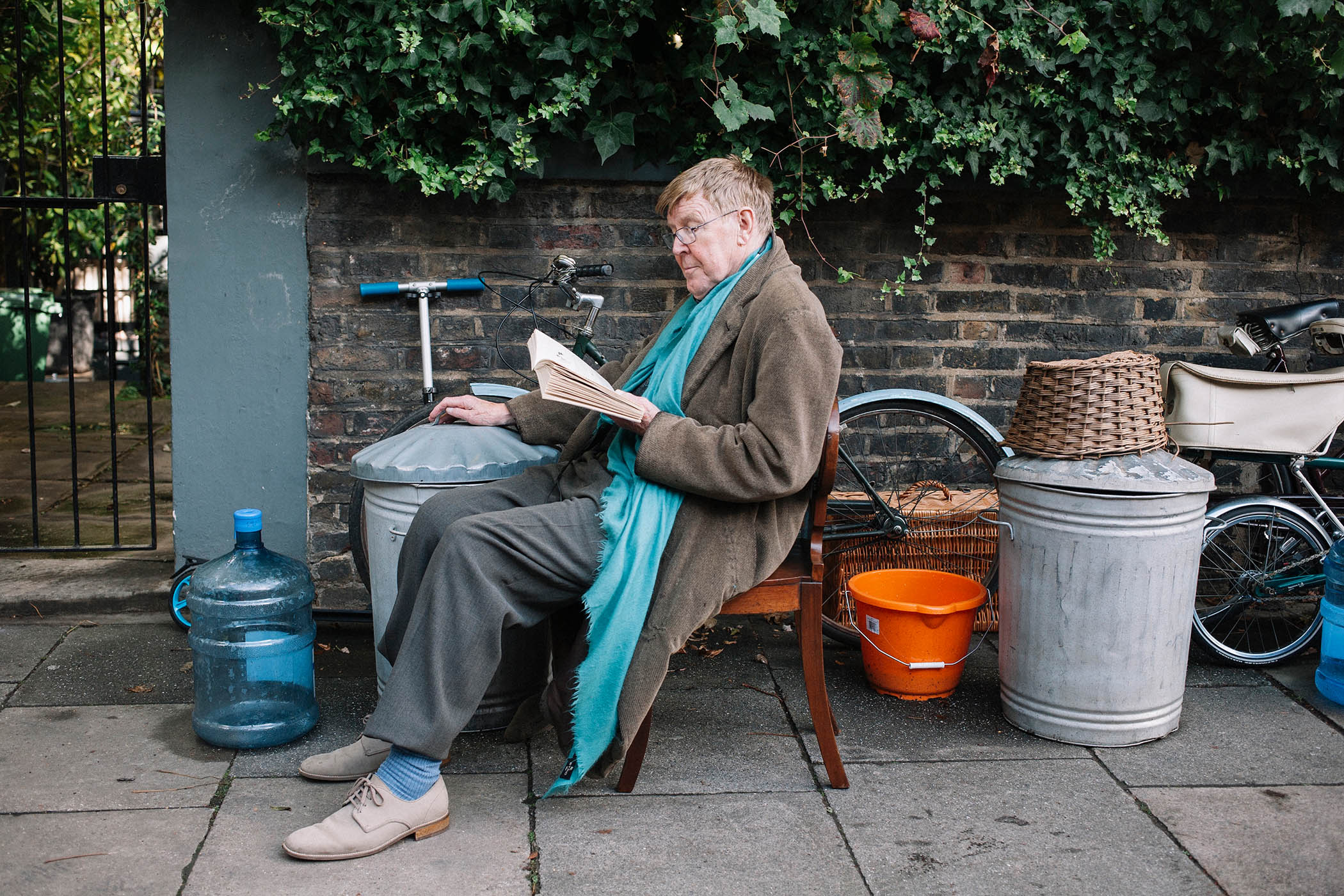
This is the fourth collection of Alan Bennett’s diaries, covering the years from 2016 to 2024, when he turned 90. As he admits in his introduction, “I have said everything before”, and most of the diaries have already been published in the London Review of Books. But it’s still nice to have them collected in one immaculately produced volume.
Inevitably they record a process of physical decline. In 2016, he is still walking every day in Regent’s Park and riding his bike to the shops. But in 2019 he falls off his bike three times and decides that his cycling days are numbered. “The word that most describes me at this point is gingerly. I’ve joined the limping proletariat.” By the end, he is in a wheelchair, and suffering badly from arthritis. But he can still write, observe and reminisce, which he does so deftly in these diaries.
The pattern of his life is already established. Bennett and his longtime partner, Rupert Thomas, live in Primrose Hill, north London, and go by train to their cottage in Yorkshire most weekends. They both enjoy visiting churches and rummaging in antique shops. They’ve been together since 1991, though Rupert only moved in with Bennett when he had bowel cancer in 1997. Rupert edits The World of Interiors; Bennett is still writing plays that his good friend Nicholas Hytner directs.
Being by now a national treasure, Bennett is recognised wherever he goes and strangers ask him for selfies. He is happy to chat and entirely democratic in his friendships. Debo, the late Duchess of Devonshire, was a friend but so too are the local binmen – he hopes the handsome one, Lou, will come to his funeral. He is hugely touched when the wheelchair team at Leeds station give him a card for his 90th birthday, and cries with pleasure when the village bellringers say they want to ring a peel of bells to celebrate: “I rejoice in the compliment and what’s more don’t intend to be modest about it.” But, as he admits in another entry, “with me, nothing has anything to do with modesty”. His public image is all self-deprecation but the diaries reveal enduring ambition and a keenly competitive streak.
He says that his writing muse is always Hytner, who has directed most of his plays and is “the only one I want to please”. “It was never Rupert, whom I love beyond work and who would not care if I never write another word.” Bennett in turn doesn’t seem much to care when Rupert suddenly resigns from The World of Interiors in 2021 after 21 years in the job. He is simply pleased to have him at home more. “I have become totally dependent on the kindness of Rupert.”
Bennett admits in one entry: ‘With me, nothing has anything to do with modesty’
Bennett admits in one entry: ‘With me, nothing has anything to do with modesty’
Oddly, he says, “I don’t feel I belong in literature ... I don’t enjoy books enough.” A teenage job in a bookshop gave him “an early and useful vaccination against the charm of books … Books are manual labour.” But still, he’s always good on other writers. “What puts me off about PG Wodehouse is his resolute flippancy, his stubborn unseriousness.” With Graham Greene, it’s “the Catholicism showing through and his frequent ‘rare’ interviews”. He has misgivings about Oliver Sacks as well as Jonathan Miller (“neither of them quite telling the truth”.) His feelings about Miller are altogether complex. They knew each other from Beyond the Fringe and it was Miller who found him the house in Gloucester Crescent where he lived for 40 years. But he has to bite his lip when Miller boasts that his Mikado has had nearly 300 performances – Bennett’s History Boys had more than 2,000. When Miller develops Alzheimer’s, he visits him dutifully and promises to read a poem at his funeral. But he is ill himself when that takes place and doesn’t attend. He seems more upset by the death of Barry Cryer: “Sheer sorrow. No mixed feelings.”
He expresses conventional fury at Brexit and Boris, then Trump, but has nothing to say about Jeremy Corbyn or Keir Starmer. His interest in politics seems perfunctory at best. But he is deeply interested in the NHS – he has no private health insurance – and when Talking Heads is revived on television he donates the royalties in its direction. He claims towards the end that “one of the few circumstances to change my mood is if I’m paid money … I am to be bought, along with everyone else.” But actually he almost never talks about money, beyond remembering what he paid for a certain plate or jug in an antique shop.
Most of his reminiscences are about his boyhood in Leeds and his strong religious convictions – he was still saying his prayers every night when he went to Oxford in the 1950s. He had crushes on other boys but never declared them; it would be many years before he came out as gay. But he does sometimes refer to an early love, “K”, and he and Rupert are apprehensive when, in 2021, they learn that K is publishing his autobiography. It reveals him to be Keith McNally, now a famous New York restaurateur but once an actor who had an affair with Bennett when he was in the cast of 40 Years On. Bennett and Rupert are nervous when McNally invites them to his flat but the meeting goes well and Bennett is “actually rather flattered” when McNally posts a photograph of them together on his Instagram. Fancy Bennett having heard of Instagram!
In 2017, he says he can’t understand why writers tweet (“What is the sense of pissing away every thought on a tweet?”), but later admits: “This diary, I suppose a belated Twitter.” It’s better than that: nicely paced, artfully varied, seldom repetitious. But whether it reveals the real Alan Bennett as opposed to his carefully curated public image is open to doubt.
Enough Said by Alan Bennett is published by Profile Books, £25. Order a copy from The Observer Shop for £21.25. Delivery charges may apply
Newsletters
Choose the newsletters you want to receive
View more
For information about how The Observer protects your data, read our Privacy Policy
Photography by Nicola Dove/John Springer Collection/Getty Images