

Every so often we are reminded of how many familiar expressions in our daily talk derive from Shakespeare or the King James Bible of 1611. We may not quite live in a world where a Bertie Wooster-type can rattle off verses from the more obscure psalms without a second thought, thanks to an expensive and not very practical education. But we still unthinkingly talk about left hands not knowing what right hands are doing, or lights under bushels, or falling from grace, or manna from heaven, or putting words into someone’s mouth: all of them as firmly located in the 1611 translation of Jewish and Christian scripture as breaking the ice or wearing your heart on your sleeve are in Shakespeare. Even if not many of us could now confidently tell you which sayings were from Shakespeare and which from the Bible, there remains a deposit of verbal tics that give off the distant echo of an imaginative world that we once shared more fully.
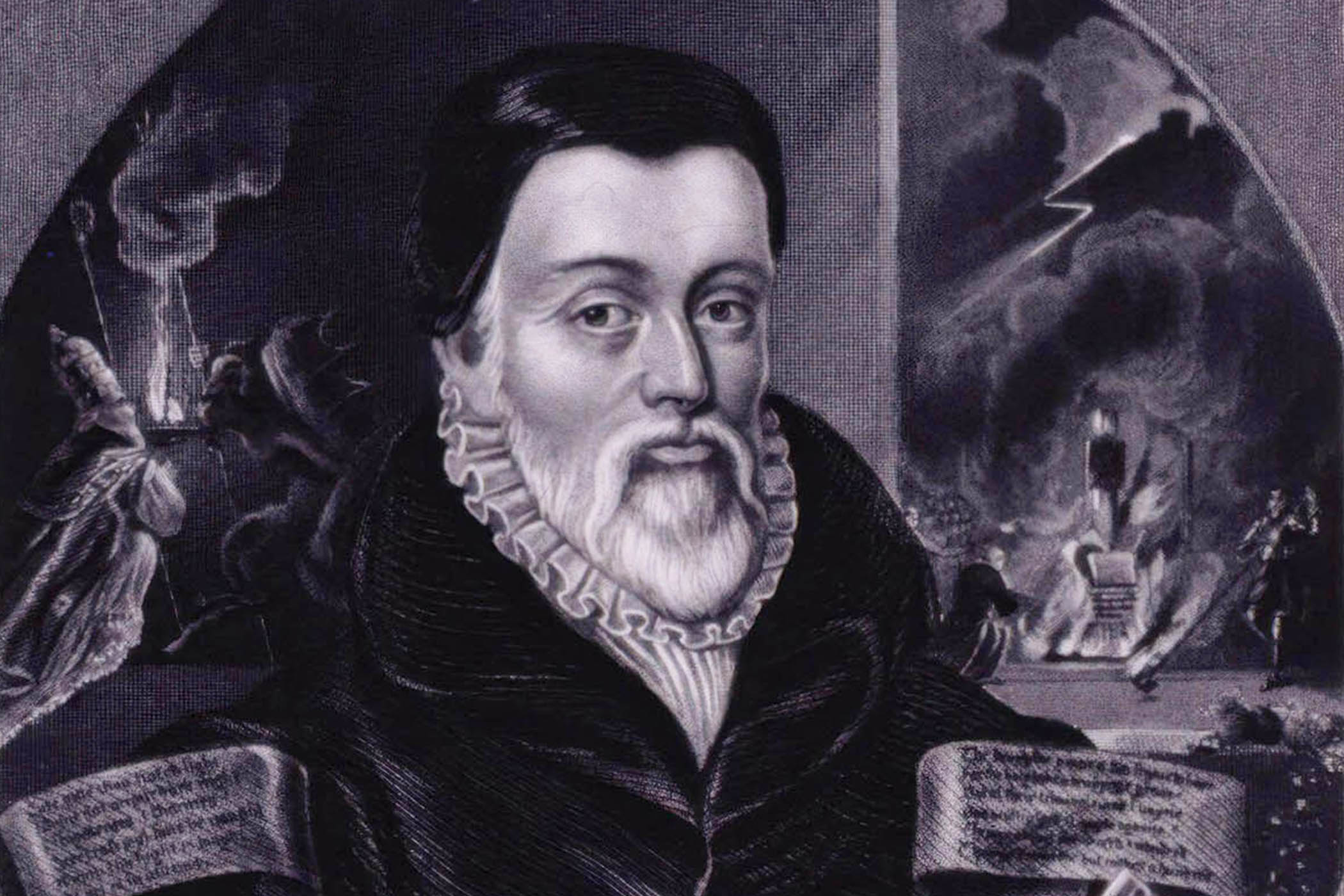
The 1611 Bible, though, did not come from nowhere. In recent decades there has been plenty of work on the prehistory of its idioms and rhythms. Most significantly, the debt of the 17th-century translators to one particular predecessor has been lovingly and exhaustively traced. William Tyndale, born in Gloucestershire in 1494 and executed for heresy in what is now Belgium in 1536, was the first to attempt a full translation of the Bible directly from the Hebrew and Greek originals into vernacular English. His brutal and relatively early death meant that his original hopes were not fulfilled. But between 1524 and 1536, working mostly in self-imposed exile in continental Europe (unauthorised biblical translation in England was assumed to be the gateway drug to serious heresy), he succeeded in completing a version of the New Testament and a substantial portion of the Old, rendered in lively, conversational English – designed, as he is supposed to have said, to be read by “the boy that driveth the plow”. This year, the 500th anniversary of the first printing of Tyndale’s New Testament in 1526 is being marked with events around the country and exhibitions at the British Library and St Paul’s Cathedral.
Tyndale’s work was heavily used by later translators, though the precise extent of their borrowing is not easy to quantify. David Crystal, a scholar of linguistic history whose copious works reveal a man delightedly in love with the story and sound of words, offers in this enthusiastic study a suite of new methods for assessing the scale of the debt.
Some have claimed that 80% of the King James text is, more or less, Tyndale; Crystal concludes that this conventional estimate is in fact not too far off. But what the later chapters of his book spell out is how exactly we can measure this. Beware, Crystal says, of over-mechanical methods of stylometry (the study of linguistic style), the kind that AI programmes are best at. You may find that you under- or over-estimate continuities because not every scan will be able, for example, to spot that a word may appear in both hyphenated and unhyphenated forms, or to understand the significance of a variation in word placement. The difference between “Unto the pure are all things pure” and “Unto the pure all things are pure” is not a break in translation practice, but more like a judgment about oral rhythms.
One of the most intriguing chapters here deals with just this issue. We remember verbal items in clusters organised by patterns of stress – and by a kind of homing instinct in the human ear for natural sequences of sounds, especially vowels. The maddening “See it, say it, sorted” of railway announcements shows how we still employ this kind of patterning, which is partly instinctive, and partly (in Tyndale’s day) deliberately cultivated and polished in training for public speaking. The famous “still small voice” of the King James Bible – “And after the earthquake a fire; but the Lord was not in the fire: and after the fire a still small voice” – is only one of such sequences. “A small still sound” would mean much the same, but its clarity and impact is lesser; something to do with the natural movement of the original vowel sounds from broader to narrower, mirroring a physical process of reduction.
Tyndale’s relish for vivid street-level usage made him perhaps the best English prose writer of his age
Tyndale’s relish for vivid street-level usage made him perhaps the best English prose writer of his age
Crystal offers lavish detail of how such memorable phrases work, how – in Tyndale’s own writings – the absence of modern punctuation means that these rhythms have to do the work of punctuation marks by tacitly guiding the voice to align with certain groupings of words. The very sound will tell you that a pause or a climax or a conclusion is coming. (That last phrase – ”a pause or a climax or a conclusion” – illustrates the point: three words with different, increasing numbers of syllables, a sequencing of vowels and a bit of alliteration to help the memory.)
But Crystal’s aim is not simply to refine arguments about the percentage of Tyndalian phrases in the 1611 text. As his title states, he is presenting Tyndale as a uniquely rich source for the vocabulary and idioms of the language as a whole – a very ambitious task, but one that he carries through with aplomb. He is not saying that Tyndale is responsible for coining the huge and random assortment of words and phrases that (according to the Oxford English Dictionary) are first evidenced in his works. We simply don’t know whether Tyndale depends on earlier writings that are now lost. But Crystal is emphatically arguing that Tyndale was an unusually good listener to the music of contemporary speech, with a knack of picking up bits of unintended vernacular poetry. “We see it, had we but half an eye,” “I … bade him farewell for our two lives, and (as men say) a day longer.” This relish for vivid street-level usage is what made him not only such a brilliant translator but more generally perhaps the best English prose writer of his age.
The late David Daniell in his full and engaging 1994 biography of Tyndale brings this out in his discussion of how he clashed with his great Catholic opponent, Thomas More. Tyndale and More were both thoroughly familiar with the conventions of public argument and rhetoric; both would be accustomed to applying these conventions when writing or speaking in Latin, but both would be feeling their way in English, where there was not much of a playbook for good and convincing prose. More tends to ramble: his sentences trailing on, not without vigorous and memorable patches, but with little structure overall. Tyndale seems to listen better, to work with a sense of how even baggy and unpunctuated sentences find a kind of energy through the right grouping of words. While Daniell’s treatment is shamelessly and gleefully partisan, it is hard to deny that Tyndale wrote with more concentrated gusto.
Some recent scholarship has pointed out that the exchange of discourtesies between these two formidably brave and intelligent men was not entirely a dialogue of the deaf. Both men were completely committed to the idea that the Bible needed a community to read and understand it; Tyndale was not (any more than Martin Luther was) the kind of Protestant who believed in a free market of individual biblical interpretation. But for More this had to be controlled by the guardians of the structural life of the church – the apostolic ministry of bishop and pope. For Tyndale, passionately committed to the dignity and the needs of the disadvantaged (about whom he wrote some of his most abidingly powerful theological work), the reading community was to be found in a local gathering of believers, all acknowledging the Holy Spirit in one another.
For More, religious truth needed continuity, “the democracy of the dead”, as GK Chesterton defined the idea of tradition. For Tyndale, the danger was that the democracy of the dead silenced the voices of the living, especially when mediated by a self-interested clerical bureaucracy. But neither man was an individualist, and both understood that if your beliefs depended on divine revelation rather than human authority, this was liable to put you at mortal risk when faced with political powers determined to secure conformity at every level of mind and spirit.
Newsletters
Choose the newsletters you want to receive
View more
For information about how The Observer protects your data, read our Privacy Policy
Both nursed hopes of church reform implemented by a godly ruler; More saw such hopes shattered when the “godly ruler” – Henry VIII – decided that he had unchallengeable authority over the spiritual realm; he died for his refusal to compromise. Tyndale died praying that God would “open the king of England’s eyes”; though that king had no time for the carefully qualified limitations of royal absolutism that Tyndale had argued for, or for the idea that the rich were morally and spiritually accountable to the poor for the latter’s wellbeing.
More and Tyndale believed in the church, and their literary work shows that both were drawing on an existing tradition of vernacular writing about spiritual matters in the late middle ages – which included translation and paraphrase of biblical texts. It is one theme about which Crystal might have said just a bit more. But More and Tyndale cared deeply about how the eternal truth of their faith could become natural – “homely” in the word beloved of the 14th-century visionary, Julian of Norwich – to the ordinary layperson. For More, paternalist and conservative, that “ordinary” Christian needed tradition and authority to provide protection and education. For Tyndale, who was much more radical, translating the Bible was an act of trust and respect towards the common folk whose language he so relished and whose powerlessness he so deplored.
It is not a tension that will go away in a hurry, in religious institutions or outside them. What Crystal has done is to show how deeply and persistently the business of communicating political and religious vision alike is bound up with how closely we listen to the speech of our neighbours.
William Tyndale and the English Language by David Crystal is published by Bodleian Library (£25). Order a copy from The Observer Shop for £22.50 (10% off RRP). Delivery charges may apply
Photograph Penta Springs Limited / Alamy Stock Photo