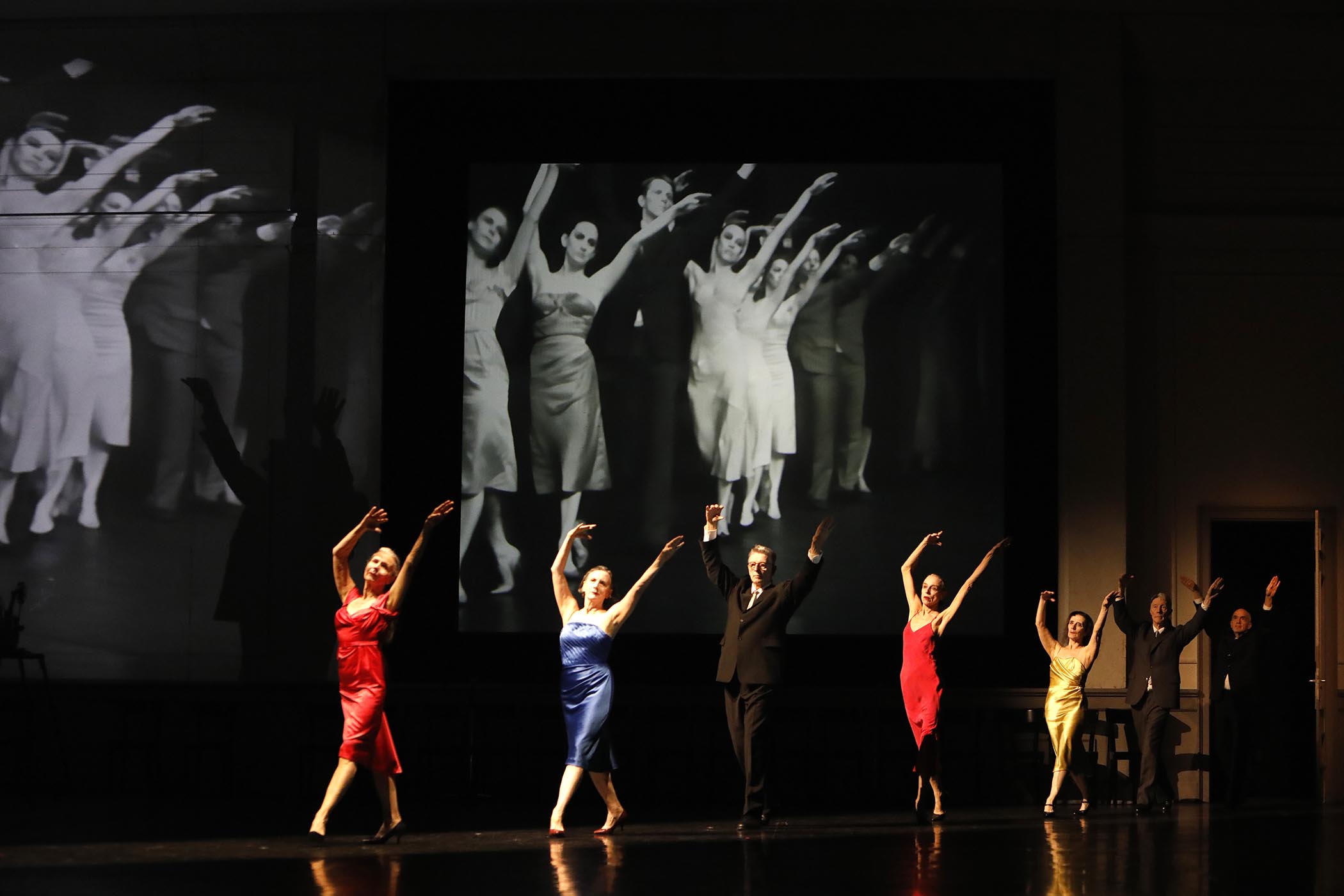

A 76-year-old woman in a red silk frock stands at the front of the stage, smoothing the fabric over her hips, checking her teeth in an imaginary mirror. She looks up. Above her, projected on to gauze, towers an image of her younger self, performing the same gestures. It is as if she is haunted by her past, but also having a conversation with it.
The woman is Josephine Ann Endicott, one of the original cast of Pina Bausch’s Kontakthof, a coruscating study of the relationships between men and women and the rituals that bind them together, set in a grey panelled dance hall (designed by Rolf Borzik) with chairs around three sides and a curtained stage at the back.
The genius of Meryl Tankard’s Kontakthof – Echoes of ’78, performed at Sadler’s Wells as part of the Elixir festival, is that it brings together nine of the original cast (though one was not dancing at the performance I saw), now all aged between 70 and 80, and sets them in dialogue with the black and white film of their performance in 1978, when the piece premiered.
The effect is both melancholy and inspiring, an assertion of the persistence of the human search for contact – and a poignant reminder of just how much is lost with the passage of time, as the dancers move more stiffly through moves that once seemed easy.
Each takes the part they originally performed; the film fills in the gaps of the wild interplay of Bausch’s choreography and the German songs from the 1930s it is set to. The action is beautifully shaped between frenetic movement and moments of introspection.
Tankard has cut the running time in half, so the intricate structure has changed. What is left are reflections of the past as they are absorbed into the present. When Endicott looks up at her cheeky younger self sashaying about the stage, she remarks: “Isn’t she sweet?” then adds, “She can still dance and no one can stop her” and moves off, with tireless energy. At another moment, Tankard stands alone on stage as the film shows the disturbing section where all the male dancers of the company used to surround her, pinching and poking her for what feels like hours. Her face still records the horror.
But it is the absences that are most profound. When 79-year-old John Giffin begins to waltz, his partner is no longer there, and he is left stroking an imaginary cheek. At the close of the first half, the dancers talk directly about what they do every day. When Beatrice Libonati, 71, says: “Every day I pray for Jan … I love him,” she is talking about her late husband, the wonderful Jan Minařík, whose charismatic presence still shines in the grainy images.
Finally, as they take their curtain call, they are joined by the spectre of Bausch herself, past and present winding together, rippling out from the stage. In life we are in death. But we still keep dancing.
Photograph by Ursula Kaufmann
Newsletters
Choose the newsletters you want to receive
View more
For information about how The Observer protects your data, read our Privacy Policy