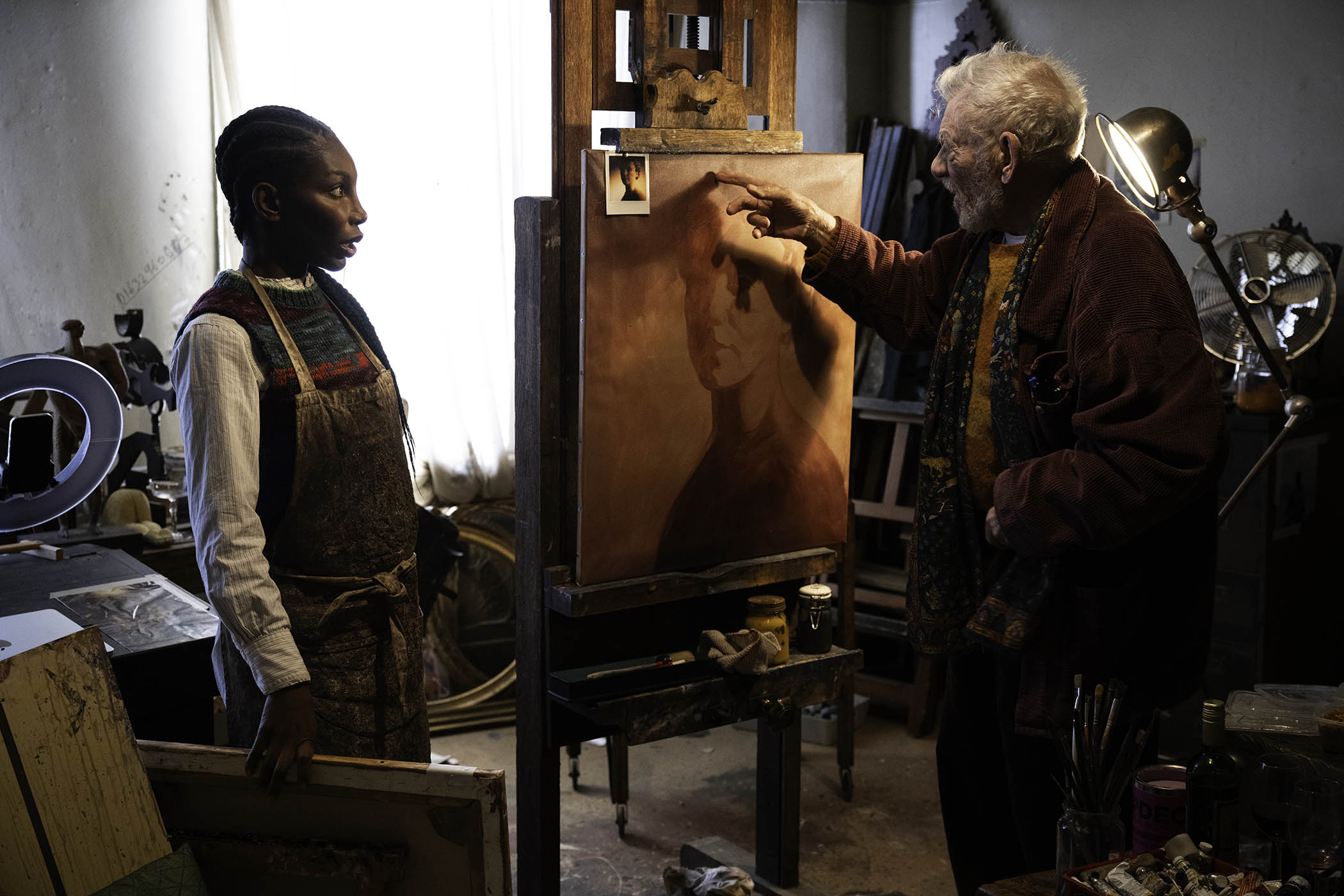



There’s a glorious moment in Steven Soderbergh’s sly two-hander The Christophers when Julian Sklar (Ian McKellen), once a celebrated painter and now a “problematic” fringe figure, pours two large glasses of red wine to toast his latest piece of mischief in an ongoing feud with his venal adult children. Seemingly unconsciously, he then slips the still half-full bottle into the pocket of his saggy, storied dressing gown. It’s an insignificant but wonderfully expressive detail, combining superb costume design (if that ratty robe could speak, imagine the tales it would tell) and artful characterisation: these are the mannerisms of a larger-than-life character who has been diminished in pretty much every way but still has his arrogant self-belief intact.
Soderbergh’s film is rich with such small but perfectly judged flourishes, and it is this depth of character development, together with the crackling chemistry between McKellen and his co-star Michaela Coel, that makes this odd-couple art world tale so charmingly raffish.
Coel plays Lori. Her website describes her as an “art restorer” but when we meet her she is hawking food-truck slop to tourists from a van by the Thames. Then she gets a call from an old art school acquaintance, Sallie (Jessica Gunning of Baby Reindeer), who along with her half-brother Barnaby (James Corden), are Julian’s estranged children. They have discovered, in their father’s attic, an unfinished series of portraits from Julian’s most prolific and successful period, inspired by his relationship with a man he called Christopher. And since the old man’s time is running out and their inheritance has been depleted by Julian’s extravagant tastes and lack of output over the decades, they would like Lori to restore the canvases. And by restore, they mean forge them.
Lori is reluctant, for reasons beyond the fundamental illegality of the enterprise. But these doubts, plus a long-nurtured personal grudge against Julian, are overcome by the lure of a payday. As an artist herself, she is both repelled and fascinated by Julian and his career trajectory, reduced from an illustrious household name to a man who sells catty video messages on OnlyFans. But she is intrigued enough to pass herself off as Julian’s new assistant. Both Lori and her new boss are borderline reprehensible characters. And the film is knottier and more enjoyable for it.
Most of the action plays out in the single location of Julian’s London home: every frame shot in the cluttered shrine to his ego is an extension of his personality. The production design team has excelled in making the house as quixotic as its owner. It has two front doors; whichever you knock is the wrong one. And the grubby, hoarder-chic interior puts you in mind of the quote from Quentin Crisp about the pointlessness of housework: “After the first four years, the dirt doesn’t get any worse.”
It’s a gift of a role for McKellen, who romps through the crisply acerbic dialogue of Ed Solomon’s screenplay with such energetic relish that a lesser actor than Coel might have faded into the damp-stained wallpaper. But my goodness, she’s phenomenal, an actor who effortlessly conveys intelligence in a character. Her stillness cuts through Julian’s noise and bluster like a Stanley knife; her line delivery is masterful, always measured and precise.
It’s no wonder Julian is intrigued by Lori. He suspects, correctly, that his despised offspring have an ulterior motive for recommending his new assistant. But his issue with his children is not so much their greed as that they are too stupid to conceal it. Lori, on the other hand, is anything but stupid. Julian, pompous, verbose and unfiltered, gets the lion’s share of the juicy lines (“I was in a throuple,” he reminisces fondly, “back when it was merely called infidelity”). But in Lori he has met his match.
The Christophers is a meaty, satisfying study of an unlikely bond, but it also asks questions about the creative process. Does the value of art depend on it being viewed by someone other than the artist? And who, ultimately, is the real fraud: the person whose skill is used to recreate the work of others? Or the blowhard who continues to talk up his own legend, without ever painting anything new?
Newsletters
Choose the newsletters you want to receive
View more
For information about how The Observer protects your data, read our Privacy Policy