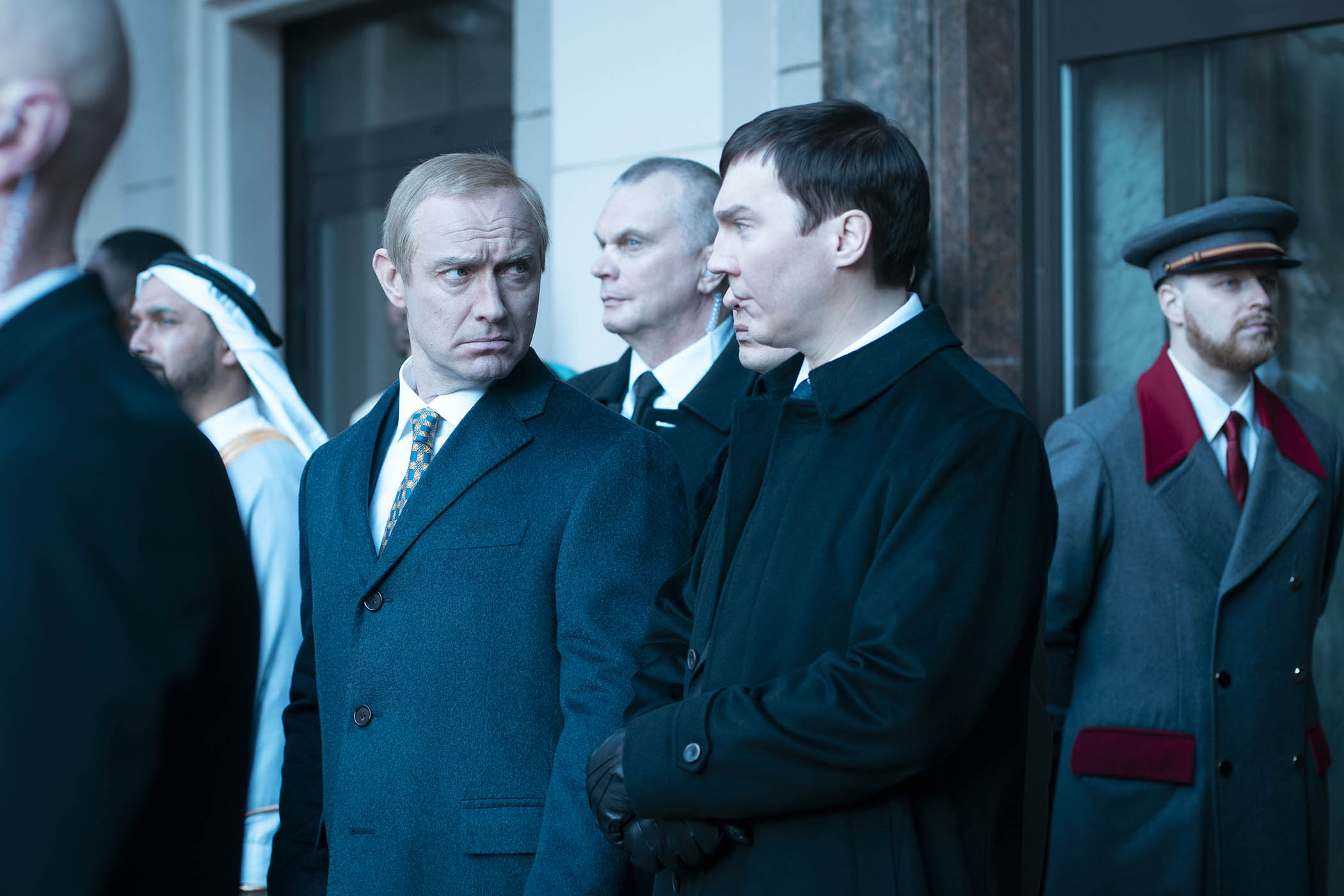


In the past five years or so, Jude Law has entered his time of monsters. And he’s producing some of the most chewy and satisfying work of his career. It started with his superb performance as a brash, vainglorious City boy in Sean Durkin’s thriller The Nest, delivered through a glossy sheen of privilege mixed with a patina of panicked sweat. Then came his depiction of Henry VIII as a cruel, paranoid, bloated tyrant in Karim Ainouz’s Firebrand, failed by his ailing body and venting his unpredictable frustrations on his court and queen. Now, in Olivier Assayas’s English-language adaptation of Giuliano da Empoli’s novel The Wizard of the Kremlin (2022), Law gives a remarkable turn as supervillain Vladimir Putin.
The film introduces us to Putin as a colourless, inscrutable entity lurking in the backrooms of Russia’s political system, and follows his ruthless consolidation of power and fear. It goes without saying that Law is considerably more attractive than Putin could dream of being, even in his shirtless, horse-riding phase. But the actor captures the future leader’s mannerisms and facial quirks: the jutting chin, the drill-bit glare, the clamped, thin-lipped, unreadable expression that could be concealing any number of malevolent intentions. Law is terrific, and there’s a choking sense of ominous tension whenever he’s on screen.
Unfortunately, he’s not on camera nearly enough to justify The Wizard of the Kremlin’s overlong runtime, stodgy pacing and other considerable issues. Putin might be the most interesting figure, but he isn’t the central character in this story. That honour falls to his adviser Vadim Baranov (Paul Dano), a fictional creation loosely based on the Russian politician Vladislav Surkov. Though as Peter Morgan’s stage play Patriots brilliantly demonstrated, the stories of Putin’s rise to power and those of the opportunistic kingmakers in his orbit are fascinating enough, without having to resort to fictionalised elements to jazz it up.
Dano’s singsong tones would be better suited to a cartoon snake with hypnotic spirals for eyes
Dano’s singsong tones would be better suited to a cartoon snake with hypnotic spirals for eyes
Baranov is our window on to a world that shifts from a hedonistic, Weimar-style period of excess to a repressive police state. He recounts his story to Rowland (Jeffrey Wright), an American journalist who says of the mysterious and guarded adviser that he “went through life in a swirl of enigma – the sole certainty was his influence on ‘the Tsar’” (the nickname, in the Kremlin’s inner circles, for Putin).
Amid the early, heady buzz of possibilities of the Boris Yeltsin era, Baranov is drawn to theatre, staging avant-garde productions of intolerably pretentious plays. In his free time he swims through wild parties, collecting social connections like a basking shark in a black polo neck. These scenes are shot by cinematographer Yorick Le Saux with the kind of hungry, fluid restlessness that evokes Paulo Sorrentino’s portraits of Roman decadence in Il Divo and The Great Beauty. It’s in this liberated, extravagant Moscow that Baranov meets Ksenia (Alicia Vikander), a social-climbing beauty whose rise through Russian spheres of influence mirrors his own.
Baranov then leaves the theatre to create trashy reality television, honing his skills of mass manipulation. But it’s in politics that he finds his passion, through a fortuitous meeting with Putin brokered by his boss, the businessman Boris Berezovsky, played here by Will Keen. (The late oligarch was also the central character of Morgan’s play.) Hovering doughily in the background, Baranov becomes a Zelig-like figure, present on the sidelines of most of the consequential events of Russian history of the last 30 years.
There’s a fundamental problem, though, and that’s Dano’s performance. He’s jarringly affected at best and genuinely terrible for much of the picture. The entirety of Baranov’s dialogue is delivered in an absurdly artificial voice – the kind of slippery, singsong tones that would be better suited to a cartoon snake with hypnotic spirals for eyes and a baby chipmunk on its dinner plate than to a Kremlin powerbroker. It’s so distracting that it undermines many of the film’s strengths: its depiction of the shifting quicksand of Russian politics, the vividly evoked sense of a specific time and place – and even Law’s vigorous, treacherous Putin.
Newsletters
Choose the newsletters you want to receive
View more
For information about how The Observer protects your data, read our Privacy Policy