
Photographs Jon Gorrigan
Earlier this year, Lily Allen’s manager started organising meetings with key figures in the music industry in order to play them a demo of her fifth album. She’d written and recorded West End Girl over two weeks last winter – it was an operatic story about a marriage disintegrating, as brutal as it was catchy, like a breakdown you could whistle. In each executive’s office, at the same points in the same songs, “the women would cry,” Allen’s manager told her. “And when he played it to the men, he could always tell who was cheating on their wives.”
Allen told me this on an ashen Monday morning in the first week of December, as we picked our way towards the radiator in her London kitchen, through a series of roll-on suitcases. She was jetting weekly between London and New York, she explained. There were the Fashion Awards to attend that evening, then a music video to record, and then there was Saturday Night Live – the night before she’d had an anxiety dream about it. “So I got to the SNL studio,” she told me, “and they wouldn’t tell me who was presenting the show, but I kept seeing a man’s back as he shuffled into rooms every time we came round the corner. I was like, what’s going on? Everyone was just ignoring me or lying. Then they wanted me to act in sketches, but wouldn’t give me any guidance on it so I was just shoved into these situations where I had to really quickly improvise…”
She took a quick drag on a Parliament cigarette.
“Oh, and the whole set was on a fairground waltzer.”
I’ve interviewed Allen a few times across her 20-year career. In our previous meetings, as she dealt with tabloid obsession to the degree that she once received a call to confirm the gender of her new baby while the umbilical cord was still attached, the fame always gave her a slightly fearful, brittle edge.
A certain level of paranoia was appropriate. Those were the days when you’d walk through Camden and see a mob of photographers moving like a single ball of fire, and you’d know Amy Winehouse was inside it, or Peaches Geldof, or Allen, who is the only one of the three still alive. This time seemed immediately different. Her album, released in October, continued to dominate not just the charts but also the headlines and the world of international think pieces. But aside from the odd anxiety dream, she seemed to be having the time of her life.
Allen was 21 when, using MySpace and an emerging social media, she became famous for narrating her experiences of fame, bad sex and heartbreak in vivid little pop songs and caustic quotes. In 2018, at 33, she wrote a memoir that unpicked the complicated privilege she’d grown up with as the child of sometimes famous, often absent parents, described untold trauma – from the stillbirth of her first child, George, to an attempted rape by a record industry executive, to a stalker breaking into her home in 2015 – and explained how a life under constant press attention had dangerously warped her sense of reality.
When she married her second husband, the actor David Harbour, in Las Vegas in 2020, “I was quite jealous that he had come into fame in his 40s,” she told me, as she wrestled with the coffee machine in her kitchen. “How nice to have a sense of yourself already and know who you are, so you can sort of… drown out the noise.”
When they married she moved her two daughters into a grand Brooklyn brownstone that the couple decorated lavishly, with hand-painted wallpaper and a carpeted bathroom. At the start of their Architectural Digest tour (which has been viewed more than 9m times) Harbour pretended he was opening the door to an ex-lover, “I have a family now, this is so embarrassing. You look good though…” If that was the gun in the house tour’s first act, it was always going to be fired in the third.
Allen’s fourth album, No Shame, released in 2018, had been her lowest-selling yet, and she’d arrived in New York planning to take acting lessons and enjoy a quiet, wifely life. “It’s not what I wanted,” she told me, “but that was what was being presented as my option, so that’s what I did.” For some time their life appeared to be quite lovely. Harbour was filming Stranger Things, she was making a BBC podcast with her childhood friend Miquita Oliver and discovering she could make more money selling foot photos to fetishists on OnlyFans than she was earning from royalties. In 2021, she made her professional stage debut in 2:22 – A Ghost Story in London, and at this point in Allen and Harbour’s marriage story we must close the door of their brownstone (now “famously on the market” for $8m, she said) and refer to the tapes.
The 14 tracks on West End Girl emerge in an arc that leads from suspicion to emancipation – the album is a piece of autofiction that uses poetic licence to pick keenly through the carcass of a marriage. The title track opens as if a curtain is rising. Allen is calling home from London, where she’s performing a play – the listener hears her side of a conversation during which her husband asks for an open marriage. In Tennis and Madeline we hear a dramatised conversation between Allen and his other woman: “I can’t trust anything that comes out of your mouth / I’m not convinced that he didn’t fuck you in our house.” The rules of the couple’s newly non-monogamous marriage – “There had to be payment; it had to be with strangers” – have been broken. In the lurid hit Pussy Palace there’s a visit to her husband’s second apartment and, with Allen’s trademark specificity, a snapshot of betrayal in the discovery of a plastic bag of “sex toys, butt plugs, lube”. On Relapse, Allen (sober since 2019) longs for the relief of anaesthetisation while trying to stay clean for the sake of her children. Later, she joins a dating app seeking validation from strangers – “I’m almost nearly 40, I’m just shy of 5ft 2 / I’m a mum to teenage children, does that sound like fun to you?” (The chorus goes: “I hate it here.”) And among the vivid details that reveal how betrayal leads to hyper-vigilance and a certain madness, there is a collection of hooks, in Allen’s sweet, dry London voice, that are so moreish and delicious (“Who the fuck is Madeline?”) that they burrowed immediately into our shared consciousness. The evening the album landed, I got on the 205 bus to find the driver singing along.
West End Girl was “inspired by things that happened in my recent marriage”, Allen told me. We were at her kitchen table, the sound of trains rattling below. She used such a cautionary tone that I asked if she’d had to sign an NDA, and she lowered her eyes, Diana-like, before adding, “That’s very difficult to answer, because if I had, I wouldn’t be able to talk about it.” Before she released the album, “I thought, because I’m ‘outspoken’ – I hate that word , ‘outspoken’ – I have felt the wrath particularly of middle-aged, white, heterosexual men for expressing things that I don’t think are particularly controversial.” She was pulling on the sleeves of her grey cashmere sweater. “And I thought, going into this record, that it was probably the most controversial thing I’d done in terms of my creative expression, but I didn’t anticipate anything, really. And if I did anticipate anything big happening, it was going to be the nail in the coffin, it was going to be, like, ‘Right, now it’s time to kill her once and for all!’”
In January, Allen put a lock on her phone’s internet browser that only her assistant could access. Her plan was to avoid reading reviews or seeing anything on Instagram that might derail her. “I was shocked, really, that it… wasn’t that,” she said. To say the response to the album was positive is to dramatically understate it. “Humans are going through a really interesting time in terms of relationships and monogamy and rules and boundaries – things feel very blurred. Some people are really leaning into that and having a great time. Other people are… not. And I think it’s those people who are really connecting with this record.” It was the UK’s most downloaded album of the week – soon after we met it surpassed 1 billion Spotify streams. Stars including Gwyneth Paltrow called it a “masterpiece”. Her tour sold out within minutes. Her songs inspired a thousand Halloween costumes. And when she released a collection of merch, her website broke down under the pressure of public desire – there was an online queue to buy West End Girl butt plugs.
And Allen, 40 years old and looking now somehow like an Audrey Hepburn Playboy spread, decided to simply love every second of it.
A tour of Allen’s London flat takes less time than a tour of the brownstone – there are three compact bedrooms and a balcony with one thriving tomato plant. Opposite her bed is a shop display unit on which hangs a private pension of handbags. “It’s my consumerist wall,” she told me, pursing her lips with some light disgust. She and her daughters had put the Christmas tree up early because why not? Bouquets of congratulatory flowers rested on the kitchen table, where, with her cigarette lighter, she burned a scented candle. “I thought I’d had a wonderful professional career,” she said, “but that those days were well and truly behind me. And now I feel like I’ve been catapulted back into something again. And it’s really nice.” What’s particularly nice, she said, is having “more of a sense of myself, and what I’m comfortable with. I feel like I’m not operating from a place of fear of losing everything, which gives me more freedom. And it feels more fun.”
The road to get to that place of freedom was rocky and lined with various horrors, some documented, some less so. She and Harbour broke up in late 2024, and soon after that she wrote the record. “Then it was Christmas and I had to take the girls on holiday on my own, and I was just utterly heartbroken. Then we got back to New York and things got darker.” She stopped being able to eat or sleep. “I’d sit down at the breakfast table and try and get the girls to have their breakfast before school. And they’d go, ‘Mummy, your arms look so thin.’” She’d be in tears when they came home from school, which reminded her of when she was a child and her mother, the film director Alison Owen, had split up with the comedian Harry Enfield. “That’s one of my strongest memories of childhood, really, that period of time. It was so desperately sad that I wanted to try and get on top of it so it didn’t define too many of their memories of growing up.” She checked into a trauma centre in Nashville for two weeks of group therapy and a further week of intensive therapy, which she describes as “fucking excruciatingly painful and also, really helpful”.
Allen continues to have regular EMDR, a psychotherapy designed to help people recover from traumatic experiences. In Nashville she concentrated solely on the period leading up to her relationship breaking down, but more recently she has explored her life before that, returning to a childhood characterised by abandonment and instability. “What was quite funny is that I’d spent three weeks in this place trying to find my authentic self and then, within 24 hours, I was on an operating table, also finding my own authentic self.” She went straight from the trauma centre to Kris Jenner’s plastic surgeon in Manhattan, where she had breast implants.
What could she remember from that period of time?
“Not much,” she said, “because I was under general anaesthetic. But yeah, it was strange, going into a posh Park Avenue operating theatre and then to the hotel over the road where there are two nurses that sort of bring you back to life for a couple of days by feeding you Percocet. So having gone from a treatment centre that was not drug- related, where I am in sobriety, to then going into a hotel room to have nurses just feeding you very high-strength painkillers, I was like…” She went on with measured jollity, “Whoa. This is a contrast, for sure.”
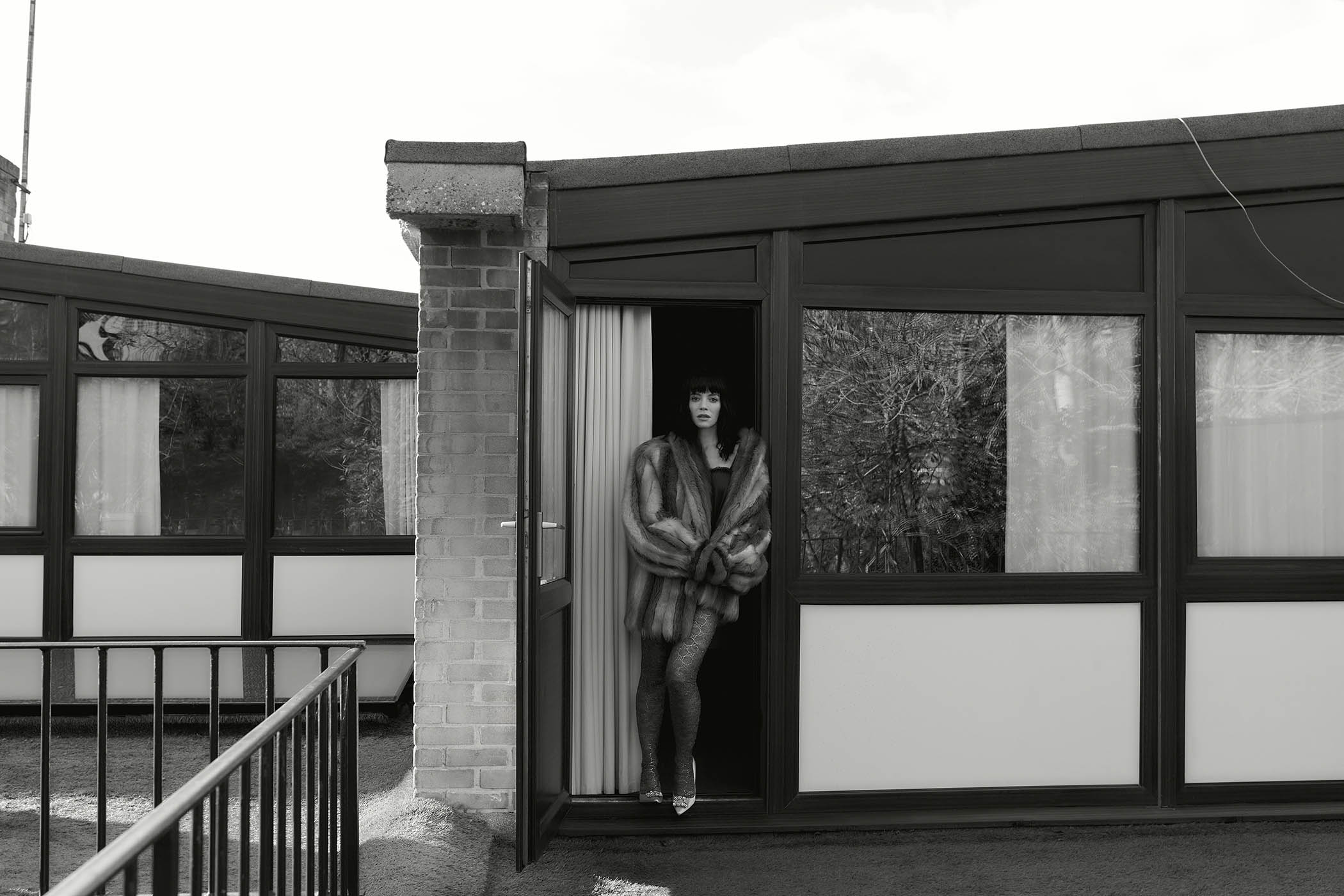
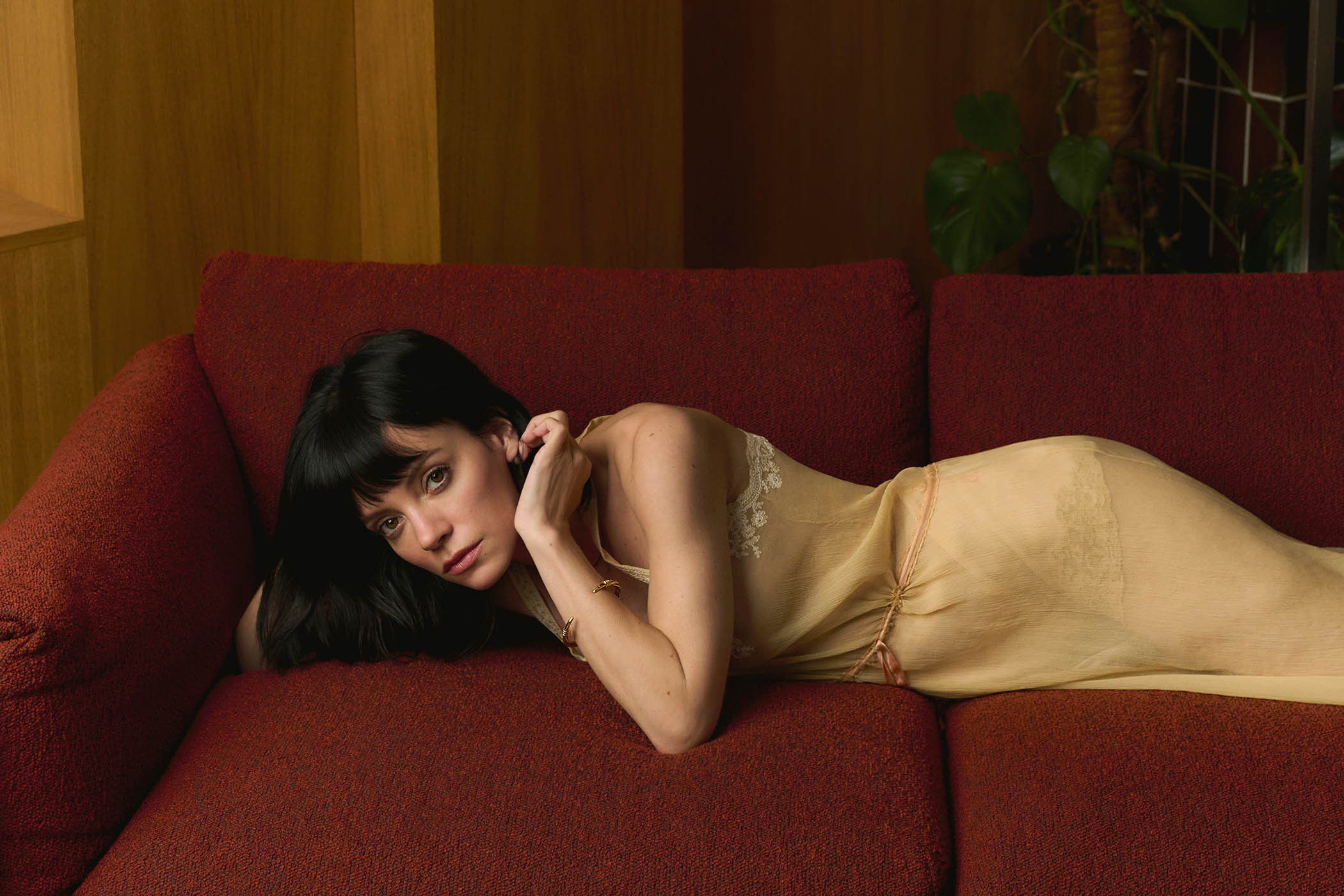
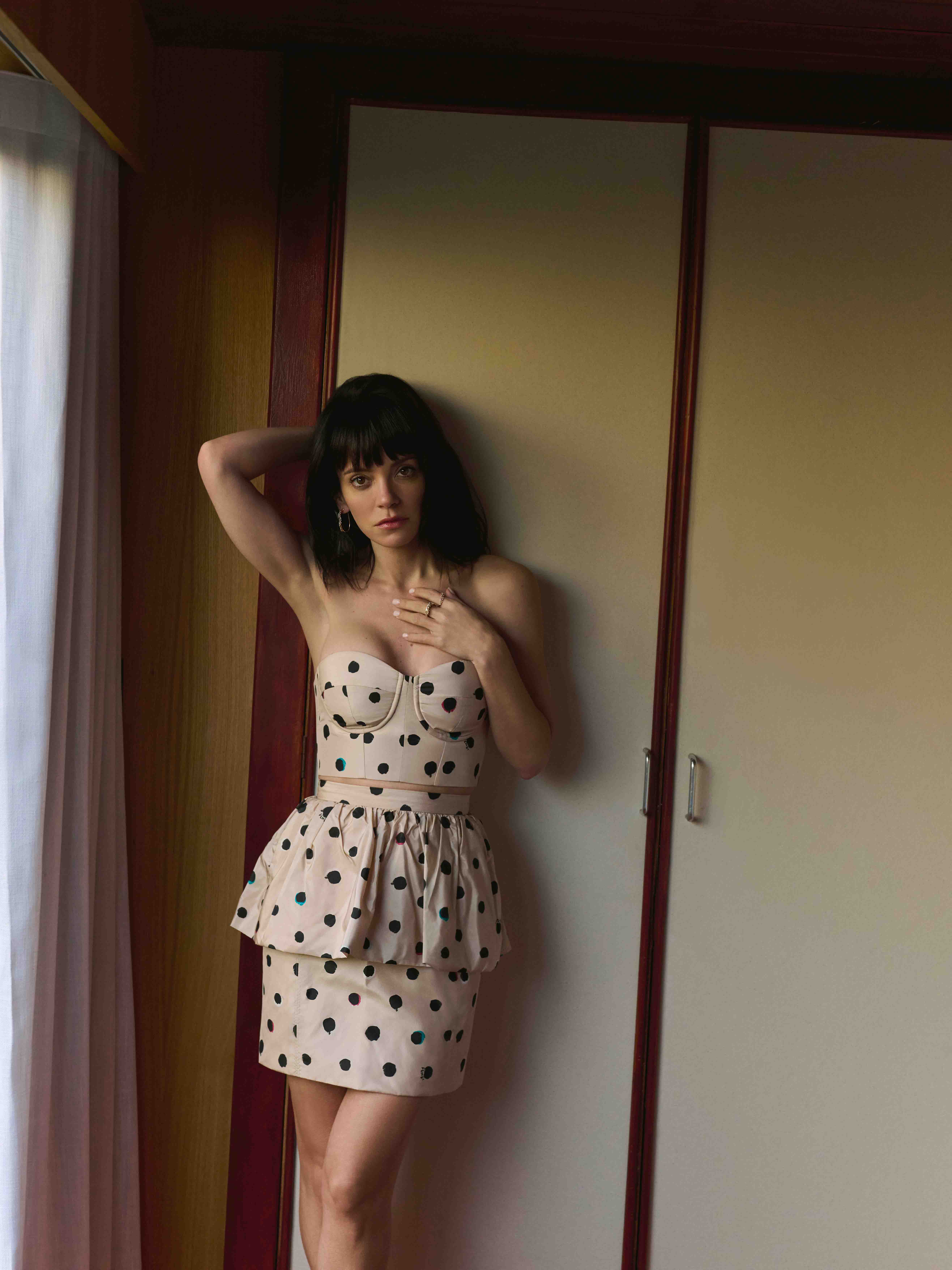
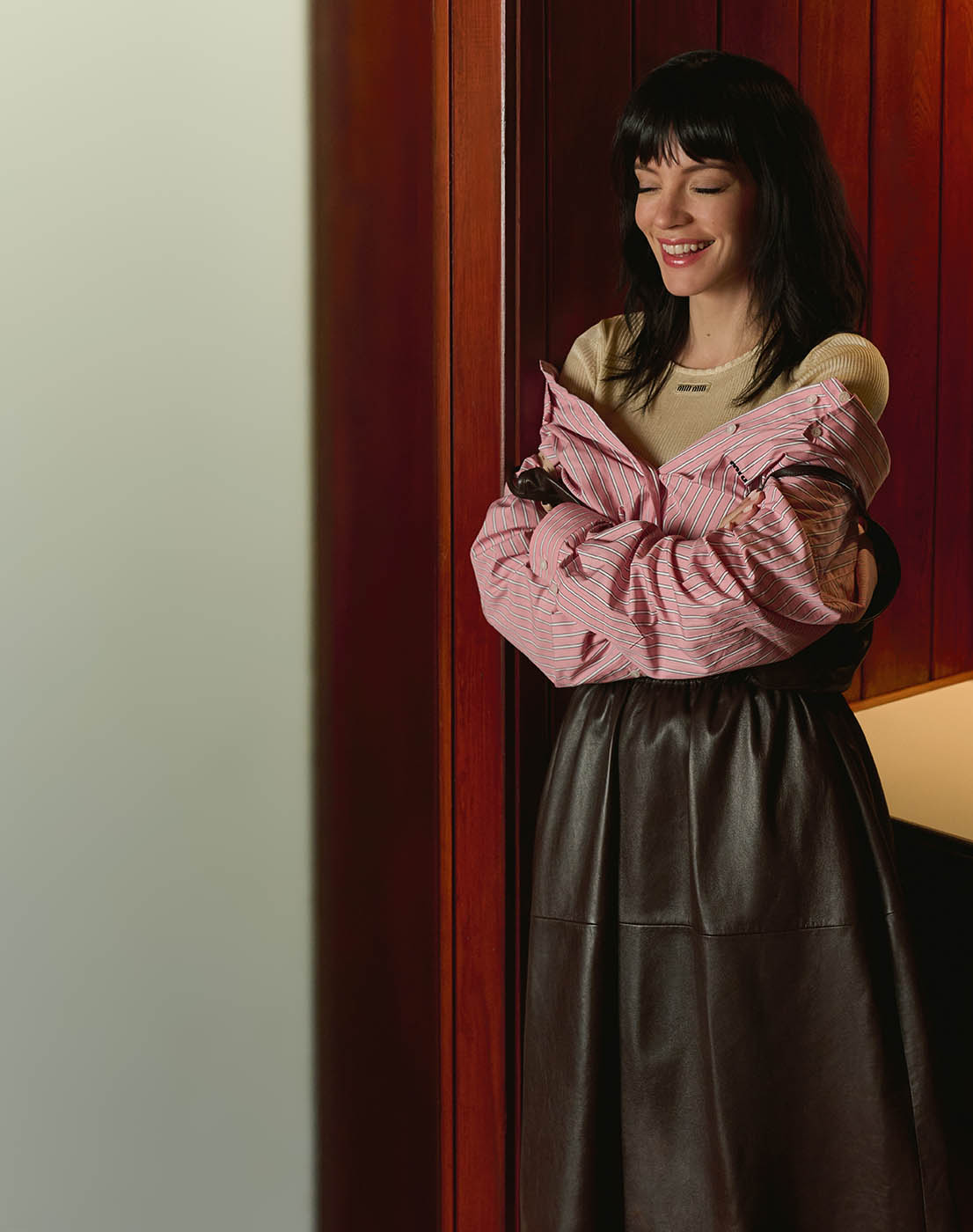
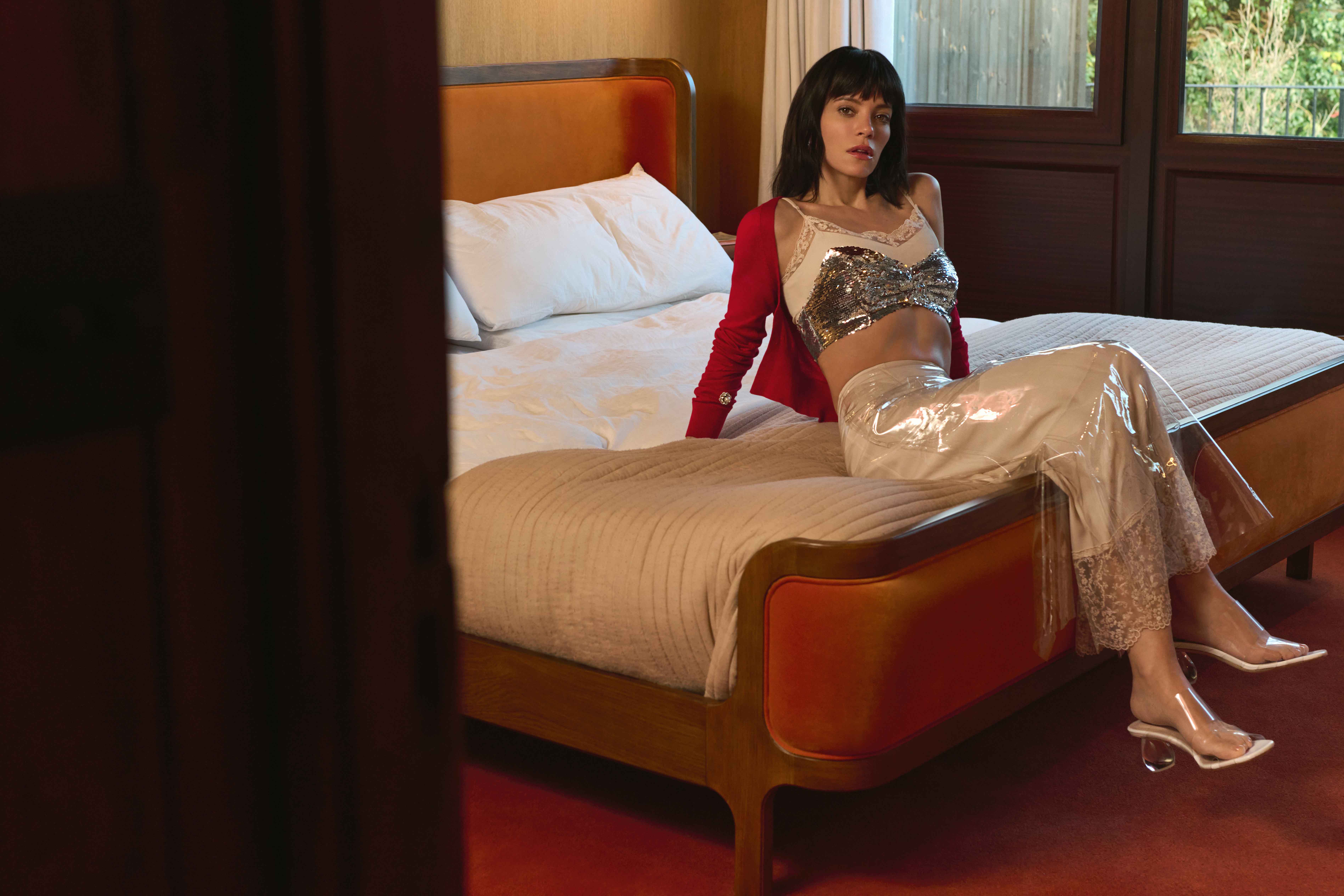
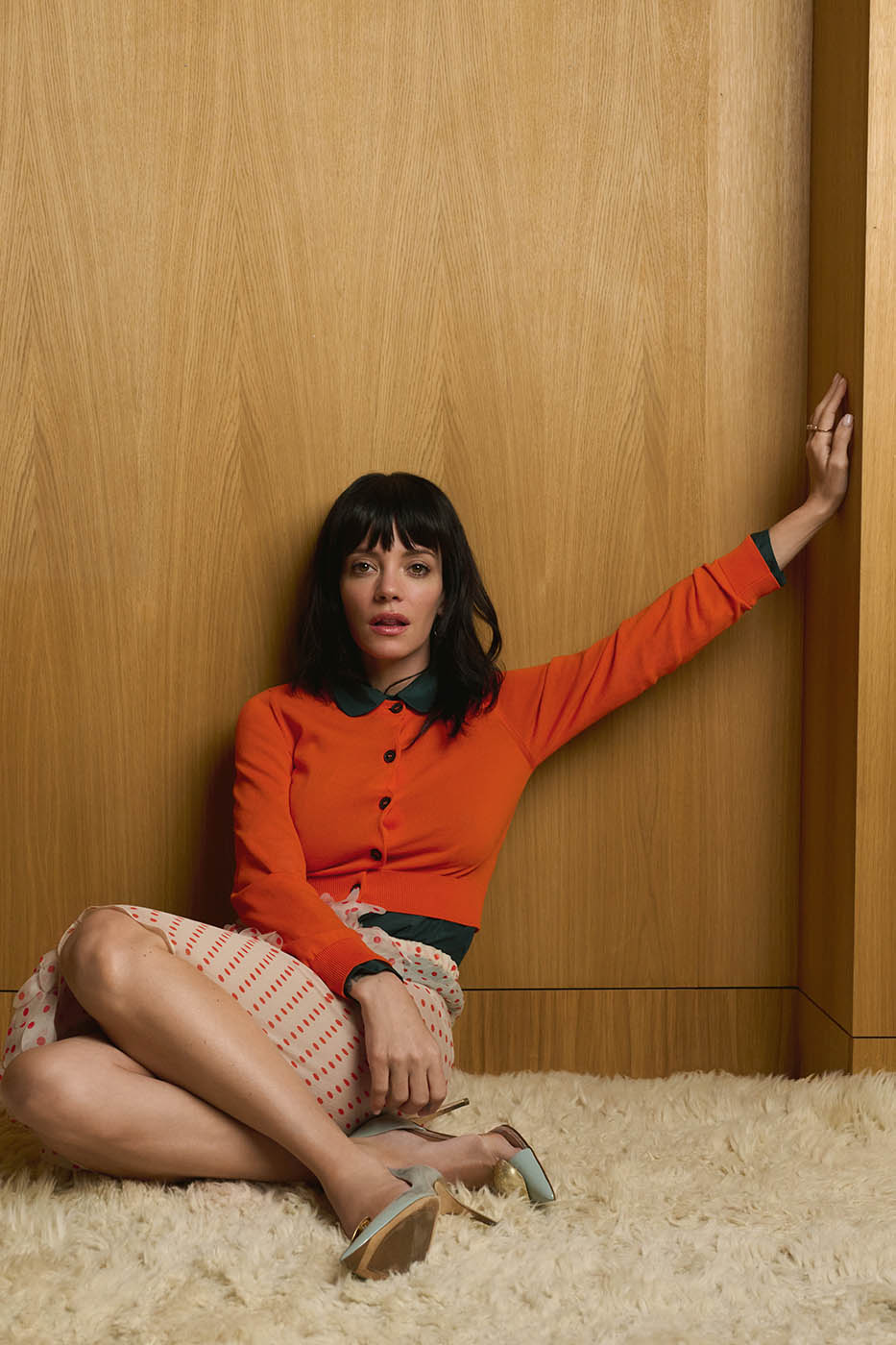
Shearling coat, silk satin all-in-one lingerie with ruffled belt and laced stockings, all by Gucci; and efflorescence pumps by Roger Vivier
When I asked what inspired her to book the boob job, she said she’d lost a lot of weight, and was concerned that when the weight returned it would go to her legs. “And because I’ve always been really small up top, I was worried about becoming really bottom-heavy. And so I felt like…” She rolled her eyes and, catching herself, apologised darkly. “This is how I talk to myself!” She went on: “I felt like if I got boobs, it would make me feel better about gaining weight. So that was my reasoning.” She shrugged, the ethics of a plastic surgeon agreeing to operate on somebody who has arrived straight from a trauma centre hanging delicately in the air.
Over the last year or so Allen has intermittently returned to Raya, a dating app populated by celebrities and the extended 1%. “You know, I used to be quite famous, that was way back in the day,” she sings on Dallas Major, describing her dabbles on apps. “Yes, I’m here for validation and I probably should explain / How my marriage has been open since my husband went astray.” The experience of her return this time around was dismal, she told me, partly because in profiles, “Everyone’s a ‘creative’. What’s a ‘creative’?”
I wondered how she described herself.
“I don’t know,” she said. “Should we have a look?”
She slid her phone over the table – her profile picture was coy, studio-lit.
“Ah, yeah,” she went on. “I’m a ‘critic’.” She chuckled prettily. I looked again and noticed the profile said she was 38. As a 40-year-old she’d seen her dating options immediately dwindling, she told me. “But a friend of mine knows somebody that works there, and they kindly changed it for me. Anyway, it says ‘Recovering addict, raging co-dependent, anxious avoidant. Mother of two.’”
She took a proud pull on her cigarette.
Did her dates want her secrets, her stories?
“Not really,” she said. “They just want to sleep with you. It’s definitely not a place to start long, meaningful relationships. That’s where I met David.”
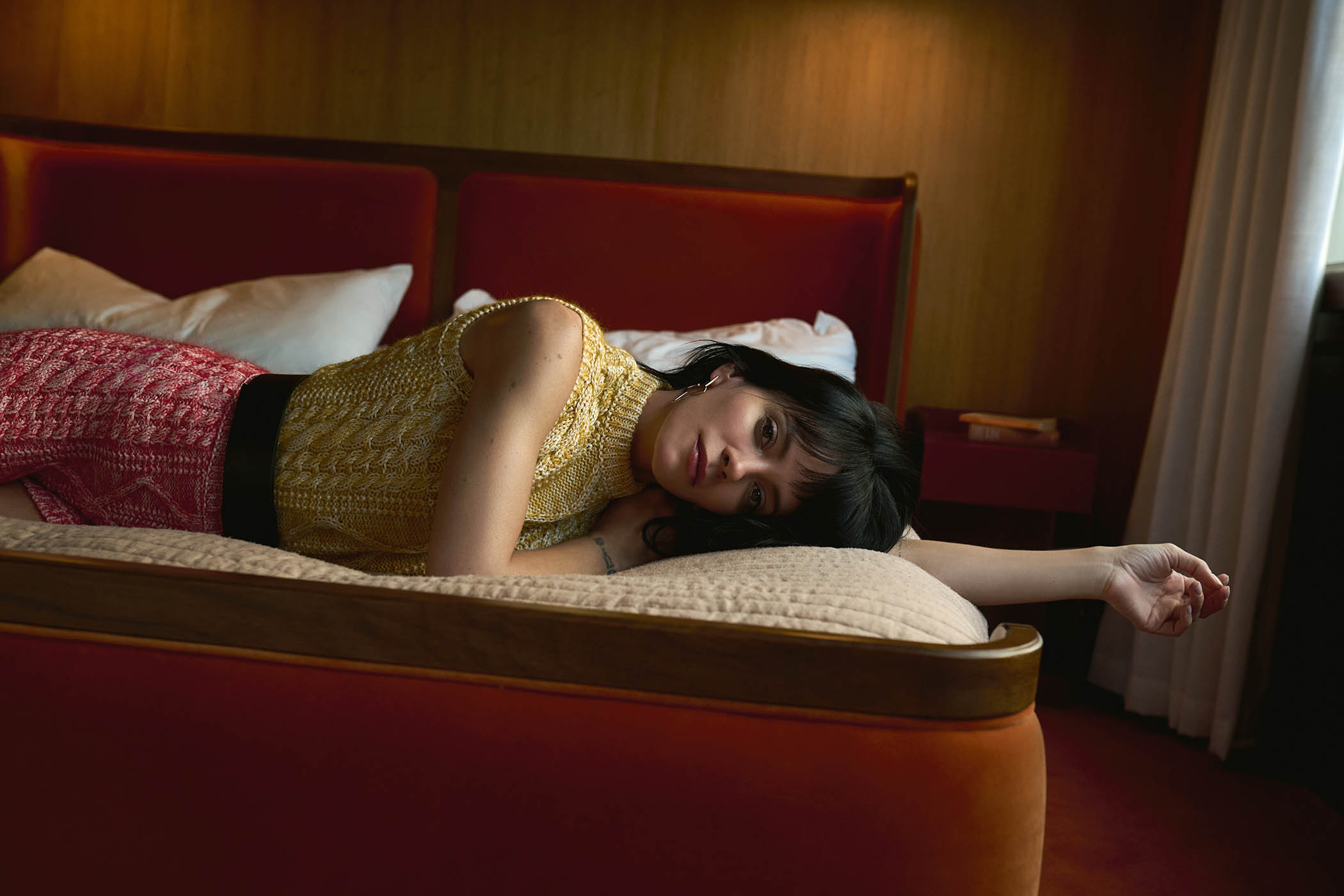
Sleeveless cable knit jumper, shorts, leather belt, and blossom hoop earrings, all by Louis Vuitton
The tabloids, and her battles with them, have been such a significant part of Allen’s life and career that some critics have wondered, with at least a flake of awe, whether West End Girl was an attempt to control the inevitable press interest in this celebrity divorce – to complete and own her own exposé. “That irks me slightly,” Allen told me, “because, you know, I am a famous person who got married to another famous person. People are going to say that it’s a tabloid exposé, but it’s not. It’s me talking about my feelings.”
She’d been trying and failing to write for years before West End Girl, “but everything that I was writing felt like it wasn’t really me and I couldn’t really get to the authentic voice. Then these sessions happened last December and these songs came out of it and it felt like me. And maybe that means that I am walking tabloid fodder, I don’t know, but that certainly is not my intention.” At the time, she was on a tiny record deal that “reflected very low expectations, especially after how No Shame was received commercially. All of the indicators were that life is over. You know, that’s done. So to be here and selling out arenas is, frankly, insane.” The thing that was most exciting for her though, was that her teenage daughters would witness it. “I’m delighted for myself and for my kids,” she told me. “Fucking excited.”
The only time her children had seen her as a pop star was when Olivia Rodrigo brought her onstage at Glastonbury. Rodrigo is one of a cohort of young female artists, including Billie Eilish, Sabrina Carpenter and Charli xcx, who have noisily held Allen up as an influence.
“When I did the Olivia Rodrigo thing I can’t underplay how insane the reaction was from the audience. And the kids were there, and I was really conscious of them because it was overwhelming. They’d never seen that before, and it was strange because I was quite newly sober.” She didn’t want to stay at Glastonbury too long after the show and risk getting sucked into the hedonism that, when she was 13, led to her visiting her dad Keith Allen in a makeshift hospital bed after he’d had a cocaine-induced heart attack, only to see him snorting more again the next day. “I took my makeup off and got straight in the car with the girls,” she said. “And Marnie was like, ‘So were you, like, successful?’ And I said, yeah, I was. And she was like, ‘Like in the charts?’ I said yes, I was like No 1 in the charts.”
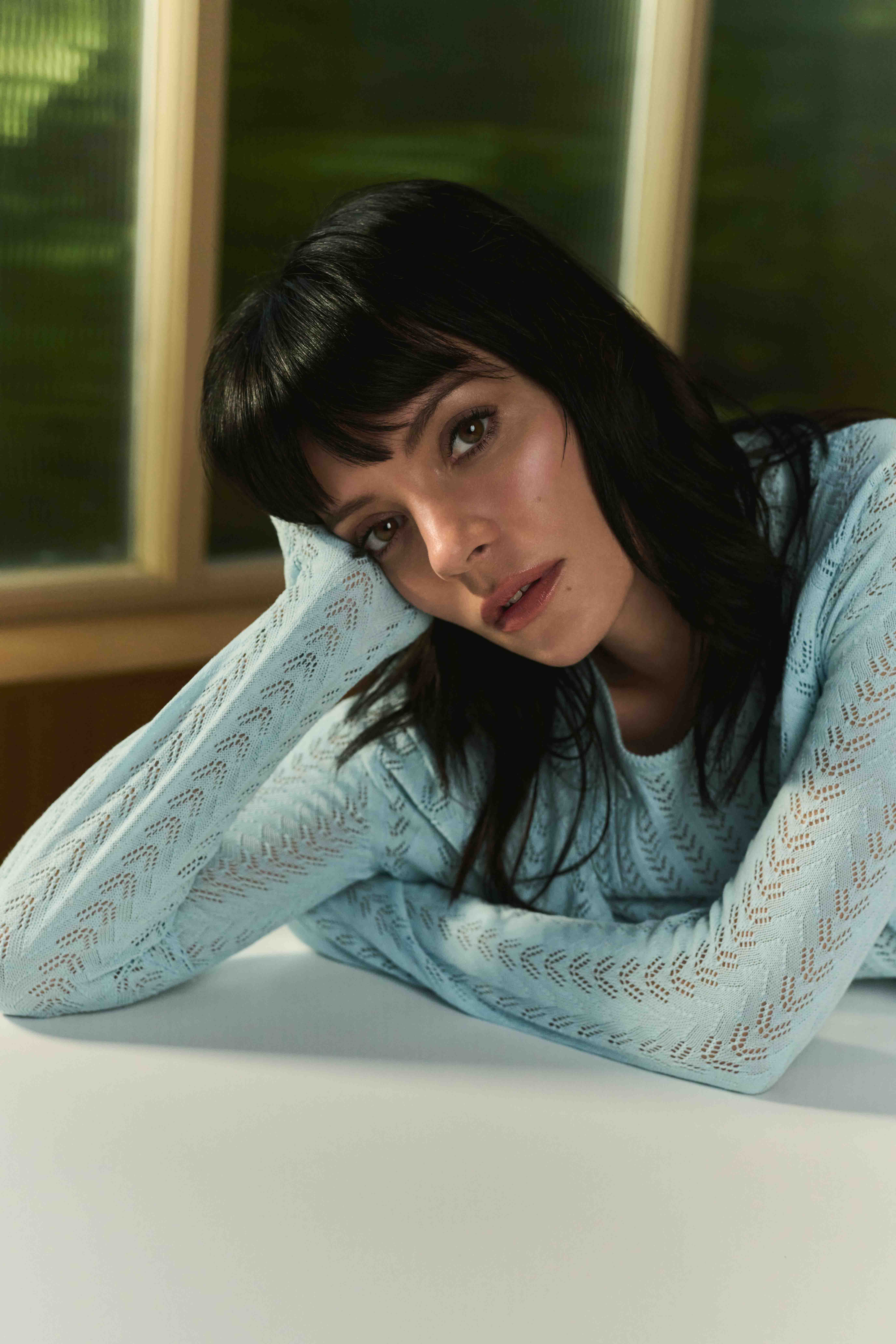
She started showing them videos of her on stage, accepting Brit Awards, the whole machine, “and they were both kind of, ‘Wow, look at who our mum used to be.’ It’s amazing for them to get to experience it with my head screwed on, you know, not coming off stage and diving into bottles of vodka and piles of cocaine.” Marnie is 13 and into Greek mythology. Ethel, who’s just turned 14, is into, “social dynamics, I guess?” Allen said, fondly.
I asked if her daughters were still in touch with Harbour.
“I stay out of it,” she said. “But they’ve both got phones. They all text each other.”
The response to Allen’s record appears to have been almost entirely and rabidly positive, which in itself feels somehow remarkable. Though she is cautious about naming Harbour or pointing to which aspects of her lyrics relate directly to him (for reasons, I presume, of dignity, legalities and money), typically when women in the public eye speak out about famous men, crisis lawyers and their various automated bots kick in to silence her. When I brought this up, Allen sighed. “I can see when comments are being left and it’s clearly bots and you know someone or something is behind that,” she told me. “But again, it’s not really something I have any control over. People will believe what they want to believe, there’s no amount of protest that you can do that will change their minds. And it’s not really my business, you know?”
When Allen started to become successful, people would reassure her that however bad that day’s story was, it would be forgotten by tomorrow. A few years into her career, though, that ceased to be true. “It stays there and it lives on forever,” she told me. “And it’s difficult to reconcile with that, but also, it’s something new that we’re dealing with as human beings.” She added loftily, “I think that it leads to self-censorship, and ultimately allows fascism to happen.” She stubbed out a cigarette and began to pull delicately on a matcha vape. “We’re all massive walking contradictions, right? That’s what makes us human beings. You can think one thing one day, and then you grow, and you think something else – that’s life. I’m a different person than I was 20 years ago because I’ve lived 20 years of my life and I’ve had two children and two marriages and I’ve learned a lot.”
This is what she has learned: that child-rearing is hard; harder, it seems, than when she was growing up. She’s learned to look after herself, by returning in therapy to childhood events during which she felt unsafe. She’s learned to save money, she’s learned to ask for help. She’s learned, she told me, there are no “baddies and goodies in a marriage but, having done things that were not very nice in my first marriage, I have a better idea now of the pain I may have inflicted. I’ve learned how horrible it is to be on the receiving end of that.” She’s learned a lot about marriage. “I’d like to say I’d never do it again, but I do like it. Everything but the institution of it, you know? I like being chosen. I like jewellery. I like getting dressed up. I like celebrating. I don’t like talking about money. I like my independence. But I don’t like divorce.”
What has she learned about divorce? “It’s just sort of devastating, really. It keeps you up at night and costs a huge amount of money and just goes on and on and on. And I hate feeling like I can’t trust anyone. But there’s something about dealing with an ex-partner and lawyers that creates an environment of feeling like you can’t trust anybody or anything.”
What has she learned about men?
“I think that they’re having a tricky time at the moment. But – that’s not really my problem. Good luck to them. They can sort themselves out from now on.”
Allen’s career has been littered with apologies: for accusations of racism (after a 2013 music video featured Black women dancing in their underwear while she remained clothed) and more recently for “being mean” to Katy Perry after her Blue Origin flight to space. In 2016, she apologised, in tears, on behalf of her country, to an unaccompanied child migrant living in a makeshift camp in Calais, an apology that brought new waves of abuse. In the past, Allen has been a vocal Labour supporter, though recently she decided she didn’t want to talk about politics any more. “I’m just very disappointed in everything,” she told me. “But I’m also not as active, vocally. Not because I don’t care. I really do. But because of the voice or the character that has been assigned to me.”
How would she describe that character?
“Like an idiot that speaks out of turn and doesn’t know what they’re talking about.”
As her career unfolded, Allen began to feel as though when she spoke up, her words were twisted. “And I think it does more damage to the causes that I believe in than help them.” Her focus has turned to her local community, rather than the wider world. Last year she became an ambassador for the addiction charity Forward Trust. Elsewhere, women in their 40s are enjoying her activism around being an extremely hot single mother in see-through dresses, embracing an elegantly curated slagginess. Alongside the album promo, she’s been on a successful tour of her own perimenopausal sexuality.
She has been asked to write another book and there are plans underway to adapt her record for film, or stage, or both – her mother, Owen, is advising on meetings, which adds to Allen’s excitement and relief. “I don’t know if I want anything other than to just enjoy the moment, and not feel scared of losing it. I spent a lot of time in my 20s being so fearful of having to hold on to this thing” – the money, the attention, these parcels of purses arriving at her door – “that it actually stopped me from enjoying what was happening.”
Allen wanted to go to the gym before her evening event, where Valentino would dress her in a custom golden silk gown (styled by Leith Clark, who previously persuaded Allen to dress like a kinky nun for videos promoting the album, and as children’s book character Madeline for Halloween), so as midday approached she offered to give me a lift into town. We hurried across the road to where her new Porsche hummed, very low against the inky tarmac. Inside, Jade Thirlwall’s album played cheerfully, and Allen sighed with pleasure as she sunk into the driver’s seat. “Now I’m able to understand that nothing is permanent and that these things happen in waves. They come and go, and that’s fine,” she said. “So I’m just very committed to enjoying what’s happening right now, not spreading myself too thin. And I’ll do that until I can’t.” This time round, fame has felt different, “even though I’m limited in what I can discuss.”
When I asked her what that felt like for someone so “outspoken”, she thought for a moment, her head resting briefly to the side.
“Actually?” she said. “It’s kind of a blessing.”
West End Girl by Lily Allen is available to stream now. The album will be in shops from 30 January
Makeup by Gina Kane at Caren using Chanel Holiday 2025 Makeup Collection and No 1 de Chanel Body Serum-In-Mist; hair by Chad Maxwell using Living Proof; fashion assistant Sam Deaman; photography assistant Louie Mire; digital operator Danny Millar
Newsletters
Choose the newsletters you want to receive
View more
For information about how The Observer protects your data, read our Privacy Policy