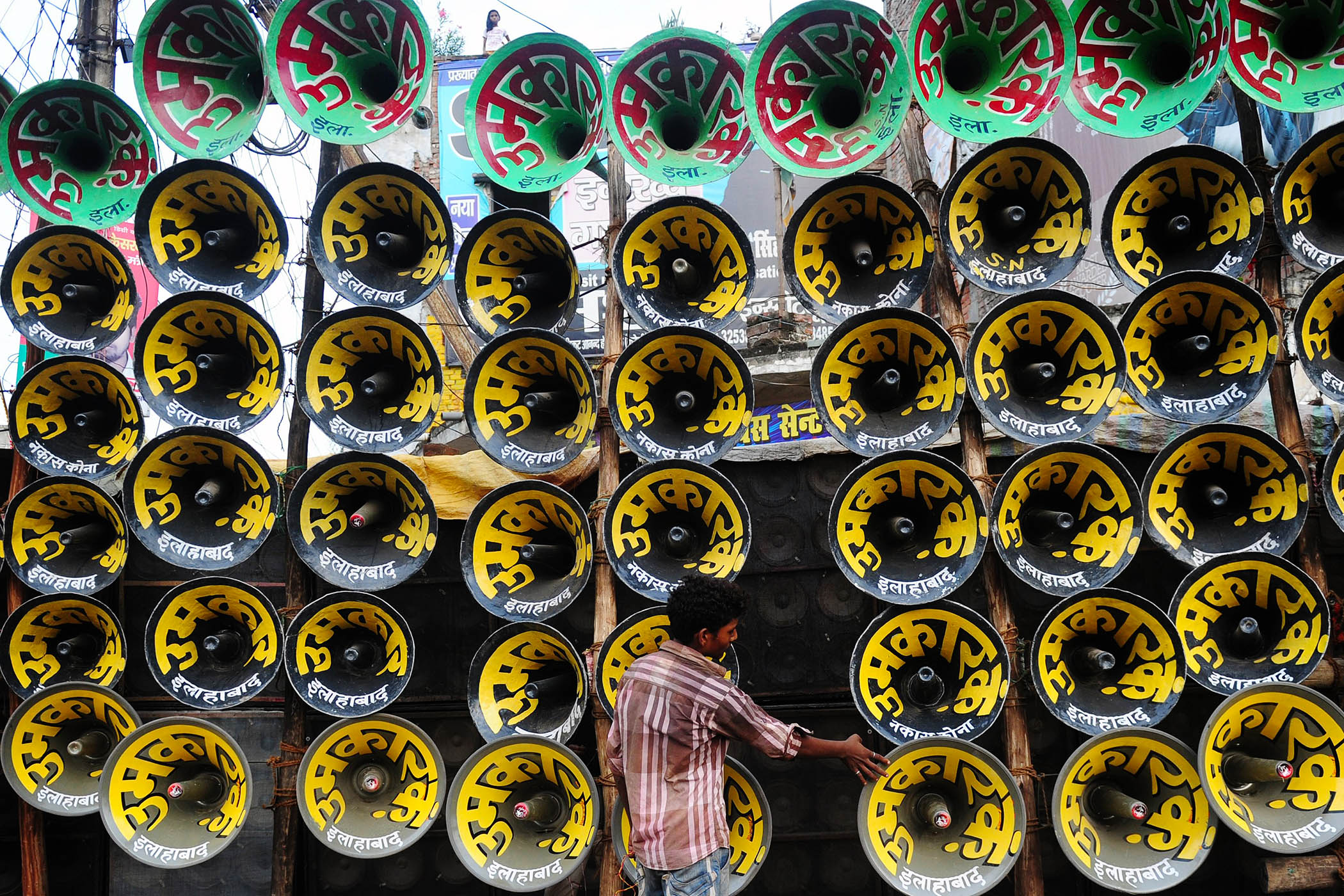


They glide through potato fields like UFOs: giant banks of colourfully painted, trumpet-shaped speakers mounted atop three-wheeled bicycles. But the hand-built sound systems that emit dek bass, an electronic music craze that has swept from the villages of West Bengal across India, are heard long before they’re felt. It’s all about the bass. Deep, earth-rattling drops as low as 20 hertz, the threshold of audibility, so low they can induce nausea. And often, the lower the drop, the faster the beat – up to 200bpm, double the pace of a human heart. Earplugs are strongly recommended.
Not that I’ve experienced this in person. I came late to the party. Viral videos of Bengali raves on Instagram stopped me in my tracks last week: a riot of colour, far removed from the funereal monochrome of Berlin-style clubs, and rural, without a hint of their industrial aesthetic. Over the past two decades, techno has become a global phenomenon, and many of the parties I’ve been to from Seoul to São Paulo have exhibited only mild regional differences. But these videos of a homegrown scene gave me something akin to what the cultural theorist Kodwo Eshun has called “futureshock” – not so distant, I imagine, from what travelling party-goers might have felt in the early 1990s as they pulled up to an acid house rave in the Norfolk countryside.
Dek bass has exploded over the past few years, but it has much older, low-fi roots. “Dek” refers to the cassette tape decks where tracks and samples are played. Multiple decks are often used at a time, but the tapes can be played out of sync to dizzying effect. Many DJs have analog means of manipulating the sound, like using screwdrivers to warp or jam a deck’s hardware. Some recognisable samples surface in mixes – traditional Indian drums called dhulki, dialogue from Bollywood films – but only briefly before the bass submerges it all.
Those speakers that resemble spaceships or many-eyed monsters are called boxes, and are made up of individual chonga, or funnels. They’re built to compete in a kind of sonic warfare: opposing music crews wheel their boxes out to the middle of a village or an open field and blast each other with sound. Sirens pierce through walls of bass while ravers stand in the middle. This is music at its most tactile and confrontational.
In his 2025 documentary short Bass Boss, Canadian-Bengali filmmaker Rana Ghose describes falling down a similar rabbit hole as I did. He was looking for YouTube footage of Kanwar Yatra, an annual Hindu pilgrimage to honour the god Shiva, when he noticed those otherworldly soundsystems. Boxes are often used to amplify mantras during religious processions as well as speeches at political rallies, but these were blasting hardcore electronic music.
In 2024, Ghose and a crew travelled to West Bengal to meet the “bass boss”, DJ Khobir, who is widely credited as one of the progenitors of the genre. In the film, Khobir explains that he began producing mixes using a widely-available software called FL Studio and sending them to Pune to play during the local Ganesh festival. Key to the sound he helped create is a “humming bass” that emerges when a song’s kick is digitally stretched and layered until it begins to wobble.
“It’s that fluctuation that makes people lose it,” he says. They aren’t looking for the songs, but rather the bass within them. “The vibrations will cave in your chest, you might vomit, your throat might hurt – that’s what [the kids] want.” Khobir says he aspires to make his music even more intense.
Photograph by Sanjay Kanojia/AFP via Getty Images
Newsletters
Choose the newsletters you want to receive
View more
For information about how The Observer protects your data, read our Privacy Policy