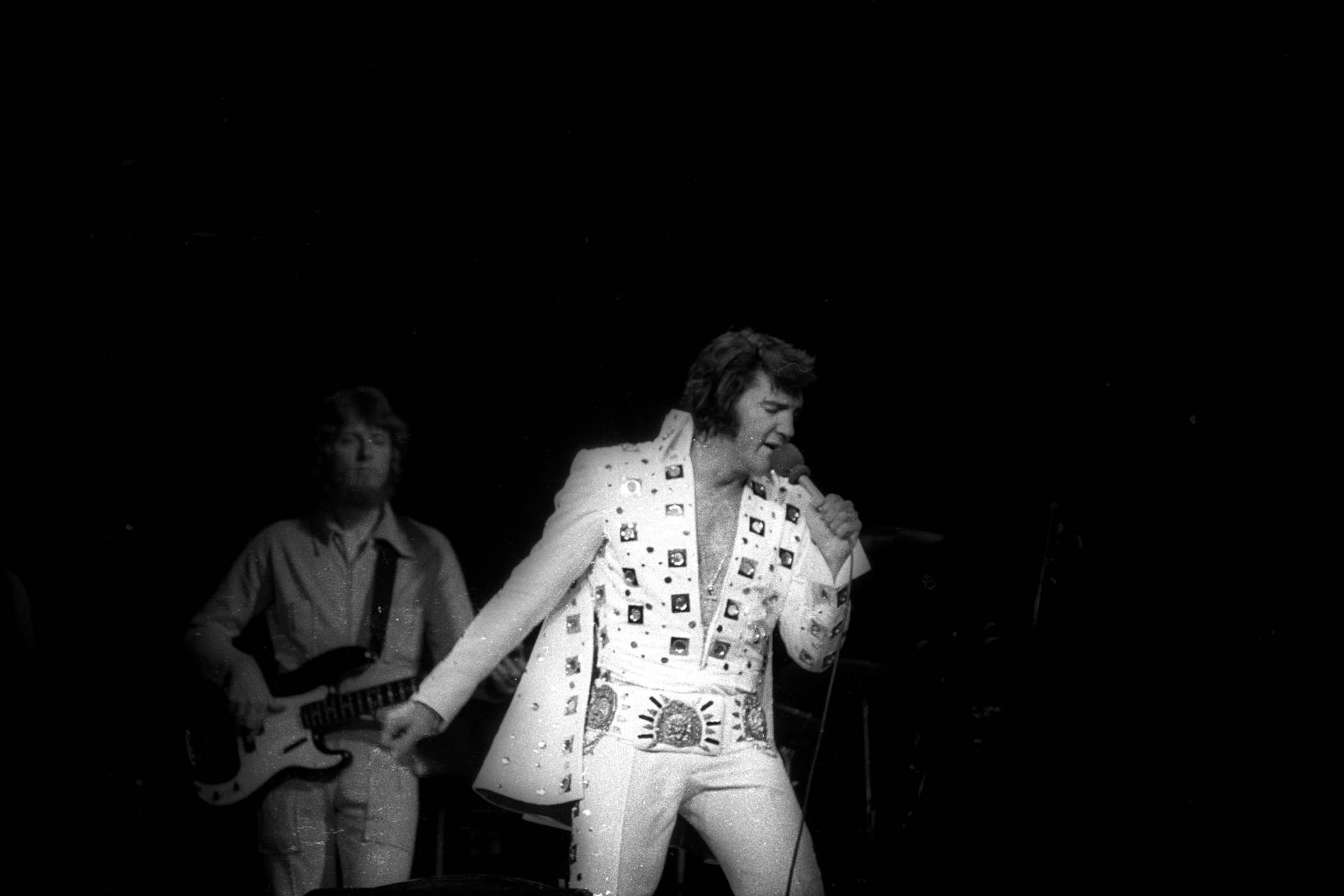


In late 1970, Elvis Presley had a temper tantrum and ran away from home. After a blazing row with his family over profligate spending, he jumped in a car and sped away from Graceland. Thus began a bizarre cross-country adventure culminating in Elvis’s unannounced arrival at the White House in an attempt to meet Richard Nixon and secure an agent’s badge from the Bureau of Narcotics and Dangerous Drugs. Wearing an Edwardian jacket, purple velvet trousers, large aviators and a high-collared silk shirt, he delivered a letter scrawled on airline stationary to the astonished guard in which he offered his services as a soldier in the war on drugs. He repaired to the Hotel Washington, soon receiving a positive reply, eventually meeting Nixon and securing his golden agent’s badge, with a huge “US” embossed in the centre.
There is a truism in pop psychology that for those who achieve a certain level of fame, their development is arrested at the moment fame is achieved. That Elvis coveted and collected law enforcement badges, indulged in have-a-go-hero crime-fighting, practised karate, read comic books and loved pranks all speaks to his essential boyishness – and a development arrested at age 21, when in a matter of weeks he went from a near unknown to a world-changing cultural powerhouse.
This immaturity extended to his spiritual journey which, though earnest, was characterised largely by naivety and impatience. Two major questions motivated Elvis: why had he survived childbirth, when his identical twin Jesse had not? And why had he then been thrust into a kind of mega-celebrity never before seen? Elvis’s spirituality and psychology have been explored elsewhere, notably in Gary Tillery’s 2013 biography The Seeker King (extensively cited here). In The Occult Elvis, Miguel Conner attempts to recast Elvis not just as a spiritual seeker, but as a “shaman, occultist, gnostic, mystic” – essentially, an active and intentional practitioner of magic. And not just that. Conner claims that when compared with noted magic users such as Robert Anton Wilson and Terence McKenna, not to mention Solomon, John Dee and Aleister Crowley, Elvis will “tower above them all”.
However, there is scant evidence provided here that Elvis is comparable to those figures, or that he viewed his musical performances as some kind of mystical praxis. He read widely on spirituality, and attempted to train in kriya yoga, but sulked when enlightenment was not quickly forthcoming. He was preoccupied with attaining “powers” that amounted to yogic parlour tricks; indeed, friends reported Elvis performing paranormal feats, such as moving a cloud from obscuring the sun, or commanding the rain to stop. Conner compiles these anecdotes alongside reports of Elvis’s faith healing, crime-busting and the various supernatural phenomena that are said to have manifested at the time of his death.
He read widely on spirituality, and attempted to train in kriya yoga, but sulked when enlightenment was not quickly forthcoming
He read widely on spirituality, and attempted to train in kriya yoga, but sulked when enlightenment was not quickly forthcoming
Do these accounts constitute evidence of mystical powers? Perhaps they are better understood as the dreamlike cognitive dissonance that occurs when the singular icon that is Elvis suddenly irrupts into one’s reality, as when he told his driver to pull over while a mugging was in progress. (On that occasion, Elvis struck a karate pose, astonishing the assailants and victim so much that they all shook hands, then posed for photos with the King.)
Conner leans heavily on the concept of “high weirdness”, as identified by Erik Davis in his 2019 book of the same name, and correctly defines it as “occultism paired with modern technology, conspiracy theory, psychedelics, and pop culture”. But strangely, he fails to attribute it to Davis – even though he has interviewed the author about the book. Davis is cited later as a “biographer” of Philip K Dick; although High Weirdness is an important contribution to PKD scholarship, biography it is not. Conner’s prose aspires to the kind of funky, west coast outsider style that Davis has perfected, but falls short, too often tripping over a clumsy turn of phrase or resorting needlessly to bullet points in a manner unfortunately reminiscent of a popular AI chatbot.
The central spiritual experience of Elvis’s life came in 1965 while driving through the Arizona desert. He and his spiritual confidant Larry Geller both witnessed a bizarre spectacle: clouds morphing into the face of Joseph Stalin. Only Elvis then saw them change again into the face of Jesus Christ. He later tells Geller: “Christ literally exploded in me … it was me! I was Christ.”
This gnostic insight seems to be as close as Elvis came to the “mystic” of Conner’s introduction. Though he flirted with the possibility of a messianic calling, he ultimately concluded that he was put on Earth to bring happiness through his music. As he told Geller in 1974, long after his theophany, “I’m not a preacher; I’m an entertainer … That’s how God [is using] me, that’s my role, and I love it.”
Now read the runners-up Julia Clayton, reviewing Southport’s Atkinson Art Gallery, and No’a L bat Miri on a new opera
Photograph by Getty
Newsletters
Choose the newsletters you want to receive
View more
For information about how The Observer protects your data, read our Privacy Policy