Not all dramatists lend themselves to an adjective. I doubt Caryl Churchill would want her plays to be called “Churchillian”. Still, “Pinteresque” is evocative. And “Stoppardian” is a useful shortcut to Tom Stoppard’s drama of ideas, fizzing dialogue, winking puns, surprising bursts of emotion. All the plays – including those for radio – are evidently by the same hand, but are wildly variable. In 1966, Rosencrantz and Guildenstern Are Dead thrilled with its swift unzipping of Hamlet, performed in the same year that another vital reimagining of a classic, Jean Rhys’s Wide Sargasso Sea, was published.
In 2002, The Coast of Utopia sagged under the weight of information shovelled on to the stage. In between were the agile paradoxes of Travesties and Jumpers, the sudden tenderness of The Real Thing (to which David Bowie offered his acting services). Then, five years before his death late last year, versions of the playwright himself on stage in Leopoldstadt.
Arcadia contains glimmers of all these Stoppards. Directed in 1993 by Trevor Nunn, its first cast included Bill Nighy, Harriet Walter and Samuel West; Ralph Fiennes and Hugh Grant were turned down for the part nabbed by Rufus Sewell. With a magisterial sweep helped by Nunn’s ability to make a stage seem to move to music, the play was a tremendous success with readers as well as audiences: there were 28 print runs of the text between 1993 and 2008.
Freighted with more varied arguments, notions and wheezes than any other of Stoppard’s dramas, Arcadia is also concerned with the disruptive effects of love: the much discussed “action of bodies in heat” concerns private parts as well as planets. There is no overarching thesis, other than that any overarching thesis is likely to be fallacious: “almost everything you thought you knew is wrong”. All this demands a difficult balancing act: keeping the action airborne, keeping it clear. Carrie Cracknell’s production delivers considerable lucidity but without wings.
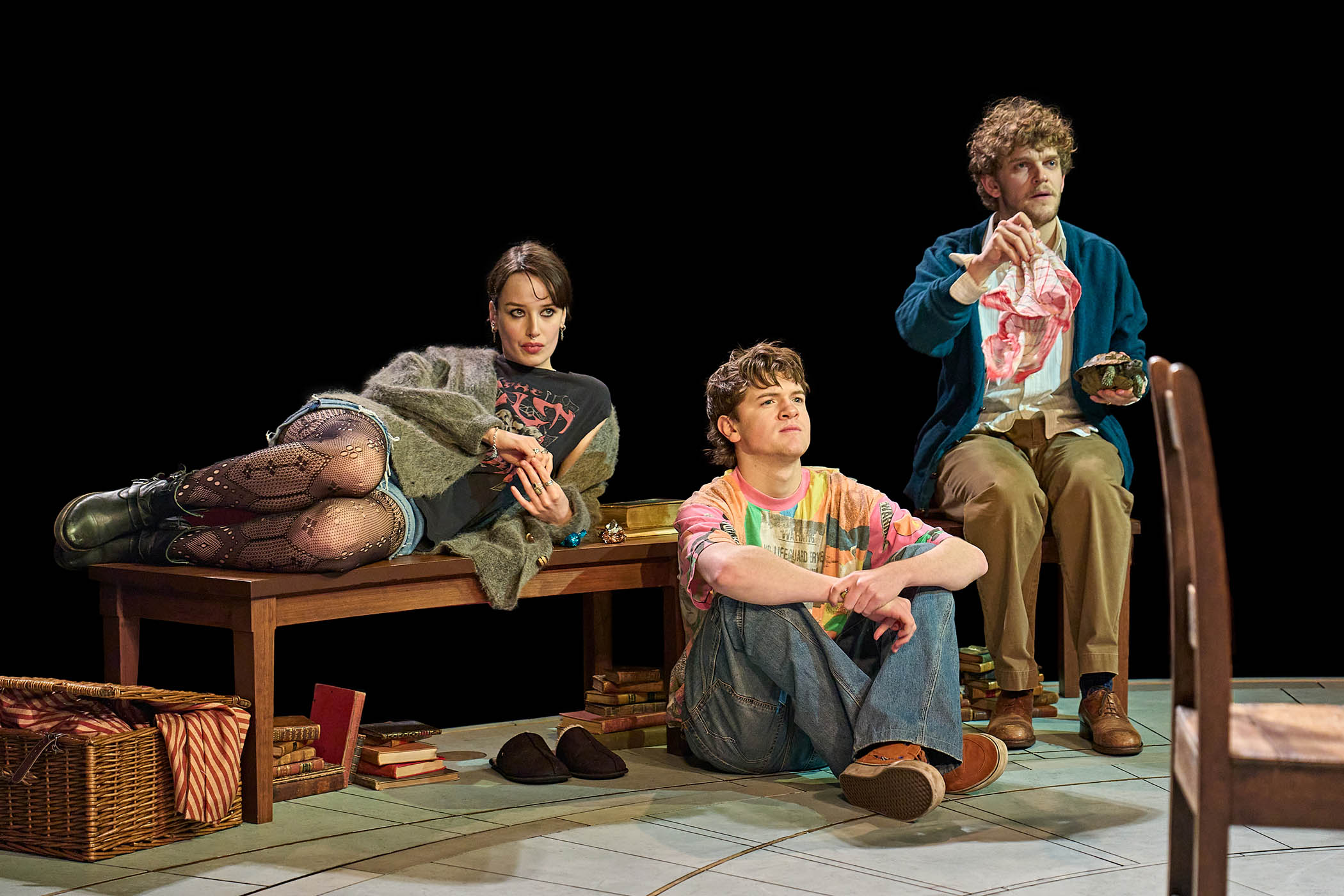
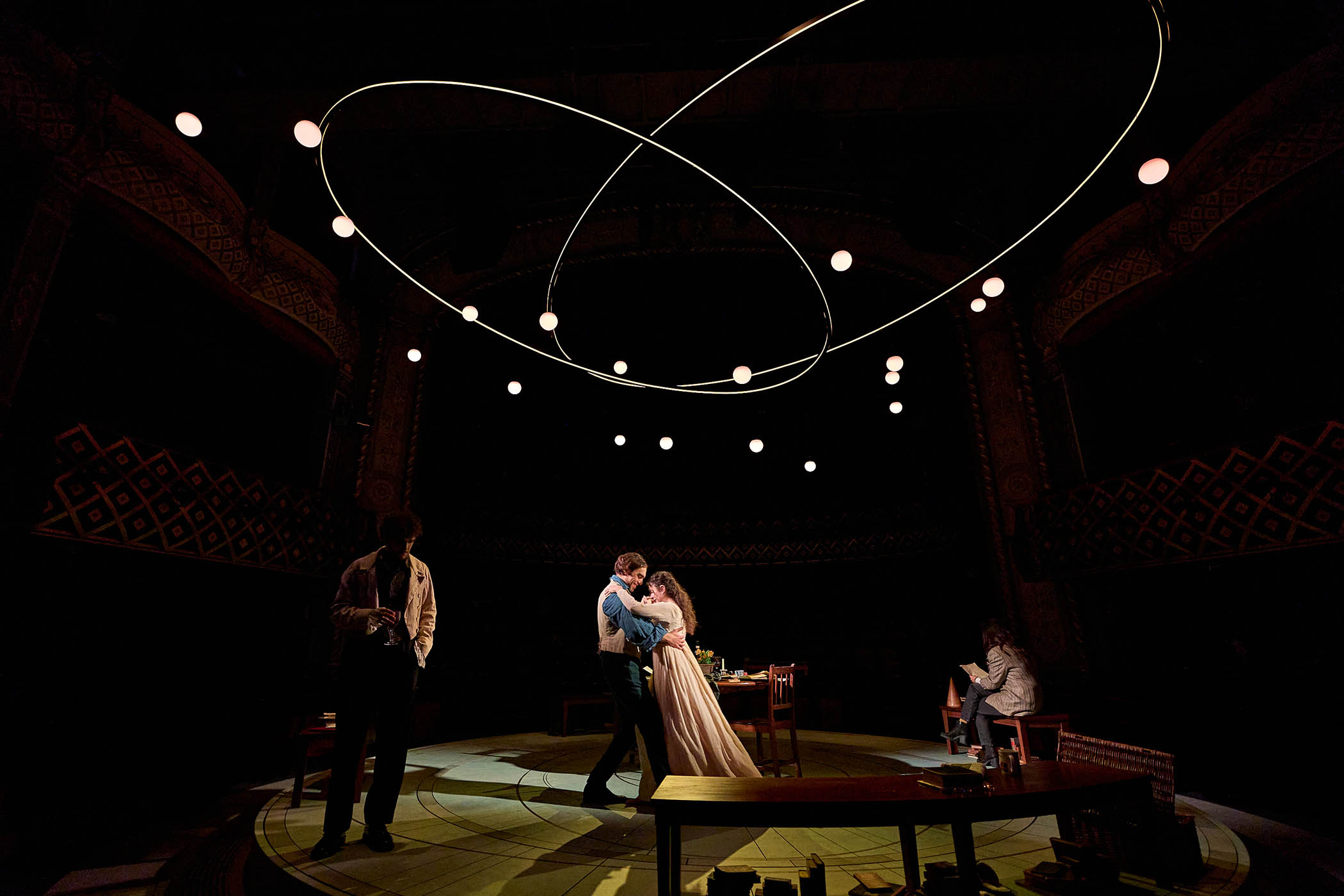
‘Scenes separated by 150 years are acted on an unchanging stage’: Holly Godliman William Lawlor and Angus Cooper in the present. Main image: Isis Hainsworth and Seamus Dillane
Scenes separated by more than 150 years are acted on an unchanging stage. In the early 19th century, a teenage genius (not, Stoppard insisted, inspired by Byron’s daughter Ada Lovelace) teases out the limitations of Newtonian theory. She also teases her tutor. There are sexual flurries in a summer house, a duel, a comically terrible poet, a discussion about landscape gardening, a hermit, and a blizzard of jokes: “Do you think God is a Newtonian?” “An Etonian? Almost certainly, I’m afraid.”
More than a century and a half later, a media don, a literary historian and a scientist try to piece together earlier events. The audience can smugly see them getting things wrong. AS Byatt said that Stoppard told her he had “pinched” the plot of her novel Possession.
From the beginning, Cracknell’s production is clear (no mean feat) but overdeliberate. Alex Eales’s design emphasises several times over the discussions of time and planetary motion. A model of the planets, from time to time seemingly set in train by a streak of neon, hangs above the stage; the performance is in the round; the stage revolves. On press night, the opening joke – a pun on “carnal” designed to perk up a Latin-savvy audience – sounded both lumbering and facetious: the flatness, seeming to last for minutes, seeped through the opening scene.
There is plenty of brio in the landscape-gardening episodes, which explore classicism and romanticism via a form of antique Cluedo: what is being committed and by whom in the gazebo or on the Chinese bridge. As the prodigy, Isis Hainsworth, quick and luscious, is a discovery, well balanced by Seamus Dillane as her elusive tutor. Stoppard wrote his own criticism when he included discussion of the inevitable loss of heat over time: the 20th-century scenes are slower and more coarse-grained. Nevertheless, a line cut during the first production now seems prescient: “shamelessness is my strong point”.
Arcadia ends with a waltz in which both eras take part. Yet, overall, this dance to the music of time is short on swing. What Cracknell does bring is an intent focus on Stoppard’s elaborate mirrorings: puns in the text, two meanings throughout the action. Everything is seen both in furrowed and frisky mode, in miniature and writ large: ah, fractals! (At least, I think so.)
Each century has not only its own algorithmic obsession but its own pet tortoise: one is called Plautus (you have to say it aloud); the other, Lightning. Tortoises are a Stoppard theme, occasioning a brilliant Hamlet joke in Jumpers. Now there’s a subject for a PhD. No doubt someone is already beavering away.
Newsletters
Choose the newsletters you want to receive
View more
For information about how The Observer protects your data, read our Privacy Policy
Photographs by Manuel Harlan