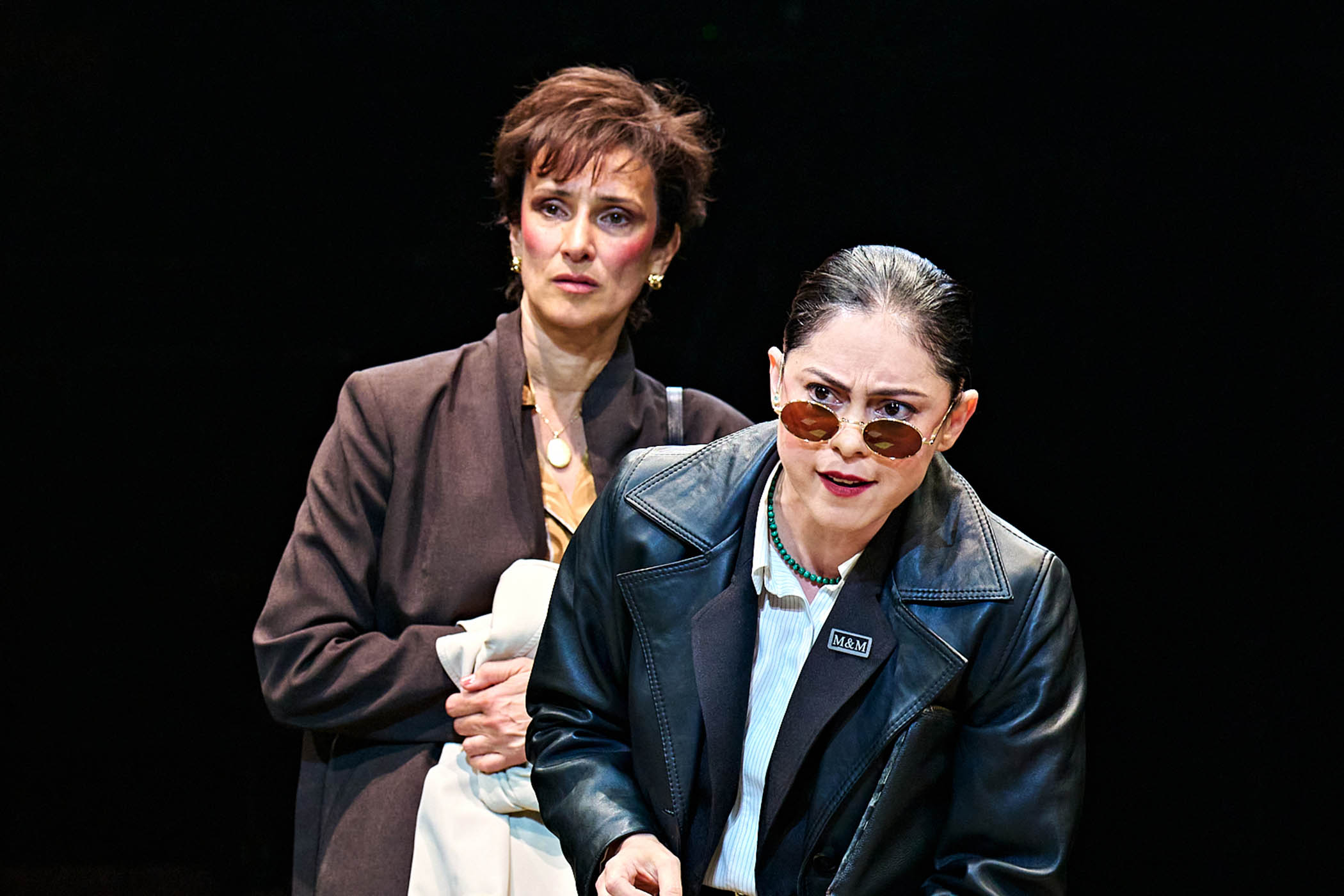


“This is not a world of men,” complains the swaggering Richard Roma in a dismissive swipe at his colleagues halfway through David Mamet’s abrasive and influential play about chicanery in the Chicago real estate trade. It’s a macho business in which clinching land deals and cheating buyers is a fundamental, defining daily goal. Roma’s line is more demonstrably true in director Patrick Marber’s new production than Mamet could ever have intended, because all the cast are women. The enjoyable textual jolt is one of several in a show that sets out to remodel the expletive-ridden one-up-manship of a script that has been quoted around the world since the success of the 1992 film version.
Staged in the round in the stately Old Vic, on a bare platform with a minimal set (from Rob Howell) that represents both the local Chinese restaurant that the sales team haunt and the office that dominates their lives, the suspense of Mamet’s plot is amplified by tense anticipation of those heavily-gendered slices of dialogue that will sound most incongruous from the mouth of a female actor. In one sweary exchange an office-bound boss is insultingly compared to a “secretary”. In other words, to a mere woman. At another point a remorseful purchaser (an affecting Mercedes Bahleda) turns up in a fur coat and heels to cancel her deal, and confesses shamefacedly that it is her wife who has vetoed the sale.
As Shelley Levene, the company’s fading former “sales machine”, Indira Varma grabs Marber’s challenge of daring a bunch of women to take on such stereotypically male roles, together gamely facing the inevitable risk of throwing the rest of the storytelling into the shade. Helpfully, her character, a direct dramatic descendant of Arthur Miller’s salesman Willy Loman, was always ambiguously named Shelley, but the fellow sales staff around her – all straining in their skirt-suits and blow-dries to develop the “leads” that will allow them to earn a crust – are called James, Dave and John.
A teenage Marber saw the play in its original 1983 production, which was directed by Bill Bryden for the National Theatre’s small Cottesloe stage. He was struck then, he has said, by the speed and energy of the performances. I saw that production too, sneaked into the back by an usher friend, and I also remember the ensemble fireworks of a cast that included Jack Shepherd and Karl Johnson, part of a familiar repertory company at the National in that era. The Observer’s first review, ironically, poked fun at the trad use of a curtained proscenium stage in a modern black box space, but it also saluted the play as the best on in London. Critic Robert Cushman noted “Bryden’s boys did good by it”, largely pulling off the accents.
Back then some of the theatrical excitement was definitely supplied by the fact these British actors were donning the mantle of foul-mouthed, fast-talking American salesman. Marber must have suspected that today, with the play so well-loved, it might take more than that to create a spectacle, and the conviction of his female cast, particularly Nicky Wardell as Dave Moss, is indeed something to behold. But part of Mamet’s magic is to so closely mimic the cut and thrust of urgent, competitive male discourse that it needs no embellishment. After all, the play’s most famous phrase, the salesmen’s doctrine “always be closing”, is also true of the structure of this play, which relentlessly drives one central character towards an unavoidable destination – an undesirable single-occupancy property at the back of a police station.
It would be unfair to say this version is simply cos-playing the testosterone-fuelled male world to highlight its peculiarities anew. The impact is entertaining and touching, and, what’s more, the context has already been refreshed: the new audience will be familiar with the hardboiled female American realtors featured on reality TV shows, while the Trump regime provides a grim dog-eat-dog background that is at least equivalent to the one that inspired Mamet to write the play in the early 1980s.
Glengarry Glen Ross is at the Old Vic, London SE1, until 18 July
Photograph by Manuel Harlan
Newsletters
Choose the newsletters you want to receive
View more
For information about how The Observer protects your data, read our Privacy Policy