Related articles:
Photographs by Adama Jalloh
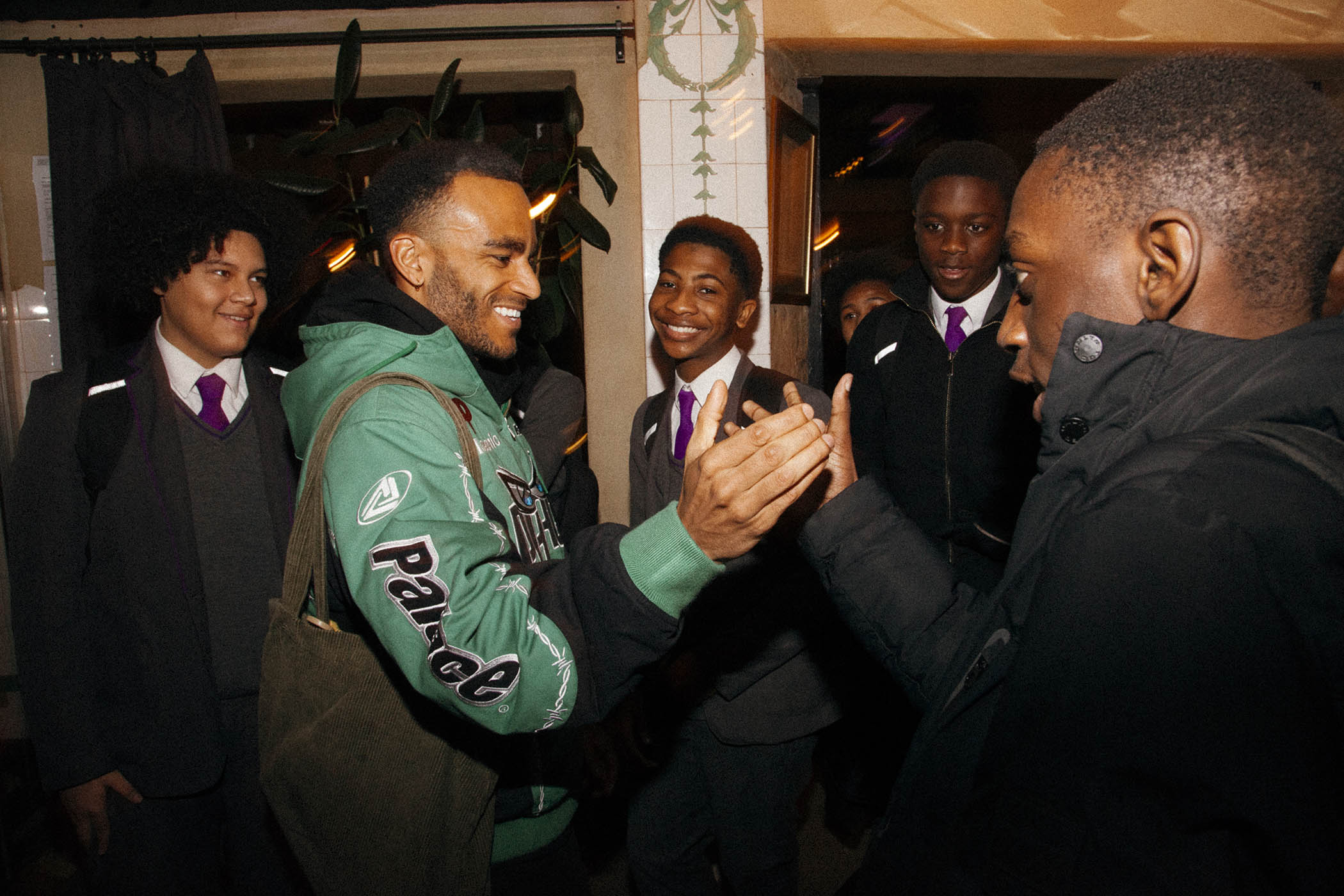
During the interval of Bengal Tiger at the Baghdad Zoo at the Young Vic, a student from Elms Academy in Lambeth, south London passes his phone down the row of seats to show his fellow pupils something. It’s a video of Unknown P, a middle-class drill rapper who wears a flat cap and spits boastful lyrics about the opera, yachts and eating olives in Venice. It’s one of the many alter egos of the actor and satirical comedian Munya Chawawa, who is sitting in a row behind the students. Chawawa had already introduced himself to the group of boys a few hours earlier – and they’d excitedly asked their teachers of his whereabouts before he arrived at the theatre – but it’s as though it’s just dawned on them that they’ve been taken to a play by the same guy they see all over TikTok.
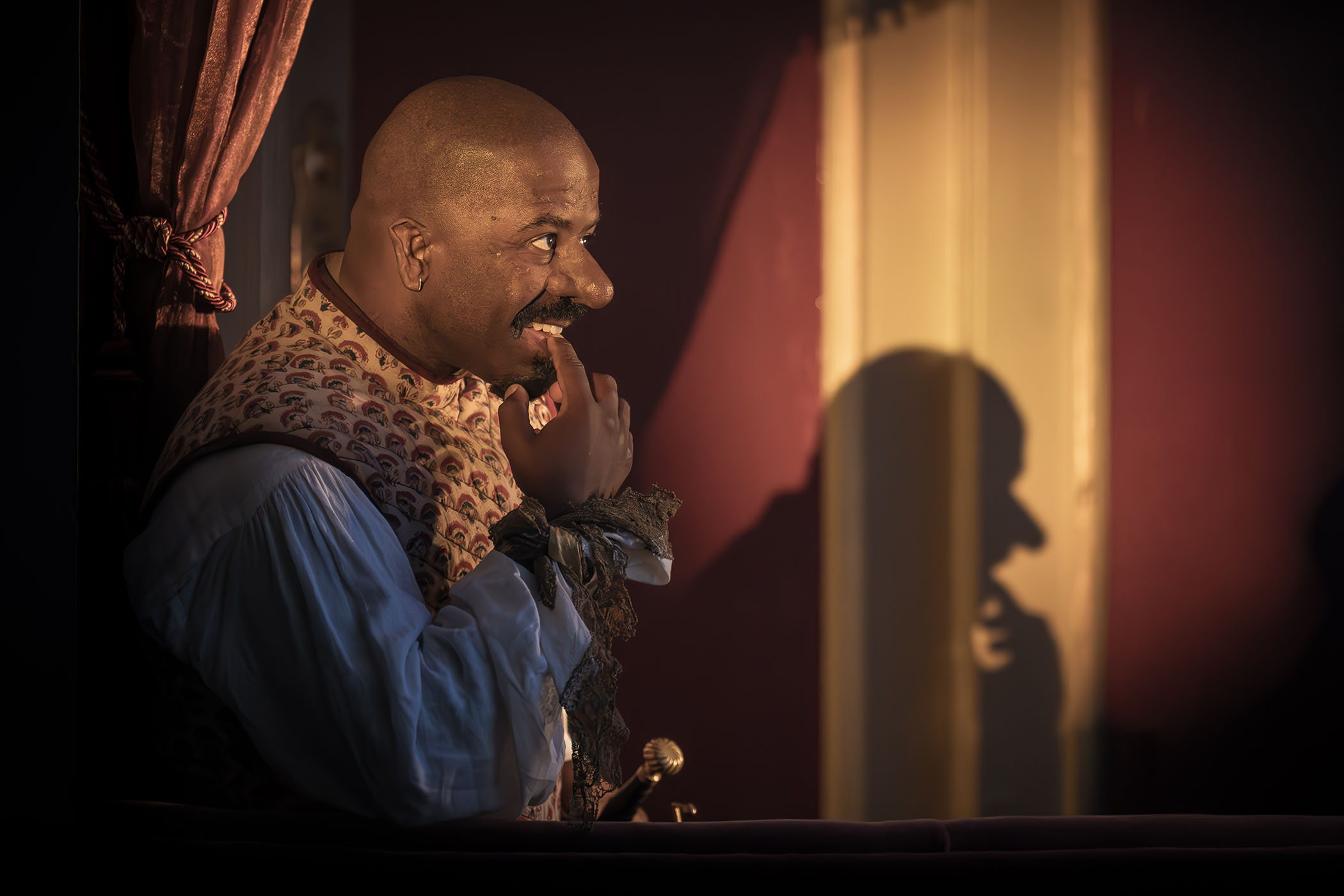
“I love the staging,” Chawawa tells me as he hands out small tubs of ice-cream to the boys while we wait for the second act of Rajiv Joseph’s Iraq war drama to start. “I love the exploded rubble. How they went between an army base camp to an asylum room, to a zoo, to a military zone. I’m interested to learn more about why the tiger has a Scottish accent.” When Chawawa isn’t releasing viral rap skits, appearing on TV shows such as The Great British Bake Off, or posting witty political sketches to his millions of social media followers, he can be found at the theatre. He goes to several shows a month. “Theatre makes me so happy. It’s like being able to step inside a dream where anything can happen.” Bengal Tiger at the Baghdad Zoo is set after the 2003 invasion of Iraq and features the ghost of a tiger wandering Baghdad and haunting the US marine who shot it. “I felt bad for [the marine],” Joshua, 16, tells me. “That’s what I like about acting. It makes people feel emotions.”
Chawawa – who was raised in Zimbabwe then, from age 11, Norfolk – has quietly been taking school groups of young Black boys to the theatre for the past year. He announced his project Black Boys Theatre Club last October, with a promotional video featuring Black British actors such as Jordan Stephens, Kedar Williams-Stirling and Mohamed Elsandel. The project aims to “open up the world of theatre to a new generation of young Black boys” with support from the National theatre, Regent’s Park Open Air theatre, Bush theatre – and Nando’s. But why just Black boys? “Sometimes there is a wrong assumption that if we’re doing something for a particular group, it’s to the detriment or the alienation of another group. It’s not that. It’s that sometimes there is so little joy among Black boys as a group, wouldn’t it be nice to see a little more?” says Chawawa. “Theatre is for everyone, but the people least likely to come to it are Black boys.”
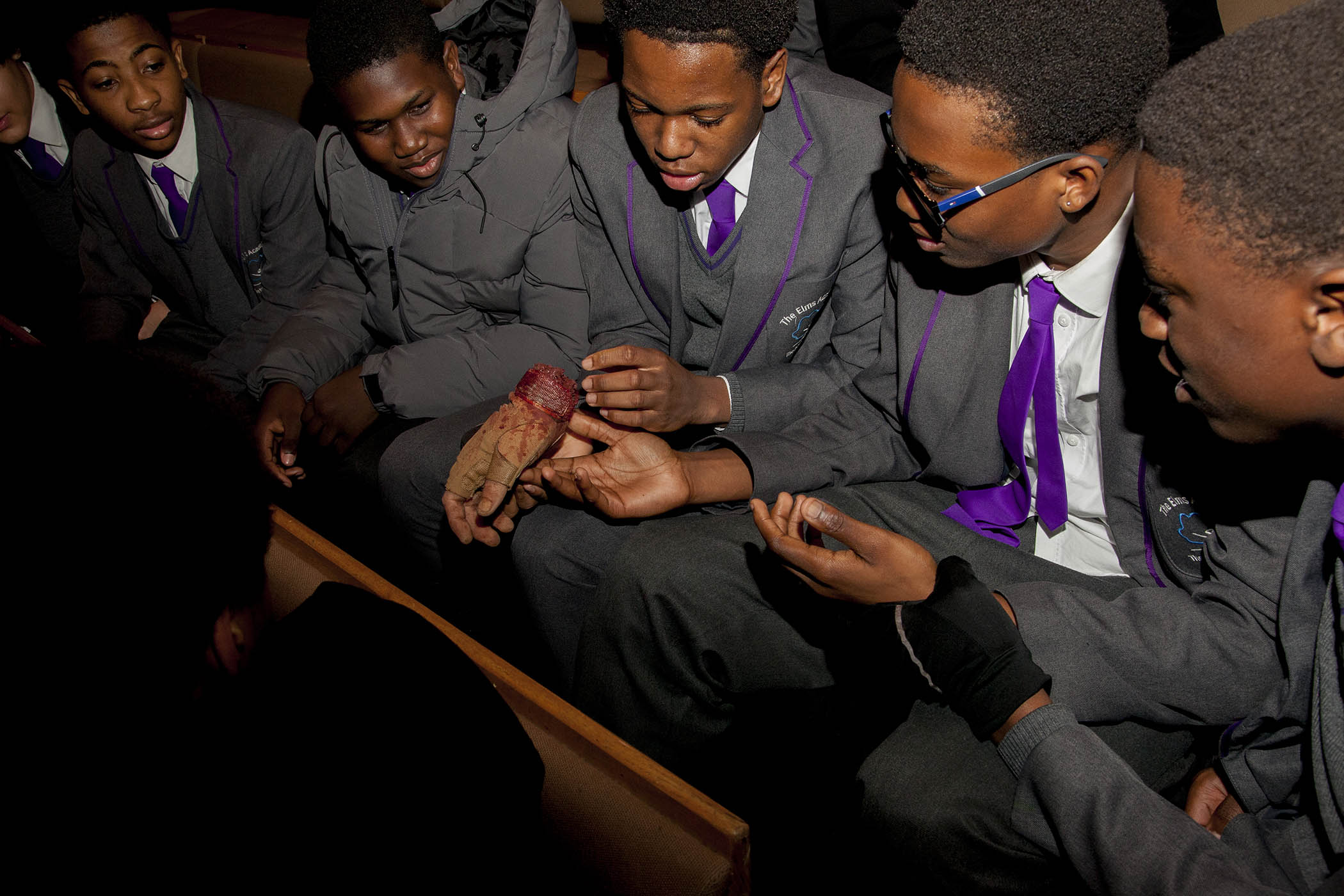
The boys are given a behind-the-scenes experience, passing around props, including gruesome severed limbs
If there is a link between the absurdity of Chawawa’s Unknown P, who raps about trust funds and private school, and the existence of Black Boys Theatre Club, it is that they both, in some way, attempt to reckon with the idea of privilege and accessibility. A 2020-21 Arts Council England report found that 93% of audience members attending nationally funded shows were white, despite about 18% of the population of England and Wales and 46% of London being non-white. In recent years, there has been an effort to draw more Black people to theatres through “Blackout nights” for Black-only audiences, but not without backlash.
Still, shifting the way Black boys see the theatre is at the heart of this scheme. “[It’s] a very intimate experience,” says Chawawa. “I might see a man who looks like my father, or uncle or brother cry in front of me or laugh hysterically or erupt in rage.” His theory about why Black boys aren’t as present in theatres as other demographics is to do with how confronting the experience can be. “One thesis I would put forward is that we are alien to our own emotions and it’s a scary experience knowing that there are rooms where you might face them point blank.”
Watching the boys of Elms Academy arrive at the Young Vic, lively and laughing despite it being a cold, wet January afternoon, feels all the more significant knowing how rare such experiences can be. Their teacher tells me that many of the boys, who are aged 14 to 17, are talented drama students, aspiring actors or musicians. For many of them, this is their first or second time seeing a play, and Chawawa makes sure to give them a rundown of theatre etiquette. “No rustling snacks. Phones in your pocket,” he says with the warmth and seriousness of a father talking to his clan. “I just came from a play with a group. It was the most intense moment of the play. This mother is crying because her son has gone to jail, and one of the boys farted out loud.”
At Nando’s, one boy says the play educated him about the reality of war. “The pacing was overstretched,” says Lejohn, 14
At Nando’s, one boy says the play educated him about the reality of war. “The pacing was overstretched,” says Lejohn, 14
“There are a lot of ghosts,” Nadia Fall, artistic director of the Young Vic, warns the boys, though much more terrifying things pop up throughout: psychosis, existential dread, sexual violence, war crimes and severed limbs. The boys don’t hesitate to grapple with the play’s complex themes and character dynamics. In one scene a US marine tells another that he never considered him a friend. “That hit hard,” says 17 year-old Ephraim. “When it comes to war, it might be too little too late to start making friends because you don’t know if you’ll end up dying. If you survive and they don’t – that’s heavy.” Another boy told Chawawa that he thought the play was a dissection of PTSD in the military, and that the tiger was a representation of the parts of war that cling to a person.
Related articles:
The club hopes to facilitate these conversations while offering the boys insight and access to professionals to demystify the industry. After the play ends, the boys attend a Q&A with the cast, who talk about how they prepared for their roles. “I watched videos of him partying,” says Sayyid Aki, who plays Saddam Hussein’s eldest son Uday. “He was always quite goofy but everyone around him was terrified because he was unpredictable. There’s something darkly comic about the goofy spoiled son of a dictator.” The boys listen intently. “How do you perfect accents?” Joshua asks. The Irish actor Patrick Gibson, who plays the other US Marine, answers. “We have a dialect coach whose job is to help us find the sounds that we’re not quite getting right.”
Later, the stage manager hands the boys some props – a severed hand, and a pillow that sprays fake blood – and talks them through how they’re made. Chawawa wants them to see what goes on behind the scenes. “I’m trying to convince the boys that it’s not just actors, but you’ve got stage hands, lighting, sound.”
Newsletters
Choose the newsletters you want to receive
View more
For information about how The Observer protects your data, read our Privacy Policy
Numerous studies have shown Black people are disproportionately underrepresented and disadvantaged in arts and culture roles across the UK. “Diverse teams challenge biases and build equitable processes for all,” says the Manchester-based playwright Zodwa Nyoni, whose play Liberation ran at the Royal Exchange and Manchester international festival last year. A 2025 census by Major Players showed that Black men and women were on average the lowest paid across the creative industries, in both permanent salaries and freelance day rates. Black, Asian and Minority Ethnic representation had increased in the last 12 months, but is still below the UK national average of 18.3%. Having BAME people in positions of power, and paying them sufficiently, is key to ensuring a healthy creative scene that benefits all. “When writers of the global majority are placed in positions of being both creative and educators for institutions and audiences, they end up doing additional labour in the creative process; and are forced to make work while constantly explaining and justifying their existence in the industry,” says Nyoni.
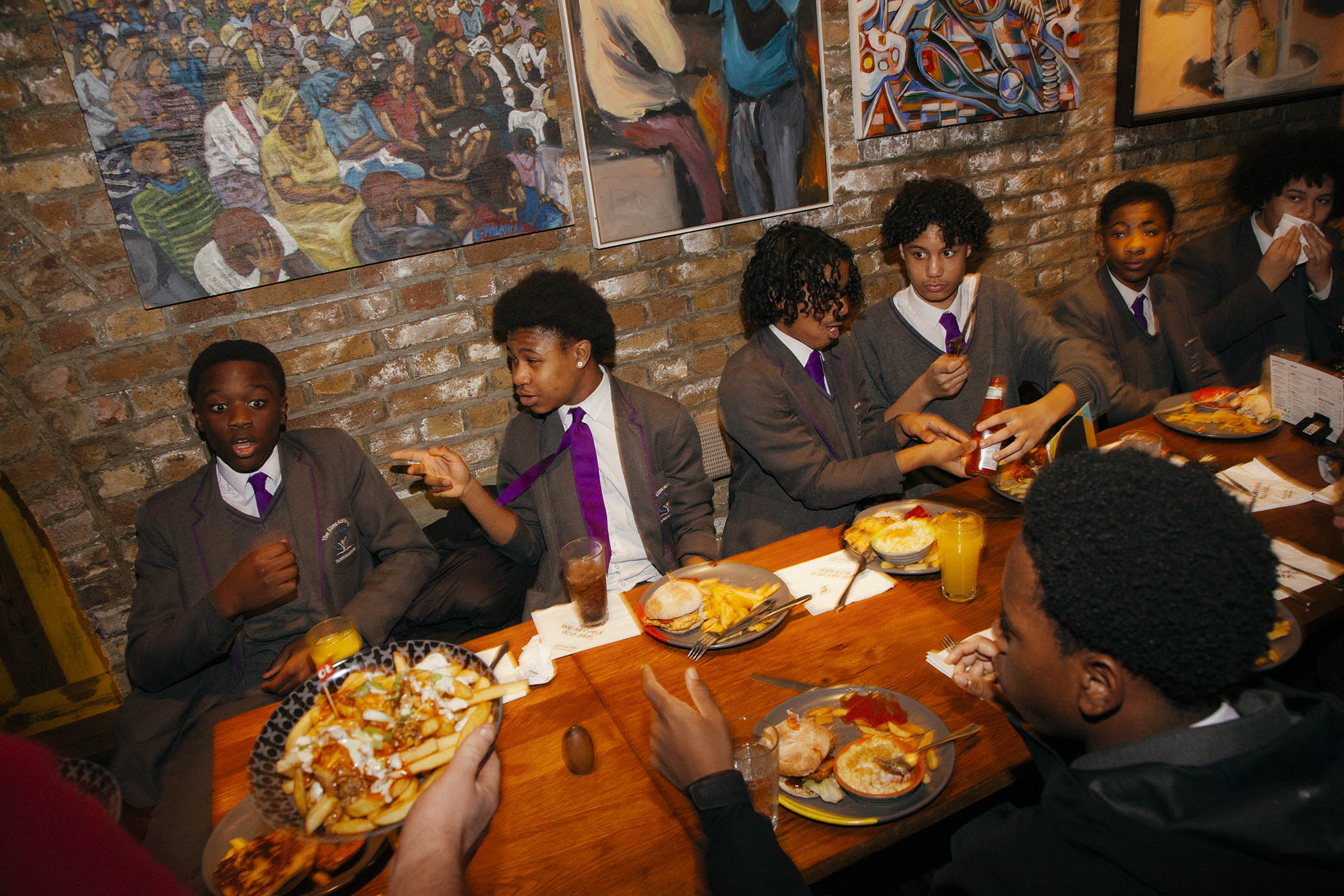
Pupils from Elms Academy in south London tuck into a Nando’s after their trip to the theatre
It’s dark by the time the pupils arrive at Nando’s. Chawawa isn’t able to join them due to a work commitment. Usually he takes away the boys’ phones so that they can have an undistracted discussion about the play over dinner. It’s a lot harder for the teachers on hand to achieve this without Chawawa here, but a few of the boys are keen to share their reviews. One rates the play an eight out of 10. Another says it educated him about the reality of war. “The pacing was overstretched,” says 14-year-old Lejohn. There’s a sense of creative electricity in the air. One of the boys asks if I can help him get work in acting. Another asks how they should go about getting an agent.
This set of boys are particularly ambitious, but that’s not always the case, says Chawawa. He is keen to manage expectations about the project. “I don’t want people to mistakenly assume that boys come on this trip, and whatever play we watch is so life-changing to them that they walk out the theatre instantly sprinting home to learn all of Shakespeare’s monologues,” he says. “If you go to a museum, you’re not going to remember all the paintings. You might not remember a single phrase from a play. You might remember the tune of a song, but not all the lyrics word for word. It doesn’t matter. Some fragment of that paint, metaphorically, has decorated your canvas.”
A 2025 BBC investigation found that teenagers are being exposed to content about weapons, bullying, murder and suicide soon after joining social media platforms. Chawawa is all too aware of this: he’s had conversations with other groups of boys about the explicit and violent videos they have come across. “We know intuitively, even as time passes, some part of [that content] stays with them for ever and alters [their] brain chemistry,” he says. “By the same token, theatre can affect us in those ways. Even by a millimetre, the plays we see can change your brain chemistry.”
Black Boys Theatre Club hopes to be more than just a nice gesture. It aims to put a positive stamp on the theatre world that is felt long after Chawawa has retired from entertainment. But there’s a feeling that he gets much out of it personally too. “I love to see Black boys smile. That is the truth,” he says. If smiles are the goal, the club has achieved that today. As the boys get ready to head home, they beam as they reflect on the events of the day. They express gratitude for the food, say how much they respect Chawawa for starting the club, because “he’s helping people”, and comment on his humility. “Shout out to Munya,” says Lejohn. “Cause you’re really nice. You took us to the theatre and you took us to Nando’s, which I really liked. Is he going to take us again?”