It is hard to imagine a more thrilling rendition. Jordan Fein’s production of Into the Woods hits every moment bang in the centre: from the footsteps of the Giant, whose reverberations are equivalent to a gang of builders drilling under every seat, to the super-size, penis-like beanstalk that rockets over the stalls. Crucially, the constantly changing plait of bitter and encouraging is tight and right: “Nice... and a little bit not.”
First staged in 1986, this is Sondheim at his most recoiling, rewinding, revising. Five years earlier, Merrily We Roll Along, now vividly filmed by Maria Friedman, went back on itself chronologically. Into the Woods remakes itself emotionally – several times in one evening. Is the “into the woods” refrain, which so immediately entangles an audience’s ears, bouncily determined or frightened? The marching rhythm argues with shivering woodwinds and strings.
James Lapine’s script is as disputatious as Sondheim’s score: a compote of tales drawn from Grimm rather than the more candied Perrault (the Ugly Sisters are given away by puddles of blood after their heels are chopped off to fit the prince’s slipper). There are many happy endings, but after the interval these are unpicked: a wife, having finally become a mother, gets crushed by the Giant’s foot; a granny, released from the Wolf’s belly, pops her clogs. Then things twist again. Bleakness is not banished – after all, “life is often so unpleasant/ You must know that as a peasant” – but dealt with practically, generously, resourcefully. People help each other out instead of hanging around waiting for a pumpkin coach.
It is easy for this to straggle. Not here. Fein, who with Daniel Fish created the hauntingly stripped-back Oklahoma! and last year redefined Fiddler on the Roof, is a foe of slack pacing and emotional flab. His unsentimental precision is perfect for projecting Sondheim’s steely distinctions: “Nice is different than good.”
Little Red Ridinghood looks as if she could make the Wolf cough up Grandma by spanking his bottom
Little Red Ridinghood looks as if she could make the Wolf cough up Grandma by spanking his bottom
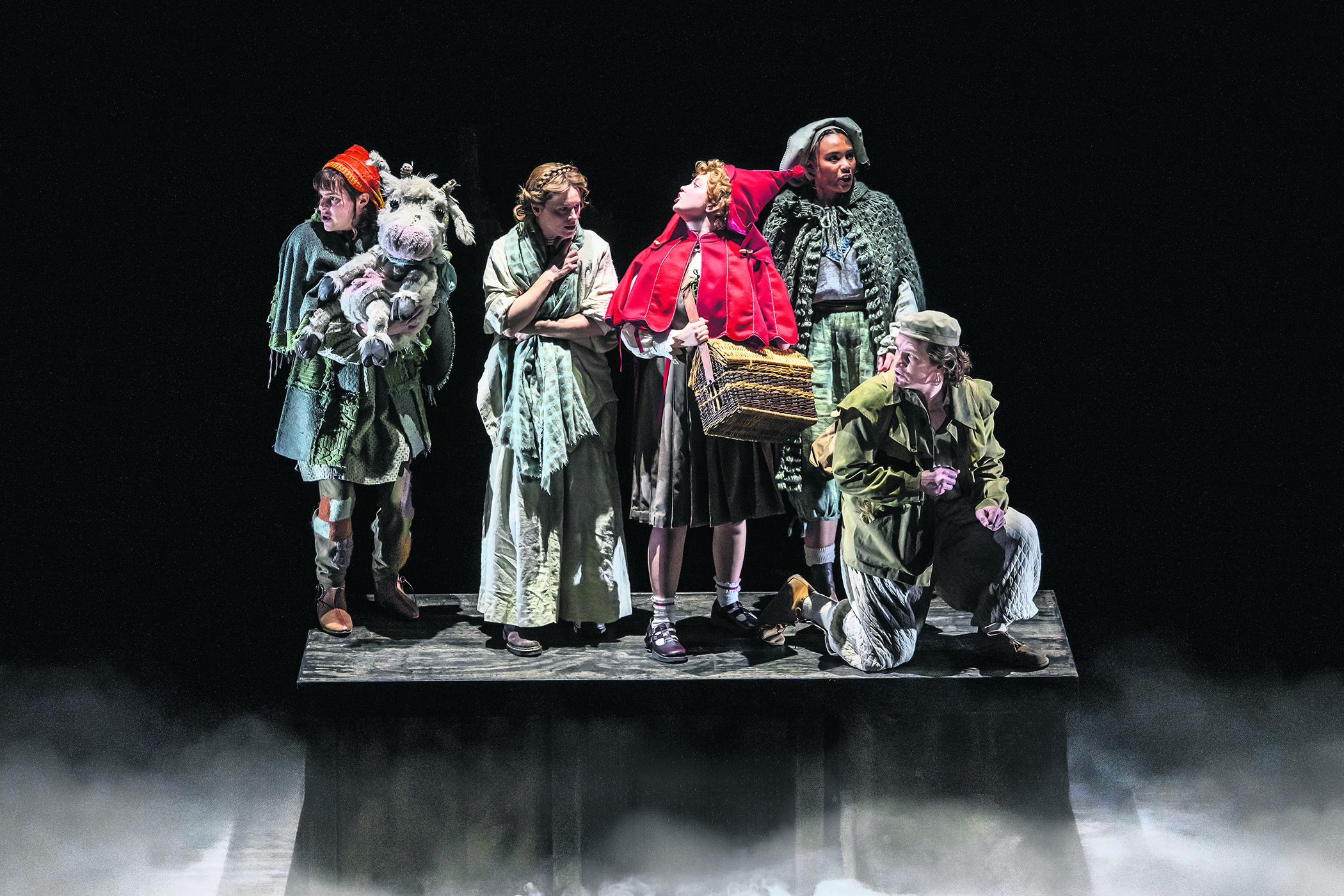
Scutt’s costumes – with the exception of Michael Gould’s corduroyed narrator – are ebullient, playful but not arch. As an arresting, creamy voiced Cinderella, Chumisa Dornford-May wears a low scooped ballgown not in girly princess colours but seductive twilight shades. Oliver Savile’s enjoyably eyebrow-wagging, ridiculous Prince – brought up to be “charming, not sincere” – is got up like the knave in a pack of cards, in diamond-patterned hose and a massive codpiece. There are slightly squashy hats all round with occasional touches of liripipes. A witch kit – a hunched bundle of putty-coloured cloth – makes Kate Fleetwood’s flesh look like stone.
He has the ideal designer in Tom Scutt, most celebrated for Cabaret though at his most original in a bare-board maritime design for Carousel and an extraordinary grass-covered shtetl for Fein’s Fiddler on the Roof. Scutt goes to the heart of things. His wood prickles with depths and possibilities, allowing a witch or a cow to vanish and reappear. Roland Horvath’s video design helps to make it an unstable place of movement. Aideen Malone’s lighting coats the vegetation in secrecy and creates a remarkable moment towards the end of the evening when the Witch, who turns out not to be such a bad egg (“Witches can be right”), takes off with her daughter, Rapunzel. The two exit the scene walking on beams of light as if they were treading the radiant way.
This is an infinitely stronger production than the visually noisy one Terry Gilliam offered in Bath three years ago, when larkiness swamped action and feeling. There are no dim performances. Twenty-seven years ago, I thought I had seen the definitive Little Red Ridinghood in the shape of a 17-year-old Sheridan Smith, who dimpled like a six-year-old and scolded like a matron. I wouldn’t take back my words about her being “a comic find”, but the memory did not diminish Gracie McGonigal’s fresh interpretation: no-nonsense, practical, she looks as if she could make the Wolf (Savile again) cough up Grandma by spanking his bottom.
In the crucial role of the Baker’s Wife – her wish for a child triggers the action – Katie Brayben sings and acts with lovely candour. Oh, and it’s worth the price of a ticket to see Fleetwood give the performance of a lifetime. When she sings Last Midnight, it is as if the music is stretching her sinews. Her voice cuts through tangles. Her morphing – from scrunched-up curser to anxiously loving mother, from magical force to strong grappler with the outside world – gives the evening its pulse. She takes the audience out of the woods.
Into the Woods is at the Bridge theatre, London, until 30 May
Photograph by Johan Persson
Newsletters
Choose the newsletters you want to receive
View more
For information about how The Observer protects your data, read our Privacy Policy