
Erin Doherty’s favourite day on the set of A Thousand Blows involved the moment she got to tell everyone to fuck off. In the lively period drama about boxing and organised crime and the bad old days of London’s East End, she plays a gang leader named Mary Carr, who runs a motley crew of female thieves. At the end of the first season, Mary’s power looked as if it might be fading, but here she is in season two, reasserting her authority. “I am queen,” Mary announces, to the streets. “Now fuck off!” Doherty roars the line as if dredging the words from the bottom of the ocean. “It just came out like this war-cry-scream,” she told me recently, with a big smile. She had no idea that it was going to emerge from her body with quite so much power.
Doherty and I were talking in late November, in London, while she was enjoying some rare time off before Christmas. We were sitting on opposite ends of a large sofa, in an enormous room so empty it almost made a point of not having any character. She had arrived in jeans and a V-neck jumper – she described herself as “pretty low-key” – and would have given off an air of normalcy had it not been for an enthusiasm so potent that all I could do was point out how upbeat she seemed. “I am an inherently positive person,” she told me. She is also an outlier, who, within a fickle industry, seems to do what she wants to rather than what she thinks she is supposed to, which makes her stand out.
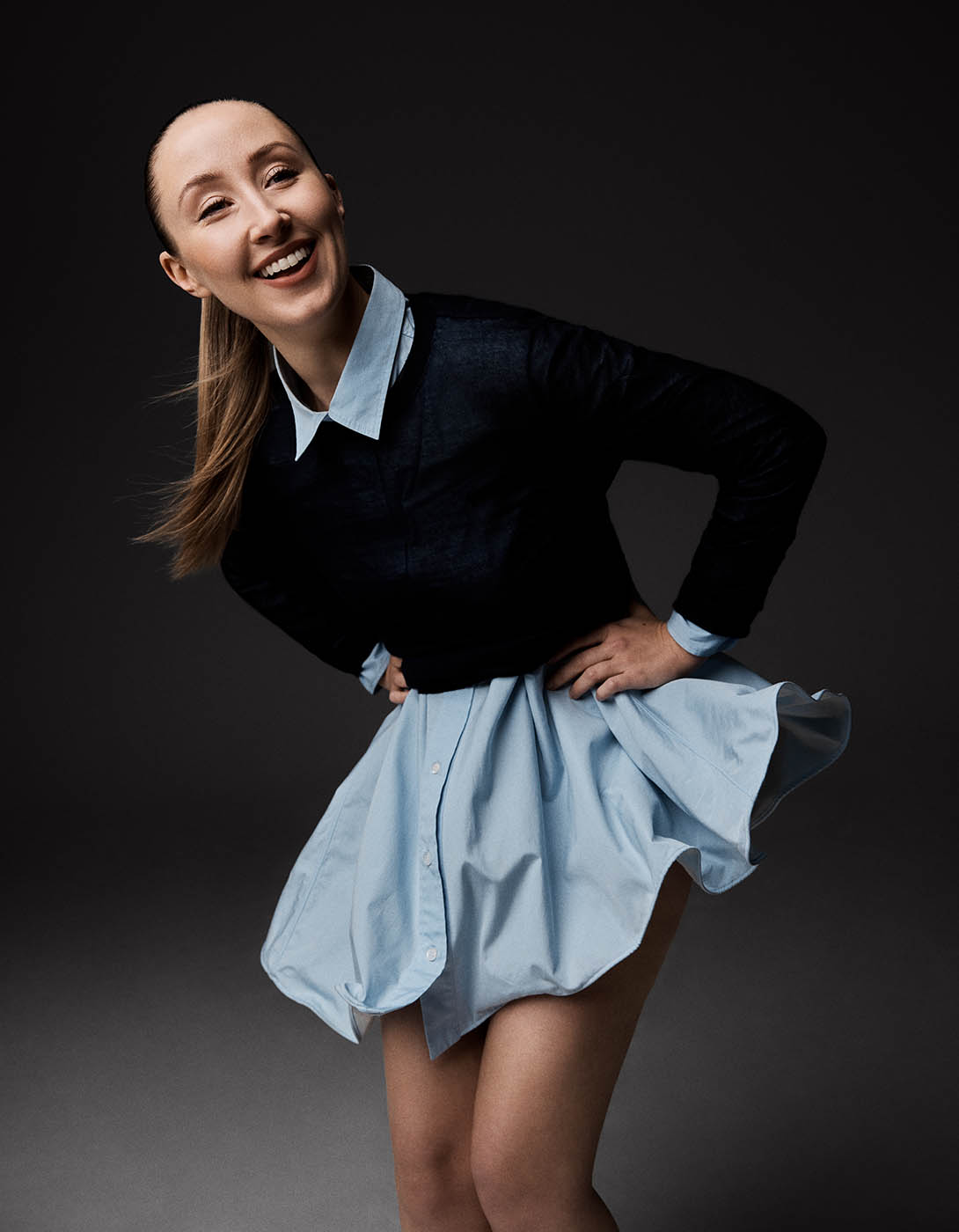
Cashmere knitwear and blue poplin dress, both by Prada
In 2019, when Doherty was 27 and already a hot-prospect theatre actor, she appeared in The Crown as a young Princess Anne, who she played as a teenage rule-breaker with a decidedly un-royal bluntness, and with such conviction that even now people are surprised to hear that Doherty is not posh herself. In the BBC drama Chloe, from 2022, she starred as a lonely woman who assumes a dead schoolfriend’s identity, in an eerily effective look at parasocial relationships and isolation. Even as her screen roles grew bigger, she kept doing theatre, starring in The Crucible at the National, and later in Unicorn, a timely play about an open relationship, at the Garrick, both in London. Then, earlier this year, Adolescence happened.
It wasn’t so much a TV series as a phenomenon, sparking big, earnest discussions about violence in schools, parenting, masculinity and smartphones. It should have been a hard sell, at least globally. It was a British drama, set in a fictional generic northern town, about a young boy who stabs to death a girl from his school. Each of its four episodes was shot in a single take. It didn’t so much have a plot as themes it wanted to explore, and it was fundamentally theatrical. But it became an unprecedented hit. For a long time, it sat higher than Stranger Things in Netflix’s most-watched English-language originals chart.
“We had no idea it was going to be what it was,” Doherty told me. She stars in the series’ third episode, a chilling two-hander between her character Briony, a clinical psychologist, and the show’s young protagonist, Jamie, played by Owen Cooper. “I’m so glad I was just in the one episode, because I got to sit down and watch the rest of them,” Doherty said. “I was just as caught up in it. My girlfriend was next to me – she’d never seen any of it. I got to feel like I fully understand why this thing is so spectacular.” The episode being shot in one take made the action feel “electric,” she explained. “It’s like you can’t breathe, you can’t blink. It’s a one-of-a-kind thing, and I still don’t really believe that I was ever a part of it.” Adolescence has topped practically every Best-of-2025 TV list, and looks set to continue its ongoing sweep of award ceremonies.
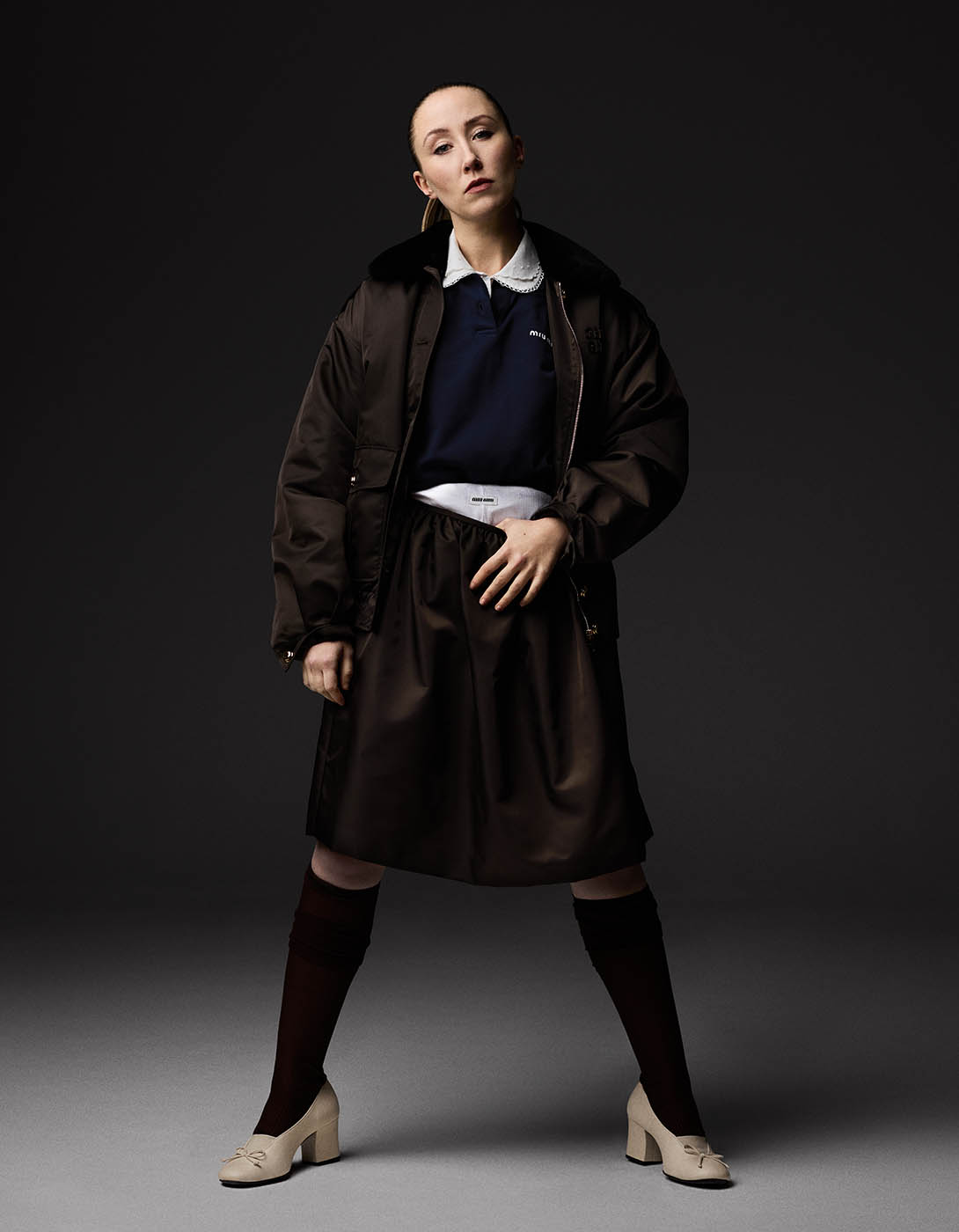
Nylon jacket, poplin shirt, navy polo, skirt, ribbed silk socks and white pumps, all by Miu Miu
Adolescence was brought to life by Stephen Graham and Hannah Walters, the husband-and-wife actors, writers and producers. The couple first met Doherty when they asked her to read for A Thousand Blows, on which they were also executive producers. Over email, I asked what they were looking for in their Mary Carr. “Someone who had an authentic energy about them,” Walters told me. “Someone with grit and determination.” Walters first spotted Doherty in Chloe, and then in The Crown, and also, she added, in a “What’s In My Bag” segment for British Vogue, which gave away Doherty’s real, Crawley, not-so-plummy accent. “A Thousand Blows and Adolescence owe in part their success to what Erin has brought to the screen,” she went on. “I would work with her on everything if I was allowed to.” She called Doherty, not unlike others have, “one of the finest actresses of her generation. I’m so immensely proud of her.”
The feeling is mutual. When we met, Doherty talked about Walters and Graham fondly and often. “They are the epitome of climbing a ladder and turning around and hoiking people up, over themselves, if they need to,” she said. “I’m just like, oh! That’s how you do it.” She believes that Adolescence is immediate because of the way it was filmed, but that at least part of its success lies in the fact it is also a story about a working-class family, told by working-class people. “The story came from the roots of our culture,” she told me. “And it was those people telling the story. I think that’s why it was so visceral.”
Doherty grew up in West Sussex. Defining her own social class is “an intricate, complex question,” she told me. “I’ve never really known how to describe myself, and I’ve always felt a bit in limbo about it.” Her parents divorced when she was four, and she spent weekdays with her mother in Crawley and weekends with her father in Guildford. “My dad definitely got the good end of the deal, because on weekends we would have all the fun.” She lived close to Gatwick airport, where her father worked. “When you go on holiday, you just jump in a taxi for five minutes. It’s cracking.”

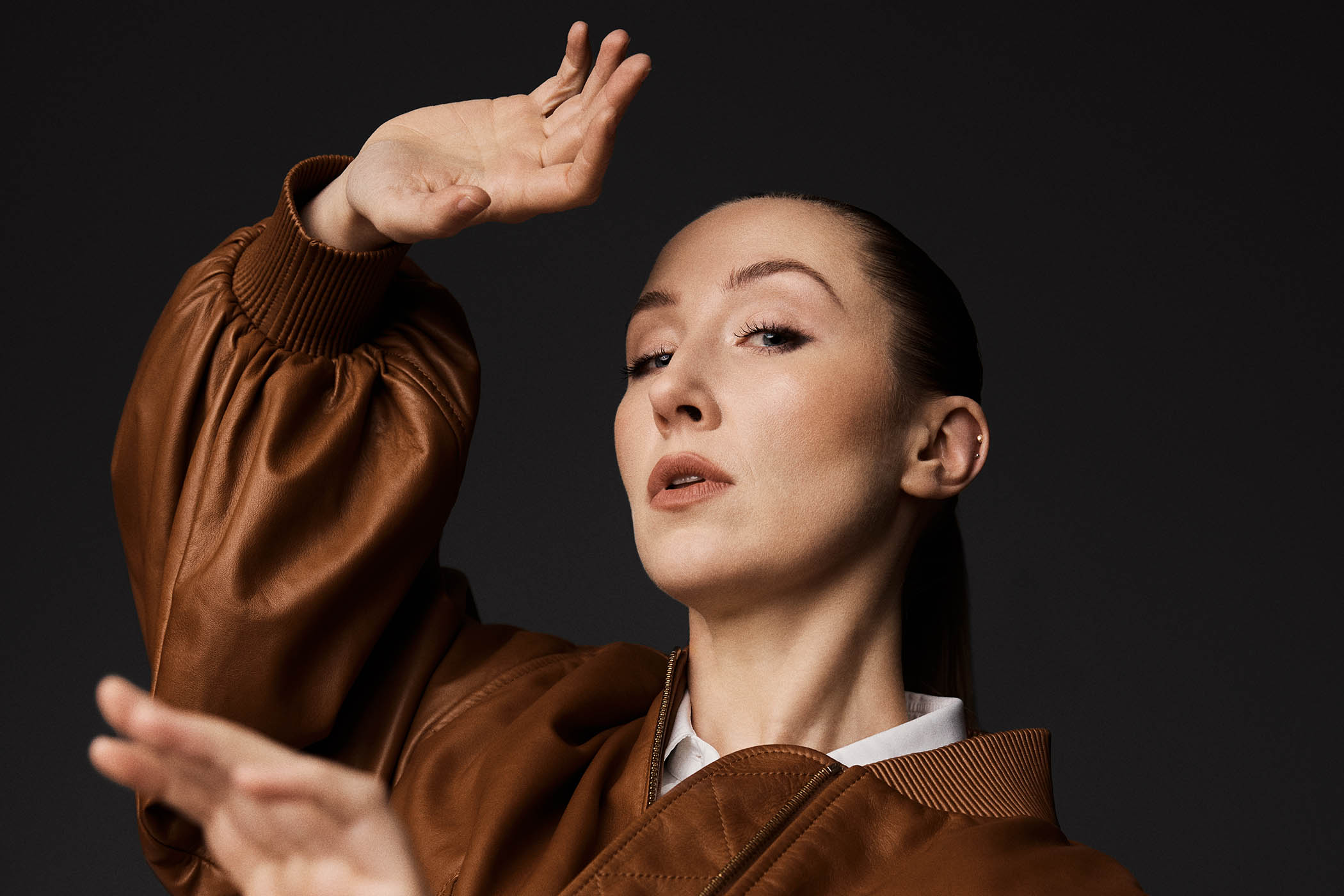
Brown leather bomber jacket, shirt, trousers, belt and boots, all Givenchy by Sarah Burton
Crawley was designed as a New Town for London overspill. “So a lot of my accent is London. But if you speak to my dad and my mum and my stepdad and my stepmum and my sister and my brother, we all sound completely fucking different.” It has made her good at accents, and a shapeshifter herself. “Maybe that’s why I’m so intrigued by where people’s voices settle, and what that tells you about them.”
As a child, her father would drive her to her two main extra-curricular activities: musical-theatre club and football. She played football for the Crawley Wasps, where she was “proudly captain”, and was scouted by Chelsea, though she was brought up a Spurs fan, something she “inherited from my dad,” she told me. “No choice in the matter.” Football was starting to take her all over the south of England, and when the scouts came looking, her father said it was time to choose. “I was just like, all right, I’m going to do acting,” she told me. “Because the outlet felt so vital to who I was.”
It was not until Doherty had done her A-levels, and was studying acting on a foundation course at Guildford School of Arts, that she first saw a play. She went to the National Theatre, on the train, to watch 13 by Mike Bartlett. (In a neat full-circle moment, Bartlett wrote Unicorn, the play Doherty was in at the Garrick earlier this year.) “I just didn’t think plays were for me,” Doherty said. But she found the experience to be “magnetic. I just remember being like, there’s something here. I want this.” It made her determined to break down barriers – to make theatre more accessible to all. “The stuff that’s being put on is for everyone. People just need to know the door is open.”
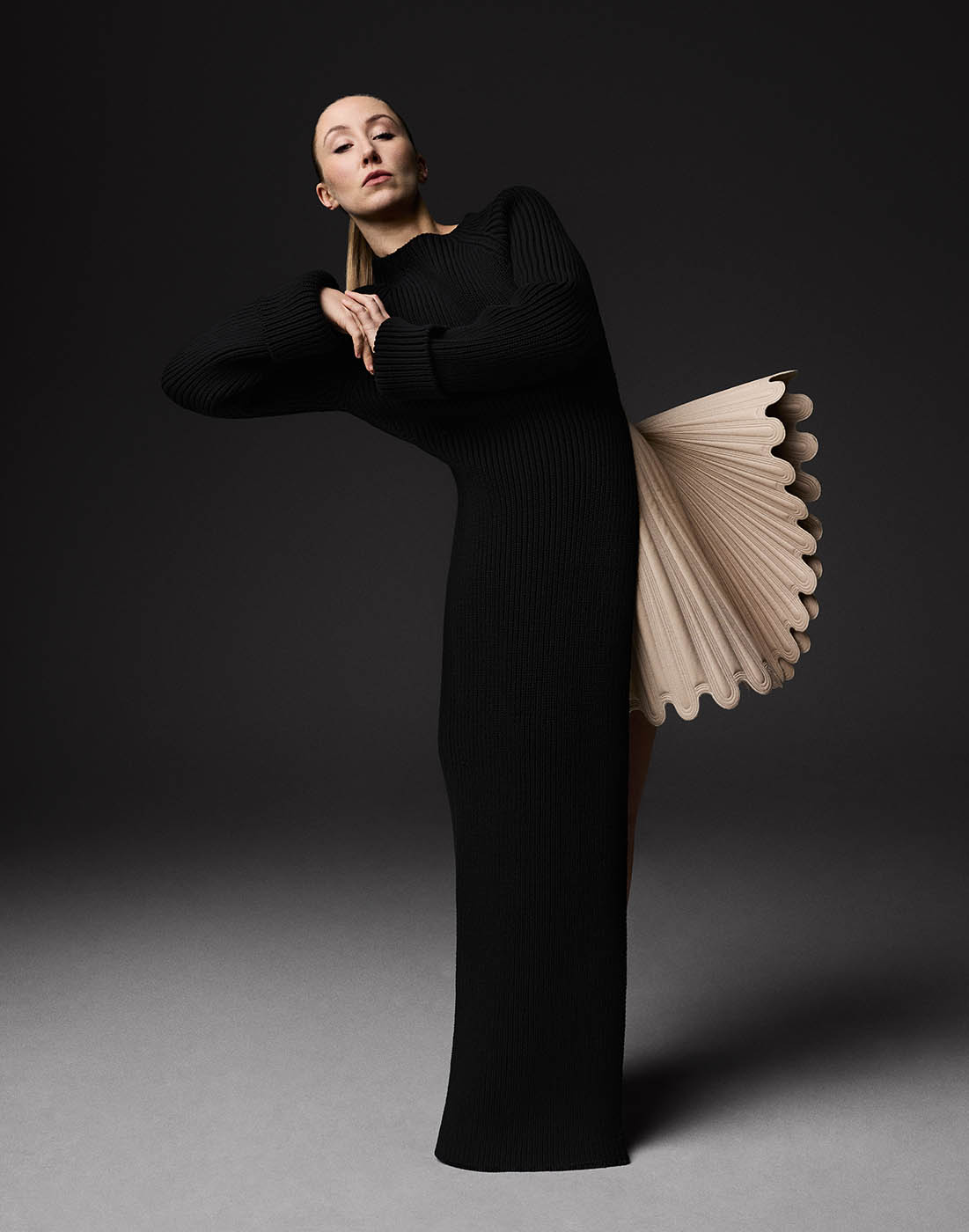
Wool maxi dress and leather pleated skirt, all by Louis Vuitton
In A Thousand Blows, Mary Carr is a master of adapting to her surroundings. She is at home in pubs and on the streets, but she can code-switch in an instant, blending in with fine artists, boxers, the aristocracy. I wondered if that was a skill Doherty possesses, even when not in acting mode. “I think maybe being from where I’m from, and because no one in my family is in the arts, I’ve always been a bit like, is this for me? Is this a path I can take?” It has made her aware of people’s expectations of her as an actor, “which is an interesting thing to navigate. I think things are starting to shift, but I remember when I did The Crown, a lot of people just thought I was posh.”
‘I ordered coffees in a Princess Anne voice, and it was massively different, it got to me way quicker. My coffee was in my hand’
‘I ordered coffees in a Princess Anne voice, and it was massively different, it got to me way quicker. My coffee was in my hand’
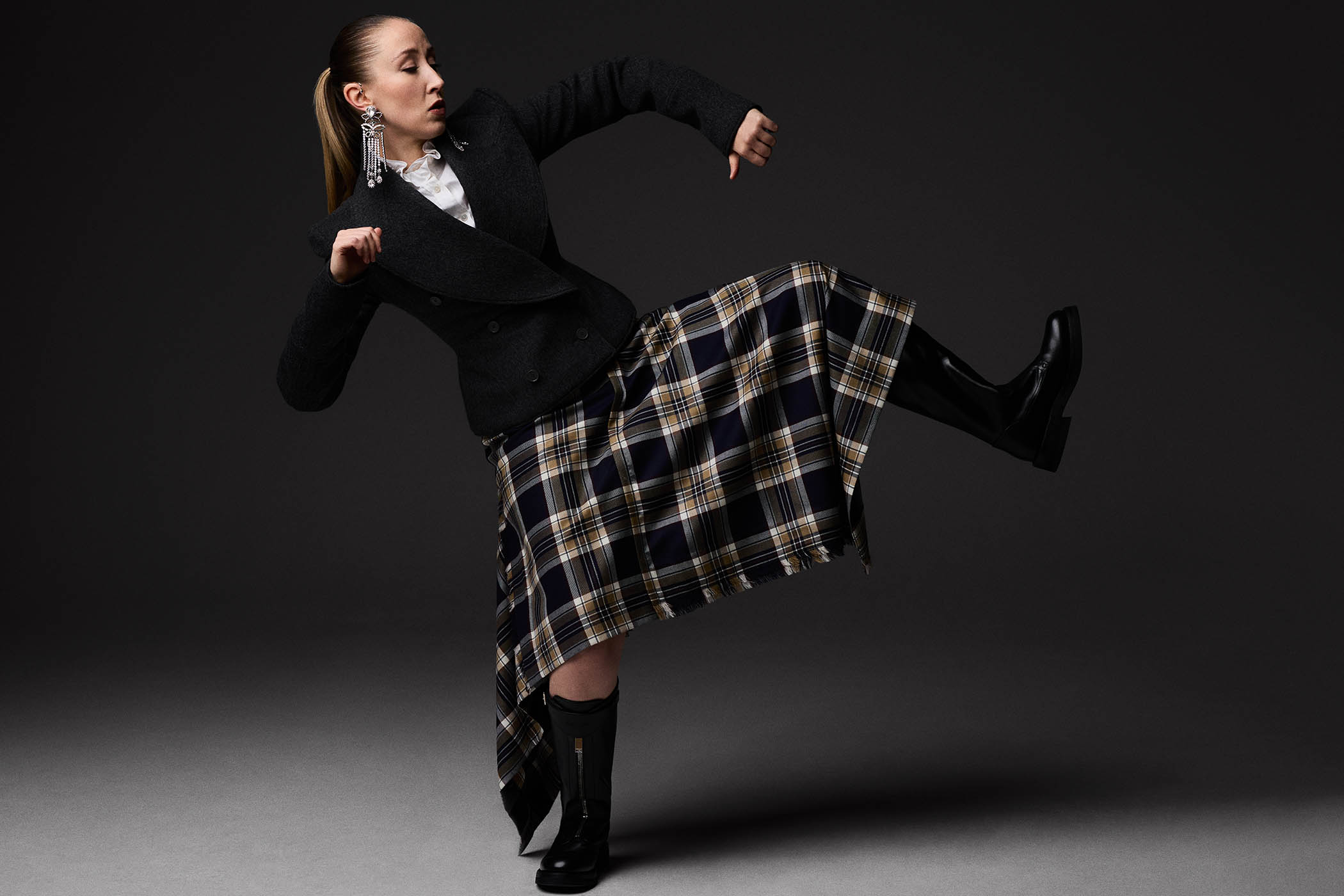
Double-breasted peacoat, shirt, draped tartan kilt, chandelier earrings and countryside boots, all by McQueen
The assumption took her by surprise. She would notice it when she met people for the first time. “You could see it in their faces,” she told me. “Not in a mean way, but you’re like, you’re just hearing my voice right now, and having a bit of an out-of-body experience.” When Doherty is preparing for roles, she likes to see how the energy of any particular character fits into social situations. “I remember ordering coffees in a Princess Anne voice, because I was like, I’m just going to see if this whole interaction changes. And it was massively different, which was interesting. Without being stereotypical, it got to me way quicker. My coffee was in my hand.” I asked why she thought that was? “There’s an authority to voices like that. And whether we like it or not, you respond differently.”
Doherty told me she thinks a shift is happening, made possible in part by Adolescence. During our conversation she mentioned more than once that she is terrible at picking up her phone, so she was not immediately aware of the show’s snowballing success. “It was Stephen [Graham] sending me voice notes,” that alerted her to the news. “Him being like, ‘Tom Hanks has watched it.’ Maxine Peake. Just these incredible people.” I wondered if the secret to its success is that it appealed to both Tom Hanks and Maxine Peake? “That’s the only bar I’m ever trying to hit,” she said.
Doherty’s episode is taut and tense, as close to a thriller as Adolescence gets. When she was promoting the show, she was often asked the questions that the show prompted, about subjects like teenage violence, say, or misogyny. When I asked her how that felt, she said, “Ultimately, daunting,” adding: “What’s gorgeous about the show is that it doesn’t have the answers. I think it’s about communication. But it felt like a lot of pressure, and being the psychotherapist, a lot of people transfer that expectation on to you.” She went on, “The point is that we don’t know, and we need to communicate. I have a younger brother, and seeing him navigate social media, I was always like, this is a minefield. I don’t know how younger generations are doing it.” Doherty’s brother is 11 years younger than her, and a true digital native. Doherty is 33. Does she feel as if she avoided it? “I do. I feel so lucky. I think I just missed it.” She makes a point of keeping social media at arm’s length. “Because I just find it so overwhelming.”
Adolescence swept the Emmy awards in September. Graham, Cooper and the show all won in their categories, and Doherty landed best supporting actress in a limited series. When her name was called, she kissed her girlfriend, Sinead, walked to the stage accompanied by Graham, thanked a lot of people, and told the auditorium that they were “all fucking stunning”. She FaceTimed her mum and sister afterwards. “My mum said, ‘I could have done without the swearing.’ And I was like, ‘I’m so sorry!’ That was the one thing I fixated on afterwards. Like, oh, ‘God, why did I do that?’” She put it down to the strangeness of the event. “Like, I met Lorelei [Lauren Graham] off bloody Gilmore Girls. She was the only person I got a photo with! So you’re a mad combination of your 13-year-old self and who you are now. So weird.”
In her speech, Doherty thanked her girlfriend for making her “the happiest person in the world”, and in a small way her openness felt like a big deal. “I’ve just become so adamant about being myself that I’ve got to the point – thank God – where I’m not monitoring it in any way.” Sinead works in the NHS. “It shines a very necessary light on what it is that I do,” Doherty told me. “Yes, I treat acting with the utmost respect, and I love it, and sometimes it can change someone’s life, but you’re also not saving someone’s life,” she laughed. I told her that sounded like a healthy perspective. “You can go, ‘I’ve had a tough day today,’ and then I walk in the door and speak to my girlfriend, and I’m like, ‘Actually, I think I’m fine.’”
In an interview on the podcast How to Fail earlier this year, Doherty said that she was open about her sexuality, because it was what she needed to see when she was figuring out her own identity, in her early 20s. I asked her if she’d had someone to look to in a similar way. “I do think Sarah Paulson was a big one for me, just watching her own it.” Paulson presented Adolescence with the Emmy for best limited or anthology series. “I’d had a couple of little conversations with her prior to that, so I was like, I’m going to find you. That was really special.” She also mentioned Jonathan Bailey, now a leading man in Hollywood. “I love what he’s doing. I love how vocal he is about it, and that makes me proud, and that inspires me.” She went to see Wicked: For Good at the cinema recently. “And I was like, Cynthia! Jonathan Bailey! Gay! How great is that! I loved it. I was just like, ‘Yes! We’re there!’ I was so chuffed.”
At the Emmys, it never occurred to her that kissing her girlfriend might have been a depressingly unusual moment. “At the end of the day, I want to walk down the street and hold my girlfriend’s hand,” she told me. “I want to kiss my girlfriend and walk up there and thank her. If that is something that people want to focus on, it’s just odd.” In her head, she said, she has always been out. “But when I first did The Crown, I remember being a bit like, is this allowed? And then, very quickly, I was like, well, I’m just not going to be that person, for my own mental health. I don’t want to have to go out my front door and think about what version of me people are going to see.”
Doherty is a big believer in therapy. She did it herself, for six years, after her stepmother suggested she might need to speak to someone and soon found her a therapist. “It just helped me so much, because I am such an introvert that I will always err on the side of anxiety and overthinking,” she explained. “It just felt like I was battling with myself and battling with this other thing that just kept getting in the way.” Therapy taught her to embrace who she is, rather than fighting it. “All this stuff that’s so easy to say, but it’s so difficult to put it into practice.” It is something she works on every day, she told me. “I think therapy’s given me the understanding and appreciation that no one knows what they’re doing. We’re all struggling, in some form or other, and that kind of strange camaraderie just eliminated a lot of my issues.”
She said she understands, for example, that her social battery is very small, and she has learned to accept that sometimes she just needs to stay at home. “And it’s a really tricky thing to embrace, because in our culture we’re told that staying home and not wanting to see people is a negative thing. But I’ve learned I need that, because if I’m going to go out and be on point, I need something in reserve.”
When I asked her what a day at home looked like, she sank into her seat at the thought of it, as if settling in for the afternoon. “Hot drink in my hand, I’m sitting on the sofa, I’m watching mind-numbing television.” Celebrity Traitors was her favourite show of the year. Would she take part in it? “Actually, from watching that show, I think I’d love it,” she said. “I’m saying it now, but I would hate to be a traitor. I just loved how much they all loved each other.” She said she watches Made in Chelsea, the Great British Bake Off, Selling Sunset, The Kardashians. “It’s just wonderful,” she grinned. “The more mind-numbing, the better. I need it.”
In December, the day after the nominations for the Golden Globes had been announced, I spoke to Doherty on the phone. Once again, Adolescence was up for almost every award that it could be up for, and she was nominated for best performance by a female actor in a supporting role on television. “I’m just so buzzed for the show,” she told me. “For everyone involved.”
After the Emmys in September, Doherty signed with CAA, a big American talent agency, marking a shift in her career. “It’s like you’re at the supermarket,” she explained, of the change, “and you think, I’d actually quite like some Doritos today, are there any of those in stock? Rather than, it’s onion rings or nothing.” It means she can start to think, a little, about the stories she’d like to tell. The approach taken by Graham and Walters has inspired her to make stuff happen herself. “I thought, ‘OK, well I’ve got to do that with queer stories.’ I don’t know how I’m going to get there, whether or not I’m a producer or a co-writer, or I’m on the screen doing it, but I will tell queer stories.”
I asked her if it was fair to say that she has a rebellious streak. “I think so,” she replied. “I wish it was in a cool way. But I always come back to trying not to care what people think, and just doing what feels right.” We’re always being told what we should be doing, she said: what we like, what we should wear, what we should watch. “But I just don’t want to buy into it.” Mind you, if she gets the chance to give another acceptance speech, in January – and she was careful to emphasise the “if” of that situation – there is a concession that she is willing to make. She will try to avoid swearing. “That’s the one thing I really do have pinpointed in my brain,” she said. “OK, Mum, I’m going to do that for you.”
A Thousand Blows, season two, will premiere on Disney+ on 9 January 2026
Makeup by Caroline Barnes using Lisa Eldridge; hair by Chad Maxwell using Living Proof; fashion assistants Roz Donoghue and Sam Deaman; photography assistants James Proctor and Morgann Russell
Newsletters
Choose the newsletters you want to receive
View more
For information about how The Observer protects your data, read our Privacy Policy