



Is sexual objectification more palatable if it’s directed at a younger man by an older woman? The new Netflix miniseries Vladimir – produced by Sharon Horgan’s company Merman – is based on the provocative 2022 novel by the American writer Julia May Jonas. It follows an unnamed female protagonist, a fiftysomething literary professor at a college in New York, who develops an erotic obsession with a younger academic called Vladimir (the title winks at Vladimir Nabokov’s Lolita).
In the series, co-scripted by Jonas, Rachel Weisz plays the liberal arts college professor – known only as The Protagonist – while Leo Woodall (One Day) is Vladimir. Weisz’s character instantly breaks the fourth wall, pondering midlife obsolescence and the waning of her sexual power: “I may not be the cause of a spontaneous erection ever again.”
This direct address to the viewer is deployed throughout. While the character’s musings (“As an older woman – truly what is more embarrassing? – I will have lost the ability to captivate”) are undermined by Weisz’s beauty, they match the spiky interiority of the novel.
Her husband and fellow academic John (Mad Men’s John Slattery), with whom she has an open marriage, is being investigated for having affairs with his students. While John’s behaviour is condemned on campus, his wife covertly reflects straight to camera: “I want to tell these women that, when they’re sad, it’s probably not because of the sex they had, but more because they spent too much time on the internet worrying about what people think about them.”
Here then is the audacious flex of Vladimir: it has a plot built on feminising the trope of the older man undone by youthful allure, and a central female character seemingly intent on subverting hard-won #MeToo gains. Last year, Luca Guadagnino’s patrician college thriller After The Hunt, starring Julia Roberts, nibbled at the same subject, but Vladimir takes a more intentional bite out of it. As Weisz’s character waspishly observes: “When I was in college, I wanted to fuck all my professors – old, young, male, female – but I was too timid.”
IfVladimir is fuelled by erudite smut – an erotic fixation on youth and beauty – at least it’s viewed through the female lens for a change
IfVladimir is fuelled by erudite smut – an erotic fixation on youth and beauty – at least it’s viewed through the female lens for a change
Running over eight episodes, transgressive moments abound (the series opens with a drugged-up Vladimir tied to a chair, before flashing back six weeks to tell the story). There are (spoiler alert) changes from the novel: Vladimir (fortysomething in the book) has been aged down (Woodall is 29), and there are some tweaks to the ending. Woodall is effectively playing a cipher: though he warms Vladimir up with easy charm and literary repartee, he’s mainly there to be lustfully pursued by the protagonist – the camera lasciviously raking over his thighs, his throat, even his crotch.
Vladimir emerges as a sexual comedy of manners, with swipes at liberal collegiate mores, and elements of French farce. It can make for ethically murky and tonally bumpy viewing: it is left to oft-lampooned supporting characters to draw attention to predatory abuses of power. But it remains intriguing, thanks to playful, intelligent writing (“I’m a grown-up. I know closure is just a myth believed in by people under 30”), and a strong performance from Weisz that moves fluidly from intimacy to black comedy. If Vladimir is fuelled by erudite smut – an erotic fixation on youth and beauty – at least it’s viewed through the female lens for a change.
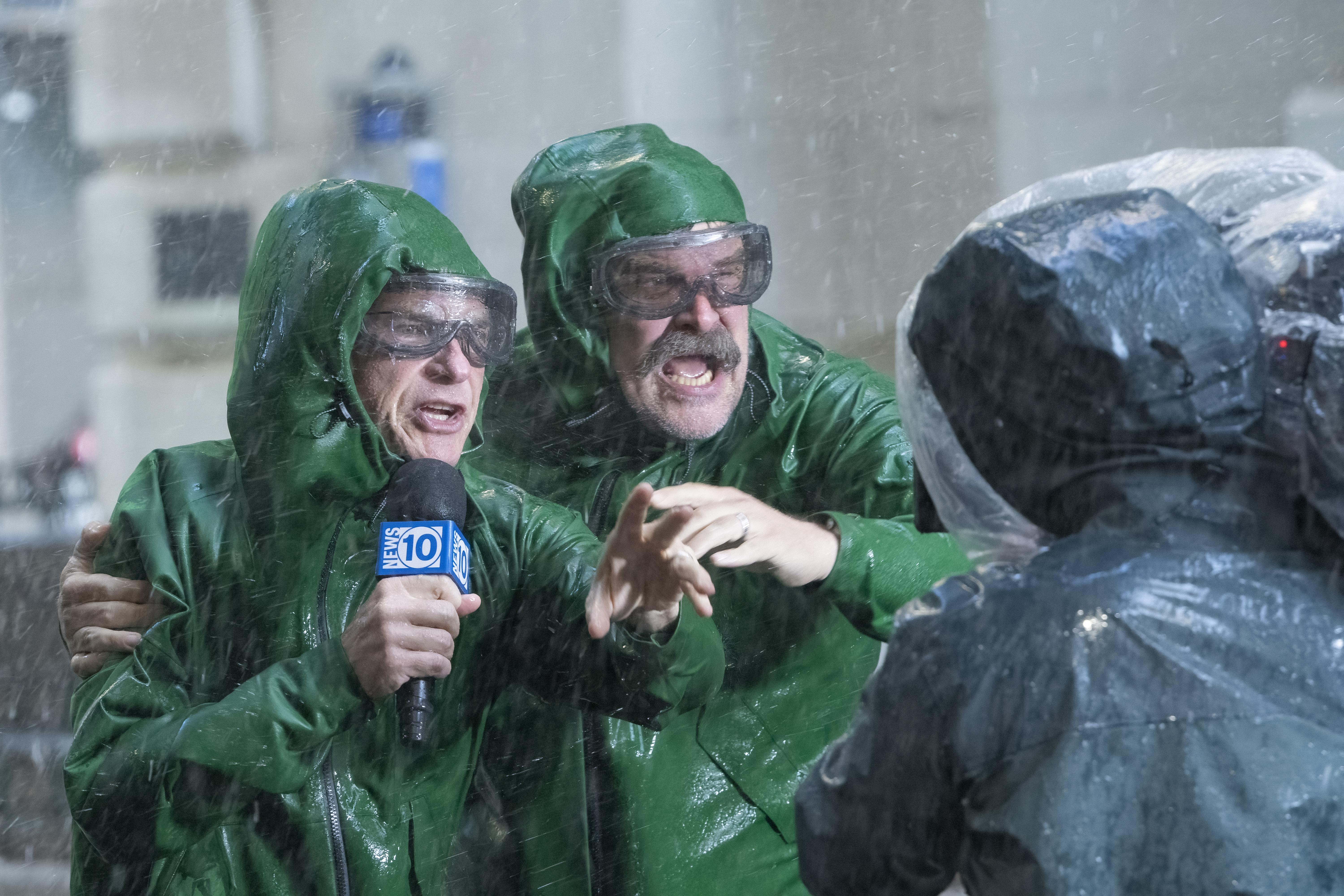
‘Deliciously unsettling’: Jason Bateman and David Harbour in DTF St Louis
There’s another darkly comedic examination of wayward 21st-century sexual impulses in the new series DTF St Louis on Sky Atlantic. Created, written and directed by Steven Conrad (Patriot; The Weather Man), it’s set in the fictional St Louis suburb of Twyla.
Jason Bateman plays Clark, a micro-celebrity TV weatherman with a geeky interest in recumbent bikes. He befriends Floyd (David Harbour from Stranger Things) a big-hearted schlub hired to do sign language for the weather reports, who lost desire for his wife Carol (Linda Cardellini) after she donned unflattering padded protective gear while umpiring kids’ baseball games to help with the family finances.
After the men start using the DTF St Louis app for extramarital sexual adventure – for the innocent among you, DTF is an acronym: Down To Fuck – Floyd turns up dead next to a spiked can of Bloody Mary and a retro copy of Playgirl featuring a soft porn Indiana Jones theme. Utilising a non-linear timeline, the show explores the mystery of who killed Floyd, and why.
Newsletters
Choose the newsletters you want to receive
View more
For information about how The Observer protects your data, read our Privacy Policy
As Harbour is the former husband of Lily Allen (the singer publicised his extramarital activities, conducted over apps, on her 2025 album West End Girl), some of these themes may – and indeed may not – seem tantalisingly apposite... But most importantly, in the four (of seven) episodes provided for review, DTF St Louis develops into a dry, clever and witty treat. Bateman is magnificently creepy as Clark, who ends up embroiled in an affair with Carol in which fetishes are acted out in a depressing motel room. Floyd, who suffers from Peyronie’s disease (a condition that curves the penis) is a man of well-intentioned gullibility, without going the full Forrest Gump. Carol transforms from a side character into something rather more complex and difficult.
With the addition of an older man/younger woman detective team (Richard Jenkins and Joy Sunday), the series evolves into a sardonic satire on the transactional nature of modern relationships. Peter Sarsgaard delivers a wickedly funny cameo as a sweetly philosophical gay man: “Nobody’s normal. They just look that way from across the street.”
DTF St Louis is self-consciously left field at times (the recumbent bikes, the deliberately plodding pace). It becomes almost Lynchian in its exploration of the existential torpor – the garden swing sets and juice bars – of US suburbia. But if you allow yourself to succumb to the ironic slow burn, it is deliciously unsettling – a reminder that nothing is weirder or scarier than what passes for everyday normality.
Photographs by Netflix/Warner Bros