
Everyone argued about Ariadne auf Naxos, not least its composer, Richard Strauss, and his brilliant and sensitive librettist Hugo von Hofmannsthal. They couldn’t agree on the story, the key characters, the voice types. Was it comedy or tragedy, high art or low? Why not mash it all up together? This two-part work, which has opened in a streamlined and unusually clear new production at Glyndebourne, conducted by Robin Ticciati and directed by Laurent Pelly, carries those disagreements through to the finished opera.
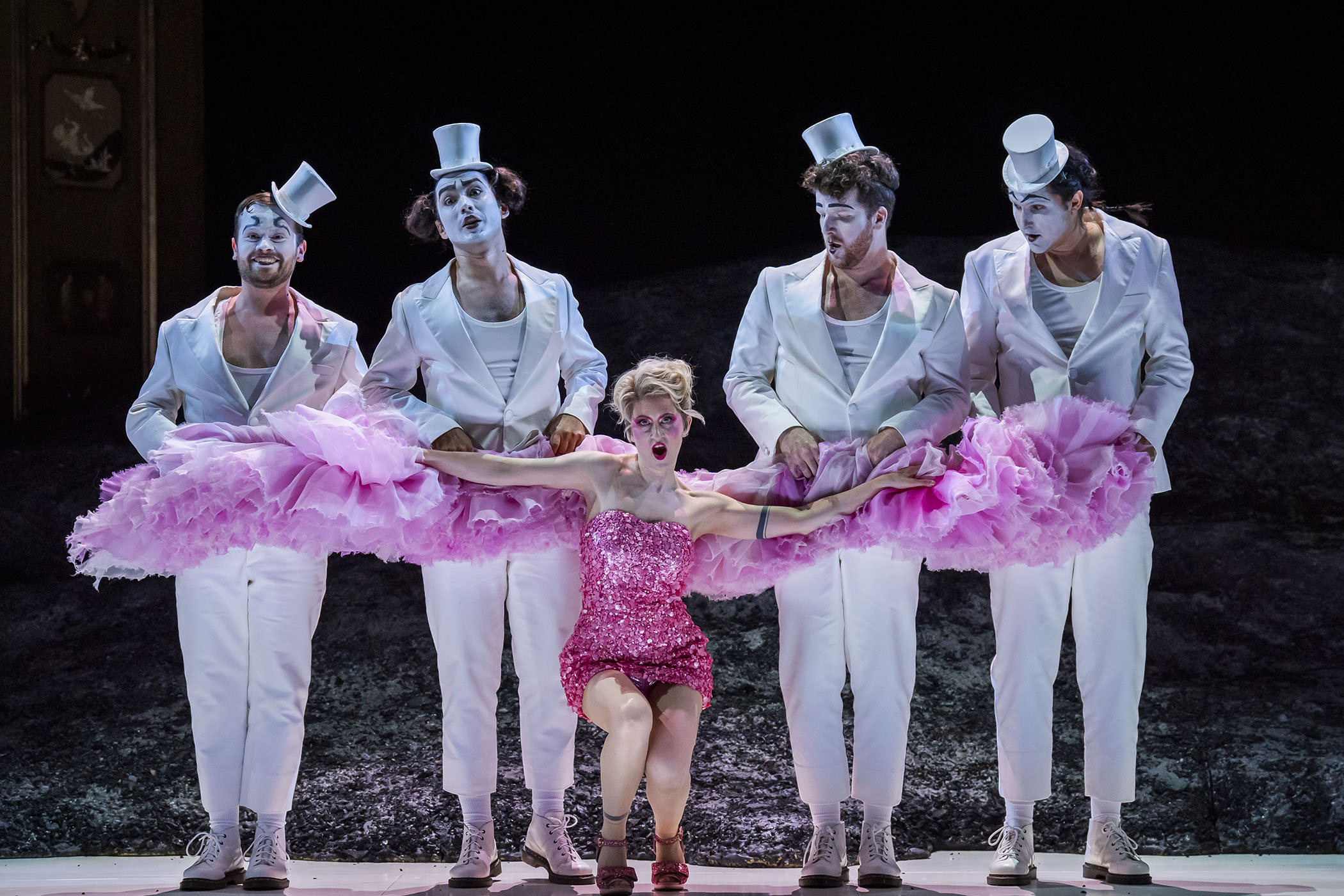
The first part, called the Prologue, witnesses a clash between serious musicians trying to mount an opera in a rich man’s house, and a comedy troupe and clowns who have their own ideas. Then follows the Opera, barely connected, in which a desolate Ariadne (Rachel Willis-Sørensen), abandoned by Theseus on Naxos, encounters a new love, the god Bacchus (David Butt Philip). The comedians, especially the flirtatious Zerbinetta (Alina Wunderlin), barge in from time to time.
It’s all a muddle. Ariadne thinks Bacchus is Theseus. He calls her Circe, the witch goddess who turns men into swine and whose island he has escaped. (Might confusion extend to the audience, who just saw Matt Damon – same grey cloak, similar beard but more grizzled – so recently in the clutches of Circe in Christopher Nolan’s Hollywood epic The Odyssey? A reminder that Greek myth is the wellspring of storytelling, especially in opera.)
The tendency in productions of Ariadne is for the director to try to match the antics of the Prologue with zany – for which read slapstick – stage action. Pelly and his designer Massimo Troncanetti, with lighting by Marco Giusti, have chosen the opposite. Their staging, an ornate facade and some tastefully striped wallpaper, is almost sober. The muted set and costumes – with occasional flashes of colour – act like a stencil, allowing the madness of the action to move freely around and within. The second act is a heap of Happy Days-style scorched earth on which Ariadne lies, but who’s to say Strauss and Hofmannsthal didn’t get there before Beckett.
The power of this work lies in Strauss’s music, running in contravention of the folly of the story
The power of this work lies in Strauss’s music, running in contravention of the folly of the story
These archetypal characters and their shenanigans are too inconsequential to move us. The exception is the fervent young composer, superbly sung by the American mezzo-soprano Samantha Hankey. The power of this work lies in Strauss’s music, running in contravention of the folly of the story. Every flicker of emotion, every hint of yearning, is expressed in overlapping melody, waltz, lament, endlessly gathered up like skeins of silk and sackcloth. It’s a miracle of invention. Trying to match a composer’s personality to their music is a fool’s game, but the polar distance between this tweed-suited, conservative and bourgeois Bavarian and his molten music – lubricious in Salome, ferocious in Elektra, vulgar and ecstatic in Der Rosenkavalier – remains a mystery.
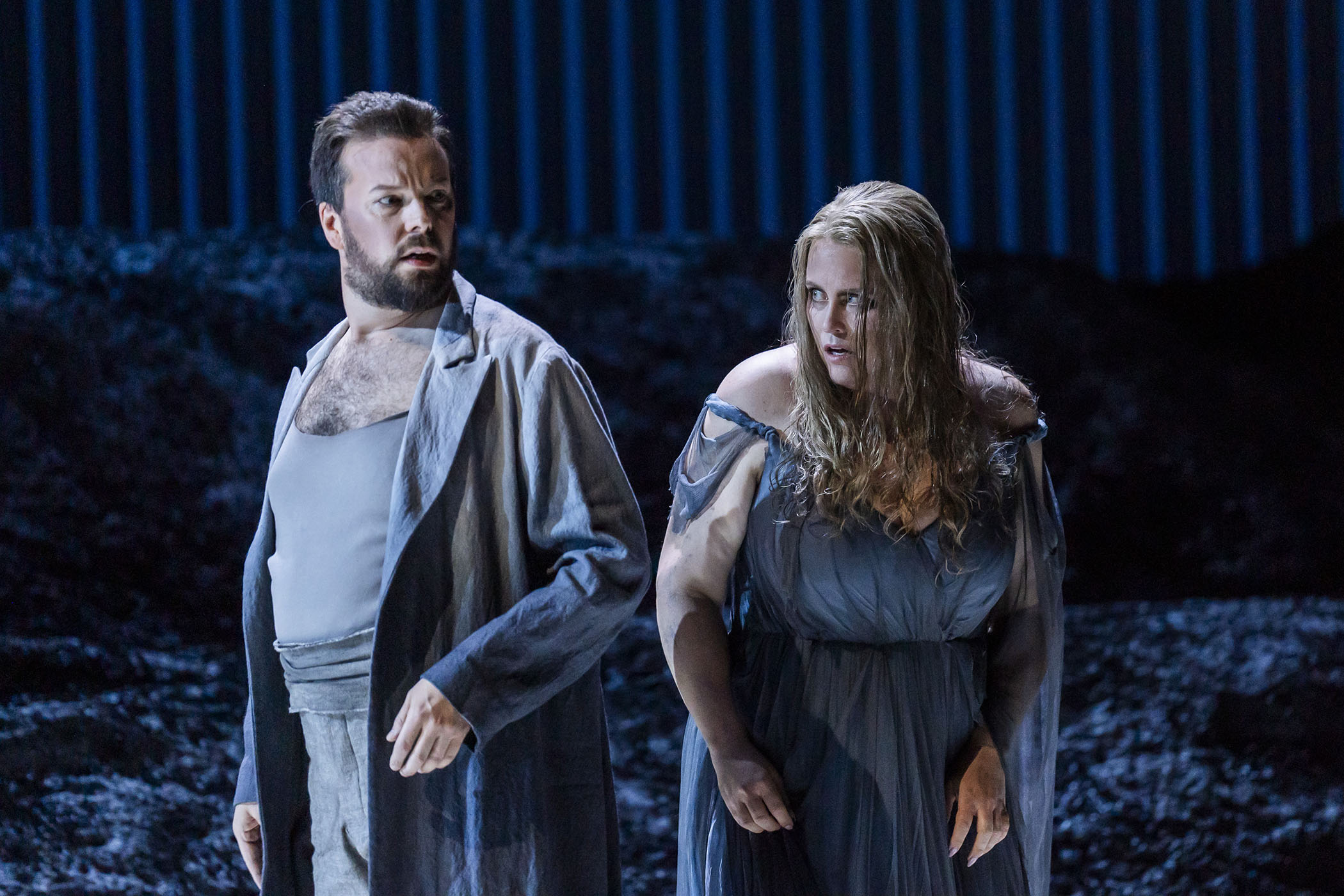
David Butt Philip as Bacchus and Rachel Willis-Sørensen as Ariadne. Main image: Alina Wunderlin as Zerbinetta
Strauss used a reduced orchestra – here the London Philharmonic on white-hot form under the baton of Ticciati, Glyndebourne’s music director, whose feeling for the pulse and essence of this music is faultless. The addition of harmonium, celesta, piano, glockenspiel and two harps adds gleam and radiance. Pelly’s staging frees us to concentrate on this luscious score, helped by a fine cast. Wunderlin’s starlet Zerbinetta, the coloratura dazzlingly sung; Willis-Sørensen’s sumptuous Ariadne; Butt Philip’s rich-toned Bacchus; the commedia dell’arte troupe and the delicious trio of nymphs were all outstanding. In this numerous ensemble every person excelled.
Glyndebourne will take a semi-staged version of Ariadne for its annual visit to the BBC Proms, which opened last week, running nightly until 12 September. The theme for the First Night (BBC Symphony Orchestra, Singers and Chorus, conducted by the popular Dalia Stasevska) was part American, part patriotic British. Any reservations about rough edges in the performance, and bittiness in the content, were not reflected in the enthusiasm of the capacity crowd. The introspective account of Ravel’s Piano Concerto in G major by the Korean superstar Yunchan Lim, lost in the Albert Hall, came across better later on BBC Sounds. Gerald Finzi’s rarely heard ode For St Cecilia is best kept rarely heard, but the BBC’s choral forces and tenor soloist Thomas Atkins gave it their all.
My best Prom listening of the week was Jessie Montgomery’s These Righteous Paths, written for the cellist Abel Selaocoe and orchestra (here the BBC Philharmonic under Gianandrea Noseda). Exploring thoughts of grief, it has a magical passage inspired by the cascade of birds in flight. This original and startling UK commission was a wonderful totem for the Proms, in all their variety, in the weeks ahead.
Ariadne auf Naxos is at Glyndebourne, Lewes, East Sussex, until 29 August
Photograph by Tristram Kenton/Glyndebourne Productions Ltd.
Newsletters
Choose the newsletters you want to receive
View more
For information about how The Observer protects your data, read our Privacy Policy