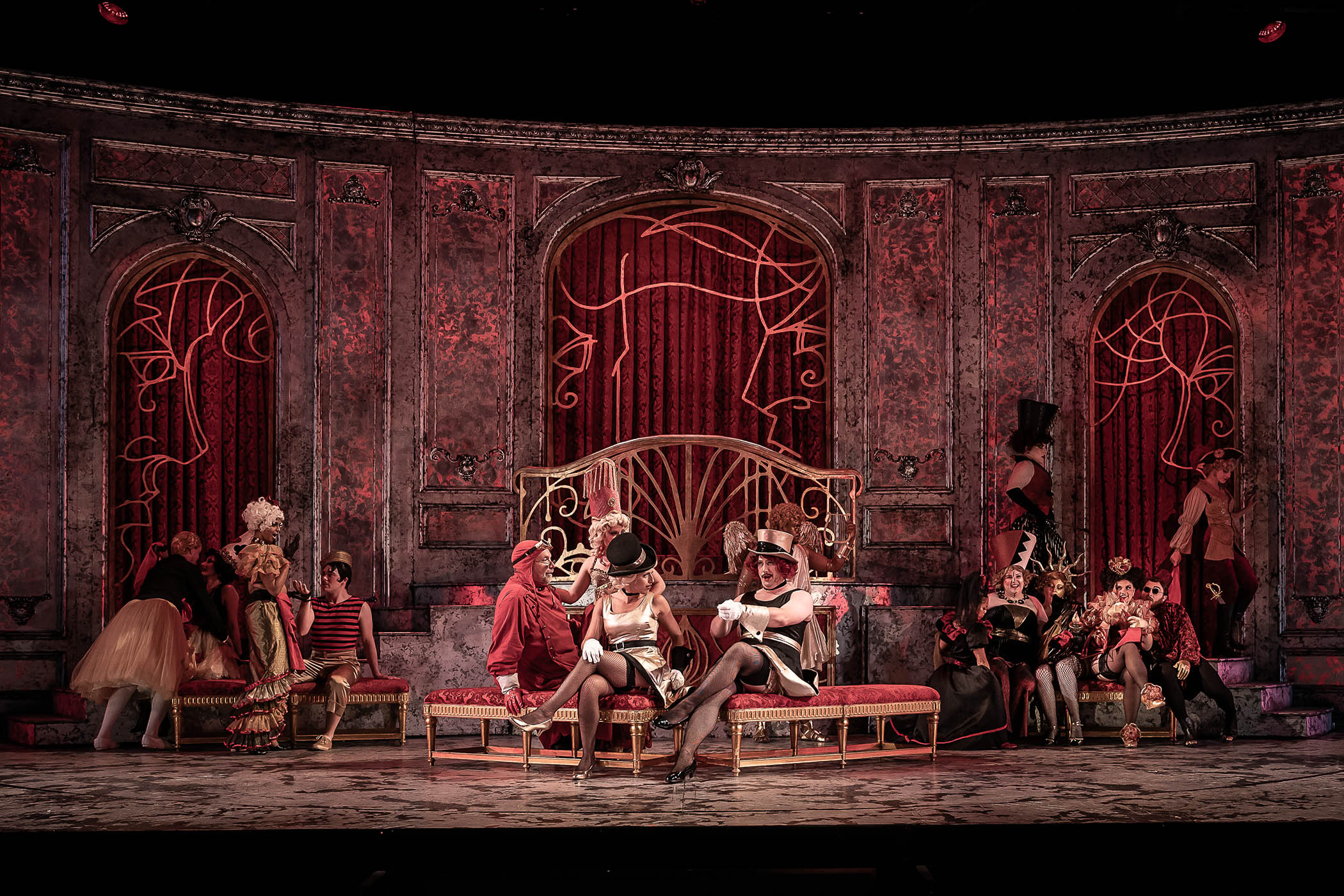


Style: you’ve either got it or you haven’t. The operatic partnership of the director Louisa Muller and designer Christopher Oram certainly has. The pair gave Garsington Opera a deeply compelling production of Britten’s The Turn of the Screw in 2022 and an anarchic Platée, Rameau’s comic masterpiece, in 2024. Now they’ve done it again; this time with Verdi’s La traviata, completing a hat-trick of hits for a company that increases in stature year after year.
They gently shift the action to 1939, when young Parisians partied hard, sensing that soon the music would stop and they would be swapping fancy dress for battledress. Queen of this giddy social whirl is the toast of the town, the vivacious Violetta, a courtesan who hides a dark secret: consumption will soon claim her life.
Oram has designed her an antique mansion of faded belle époque grandeur, mounted on a revolve that reveals a series of rooms through which the action moves with seamless ease (and that offer handy acoustic backdrops for the principals). As whispering strings open the overture, we briefly begin at the end, with a tableau in which Violetta rises from her deathbed and weaves through this many roomed set, rewinding her life to join a party in full swing.
The American soprano Madison Leonard is a truly captivating Violetta in an impressive role debut. She is in total command, whether enjoying the high life among her louche friends or when brought low by the devastating demand that she abandon her lover Alfredo. Steely Ukrainian tenor Oleksiy Palchykov sings Alfredo with a degree of formality that seems at odds with the passionate nature of the piece, but you have to admire a man who can effortlessly juggle ice cubes into a cocktail shaker while singing the famous brindisi.
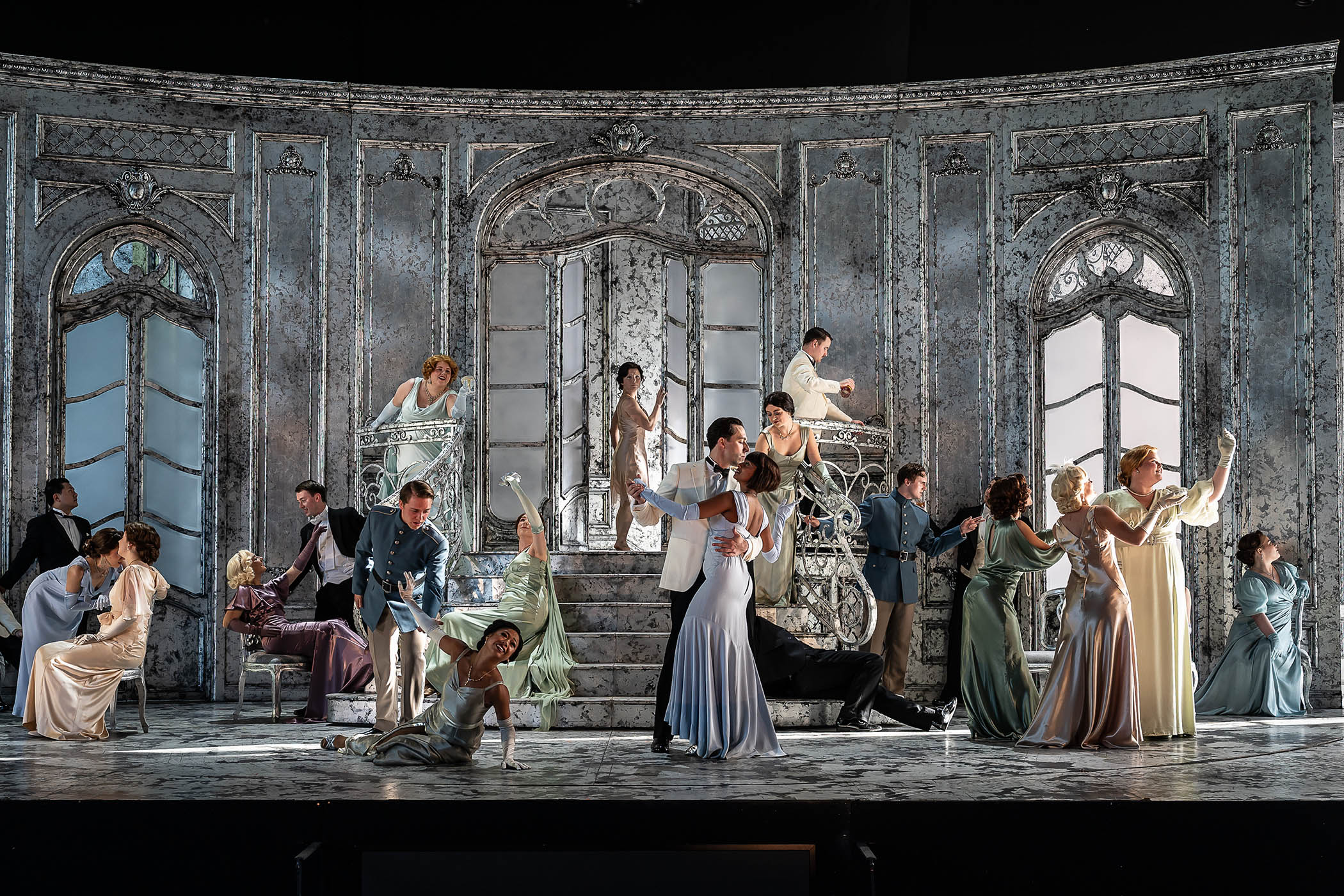
Months pass, and the set turns again to reveal the country hideaway that Violetta and Alfredo have made their home, and into which strides the upright figure of Giorgio Germont, brilliantly sung by Roland Wood. He is Alfredo’s father, resplendent in the uniform of a French general. In a baritone that brooks no dissent, he insists Violetta leave his son, as her past life would taint his daughter’s future marriage. Leonard’s performance is particularly affecting here, delicately portraying a heartbroken Violetta sacrificing her chance of happiness for the sake of a woman she has never met. Douglas Boyd’s meticulous conducting of the Philharmonia, and the focused and committed chorus contribute greatly to the admirable coherence of this first-class production.
There’s further impressive conducting at Opera Holland Park, where rising star of the podium Charlotte Corderoy is in charge of the City of London Sinfonia and the cast of a breezy new production of Mozart’s Così fan tutte. The director, Cecilia Stinton, is brimming with fresh ideas, shifting the action to 1960s Naples and promoting the role of the maid Despina to front and centre.
We first see her on the tarmac at the airport, bats in hand, waving in the plane that carries sisters Fiordiligi and Dorabella, who have flown in to meet their US marine boyfriends. Next, we see her behind the passport desk, before appearing as both receptionist and chambermaid at their hotel. Later, she cooks and slops out some unruly spaghetti. Then she’s washing up. You get the picture. Think Goldoni’s frenzied Truffaldino. None of this would have been possible without the impeccable comic timing of the soprano Elizabeth Karani. Every one of her numerous madcap appearances is a treat.
Would that some of that brio had rubbed off on the boyfriends, who disguise themselves (not very convincingly) in a bet to woo each other’s girlfriend. Tenor Osian Wyn Bowen as Ferrando and baritone Paul Grant as Guglielmo are both rather colourless vocally, particularly when opposite the incisive soprano of Madeline Boreham as Fiordiligi and the warm mezzo of Shakira Tsindos as Dorabella.
In Act II, the lovers visit Pompeii, where Boreham sings Fiordiligi’s aria Per pietà, ben mio, perdona with real poise, the music underscored by Stinton’s decision to include, centre stage, a representation of the two figures who have stayed locked in an embrace since the eruption of Vesuvius in AD79. The fact that in 2017 they were found to be two men hardly matters. The message is clear: as Philip Larkin wrote: “What will survive of us is love.”
Photographs by Clive Barda
Newsletters
Choose the newsletters you want to receive
View more
For information about how The Observer protects your data, read our Privacy Policy