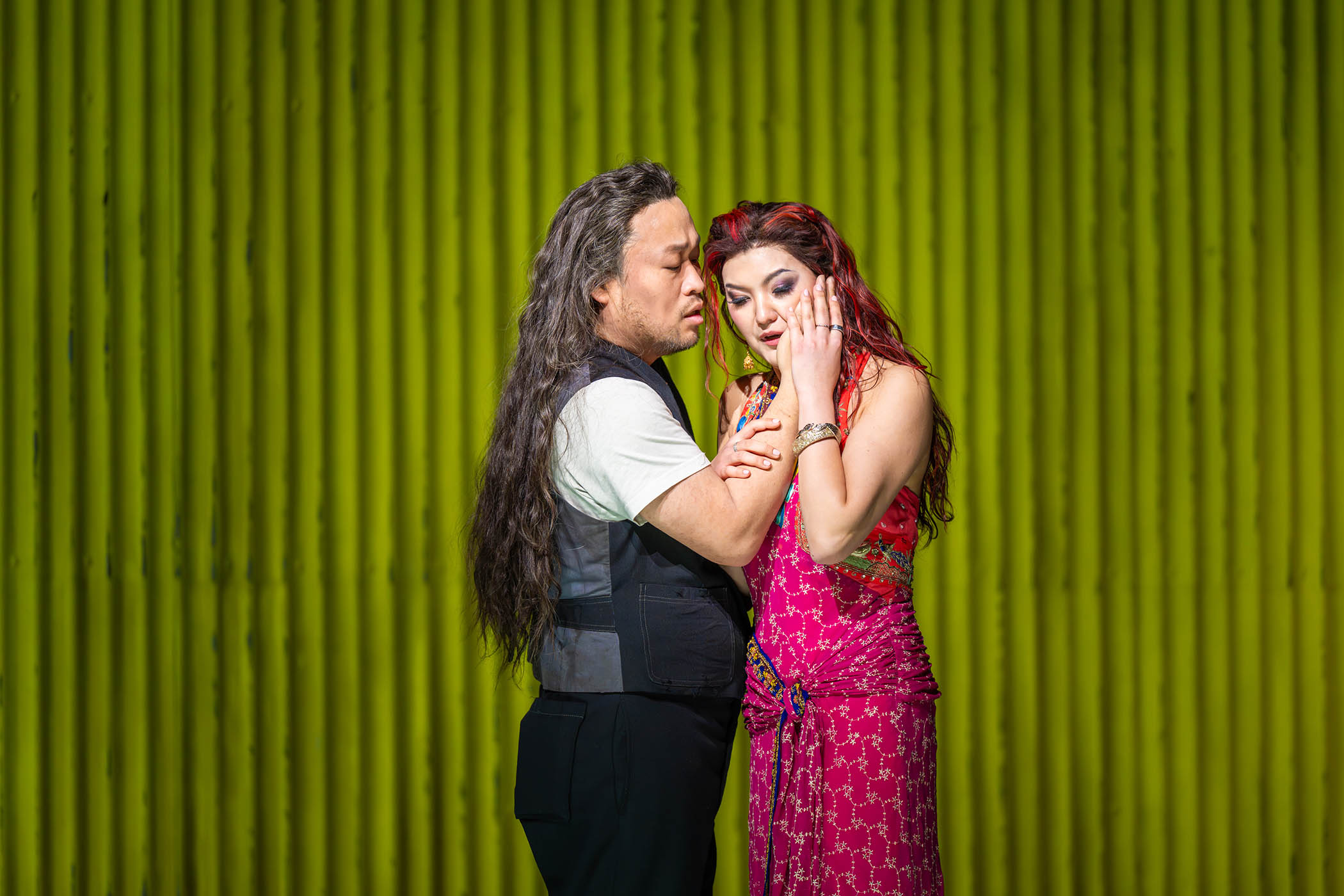
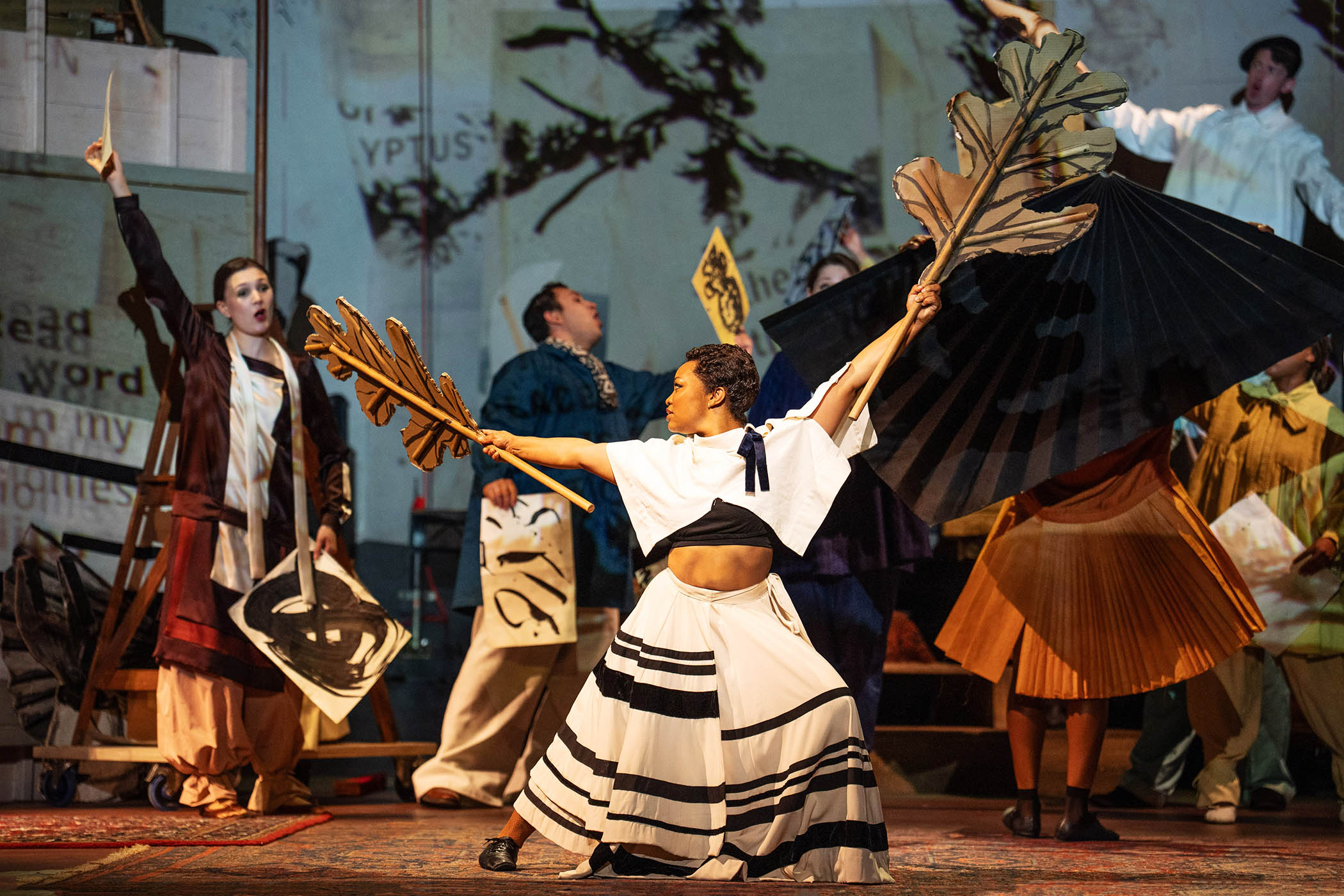
A square in Gaza. Philistines and Hebrews fight. The warrior-leader of the Jews loves a woman from the enemy camp. She betrays him. Not all directors would resist the urge to treat Saint-Saëns’s Samson et Dalila (1877) as a critique of today’s Middle East. This grand opera’s mix of sex and religion, orgy and zeal – all headily atomised with the scent of 19th-century French Orientalism – seems to cry out for a dose of stringency. Modern politics, occupied territories? Why not? The director Richard Jones is too smart to take that easy bait.
Instead, in his 2022 staging for the Royal Opera – now revived, conducted by Alexander Soddy – Jones treats the violent haircut story, based on the biblical Book of Judges, as an ancient tussle between faith and materialism. In so doing, he brings sinew and tension to Saint-Saëns’s musical hybrid, part oratorio, part over-the-top operatic spectacle. The opposing sides are clearly defined: the Jews are recognisable, the Philistines, long extinct as a tribe, are generic worshippers of mammon. A surprise visual coup in Hyemi Shin’s colour-saturated designs, each detail sharply observed, comes at the end: their god Dagon appears as a shiny, gigantic comic-book idol who clutches cash in one hand, poker chips in the other. A perfect setting for an orgiastic bacchanale.
Saint-Saëns (1835-1921) – child prodigy, organist, conductor, capable writer of novels, plays, criticism, as well as music, fluent in several languages – can seem a lot more interesting than his music, much of which is unplayed. Samson et Dalila is the only one of his 13 operas still regularly performed. Above all, full of orchestral variety, it is a showcase for two star voices. The Royal Opera came up trumps. The Bashkir mezzo-soprano Aigul Akhmetshina, whose versatility has enriched her many recent performances of Carmen, made her debut as Dalila. She brings vocal subtlety and glamour to the role as well as feline cunning. The South Korean tenor SeokJong Baek returned to sing Samson. Once a baritone, who became a tenor in the Covid lockdown, he has exactly the lower weight and higher, ringing strength needed for this morally conflicted role. With Łukasz Goliński (High Priest), William Thomas (Samson’s Rabbi), a first-rate chorus, dancers and orchestra, Samson et Dalila gets a fine showing here.
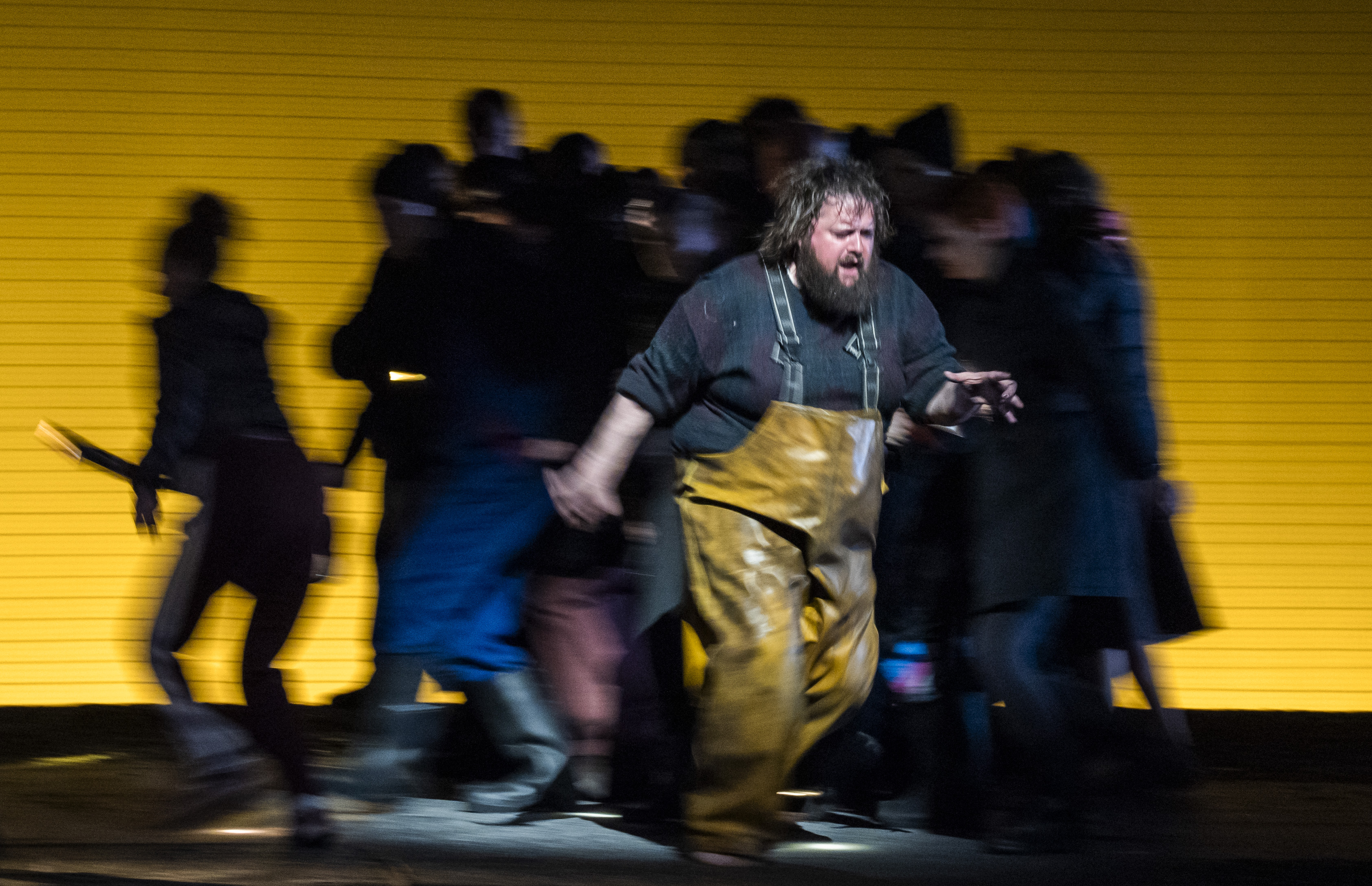
The ‘heartbreaking’ Allan Clayton in Peter Grimes
New in 2022, a co-production with Madrid, Rome and Paris, Deborah Warner’s staging of Benjamin Britten’s Peter Grimes (1945) has returned to the Royal Opera with the tenor Allan Clayton back in the title role. Jakub Hrůša, the company’s music director, conducts. On a second encounter, this fierce, clear reading seems yet more perceptive and harrowing, at once cruel and humane. The mob, rather than Grimes, are the perpetrators. The outsider fisherman’s greatest fault is that he has never learned kindness. Clayton, musically faultless, poetic, sensitive, is – hard to put any other way – heartbreaking.
Warner builds on the sense of place that’s key to the work. For Britten and the poet whose work inspired him, George Crabbe (1754-1832), that place was the North Sea coast of Suffolk. Warner and her designer, Michael Levine, shift the action south to Essex. Grimes speaks of being “rooted here” not by a community, friends or family but by nature itself, by marsh and sand, prevailing wind. Britten burns that loneliness into the music: into the very layering of strings, woodwind, brass.
On occasion the technique is purely expressive, to suggest gull, sea spray, church bells. On others it is embedded in musical invention we may sense but not notice. At the start, asked to swear an oath in court, Grimes replies to the standard “Will you swear by almighty God?” not at the same conversational speed set by his interlocutor, Swallow (Clive Bayley), but at exactly half that metric tempo. The effect is immediately to slow the pace, as if Grimes is already at odds with authority.
Later, Grimes sings with Ellen Orford (Maria Bengtsson, excellent and sympathetic), apparently in union with her but initially in a different key. As for the “passacaglia” Sea Interlude in Act 2 – dark, mighty, elemental – here Britten does the seemingly impossible: he uses a seven-note bass theme 39 times (I did not count), as if wanting to traverse an entire musical universe from a place of imprisonment. It’s a moment of genius. The power of the story, the psychology of the drama, can sometimes make us overlook the fact that Britten’s music is the prime mover. This was, astonishingly, his first opera – conceived in wartime America but given its first performance at the start of peace, at the reopened Sadler’s Wells, London, on 7 June 1945.
In a great ensemble cast, Bryn Terfel, in glorious voice, steadies the rabble as a big-hearted Balstrode – “shrewd as a travelled man should be”. Christine Rice as the awful Mrs Sedley and Catherine Wyn-Rogers as Auntie are only two of the several who, by gesture or phrase, turn a cameo into a full character. Peter Grimes is, above all, a chorus work. Rightly they, and the orchestra, won especially noisy applause. Out of a few lines from a quirky poem about a brutish fisherman, Britten created a work for all humanity. It is one of the toughest evenings in the opera house. As done here, it is one of the best.
Samson et Dalila is at Royal Opera House, London, until 3 June and Peter Grimes is on until 28 May
Photograph by Mihaela Bodlovic/Tristram Kenton
Newsletters
Choose the newsletters you want to receive
View more
For information about how The Observer protects your data, read our Privacy Policy