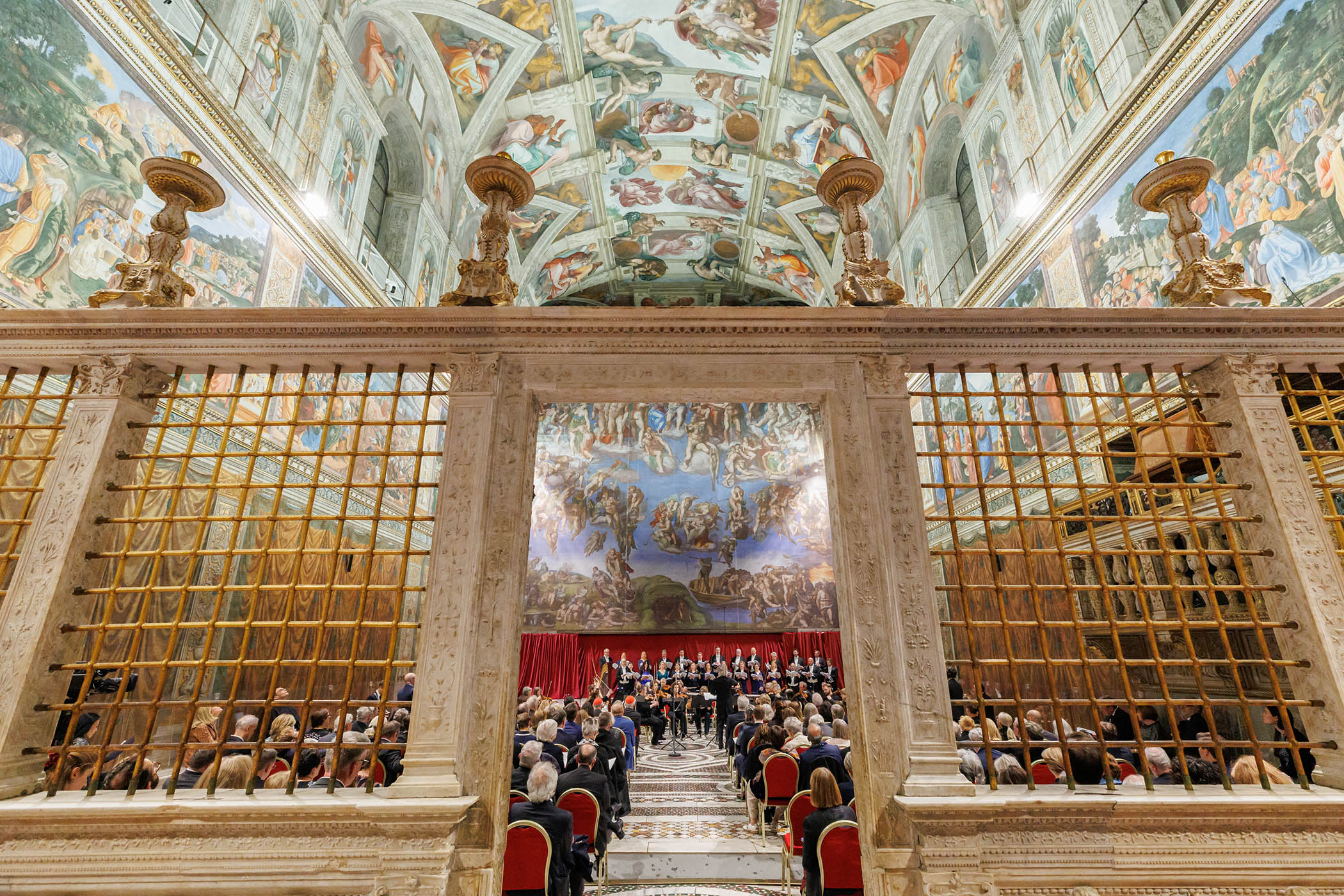

Look up. God, carried by angels, stretches out a finger to meet Adam’s languid hand. Ahead on the altar wall, stricken souls hover in gaseous blue space, faced with salvation or eternal doom. Many artists contributed to the Sistine Chapel over centuries, but the peerless frescoes of Michelangelo dominate. From The Creation of Adam to Last Judgment, via prophets and apostles, saints and sibyls, every inch of the building’s interior bristles with action and colour. Mind and senses are overwhelmed, as if deafened by a roar of imagery.
This Roman holy of holies, stark and unadorned on the outside, approached along windowless marble corridors and grand stairways, feels shut off from the world; the mysterious heart of the Vatican. (Though, technically, it is less hidden than it once was, with an estimated 25,000 visitors a day providing about £70m annually for the papal coffers.) What could music add to all the visual tumult?
Would it be possible to listen – to hear properly – a complex new work in the pope’s own chapel, seat of the mighty papal conclave, except with your eyes shut? How not to wonder where the chimney, emitter of black or white smoke is; or if that door really does lead to the Room of Tears, where a freshly elected pontiff can retreat to weep at his new burden.
These questions felt real and pressing before a private concert given at the Sistine Chapel last weekend. The occasion was the world premiere of Angels Unawares, a 70-minute oratorio by the Scottish composer James MacMillan (b1959), performed by two world-class British groups, the Sixteen vocal ensemble and the Britten Sinfonia, conducted by Harry Christophers. The text, by the late Robert Willis, Anglican dean of Canterbury Cathedral, is a poetic meditation on angels: 12 in all, who appear in the Old and New Testaments, as messengers, guides, intercessors.
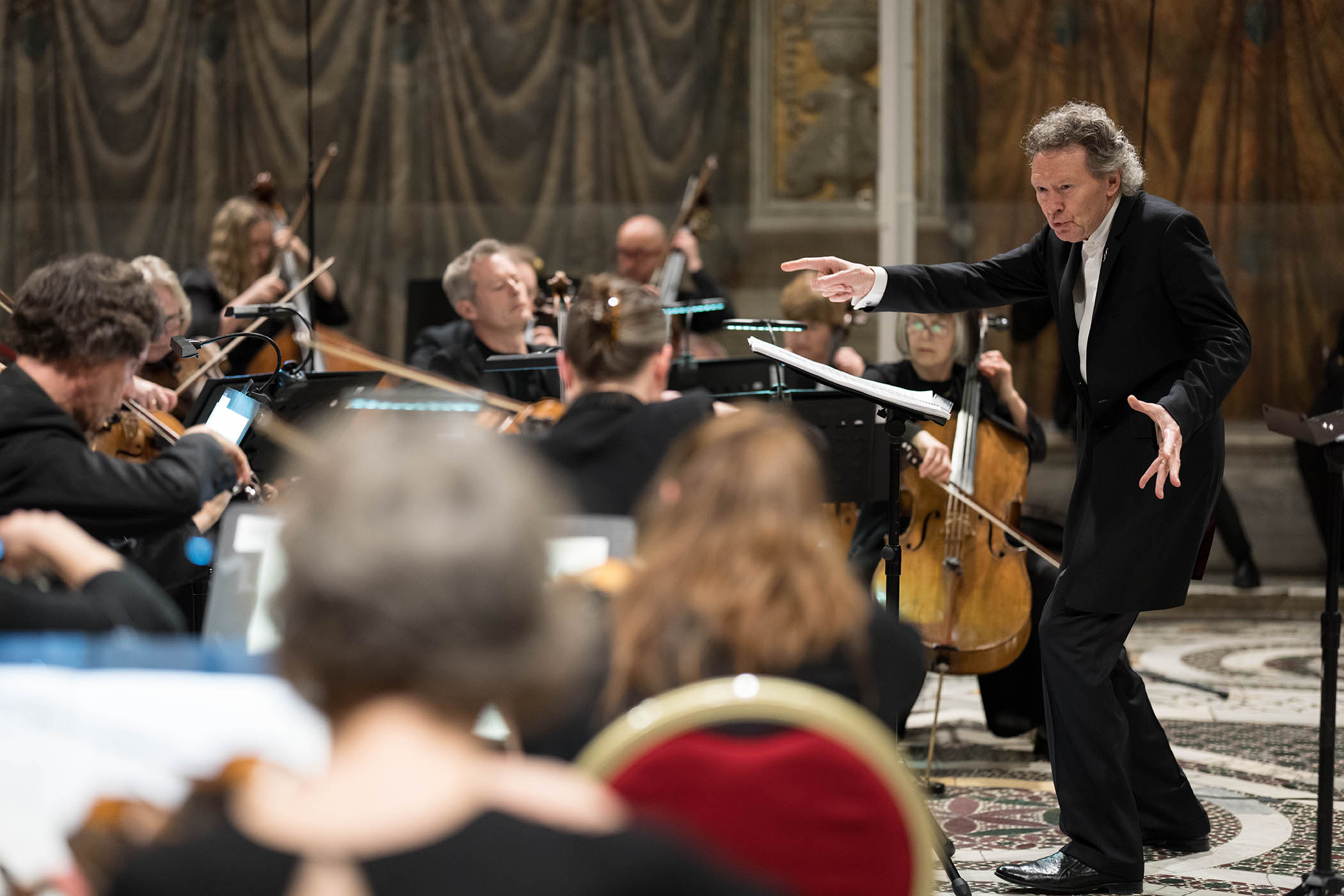
Harry Christophers conducts the Sixteen vocal ensemble and the Britten Sinfonia in the Sistine Chapel
As people assembled, all of us somewhat awed by having the place to ourselves, MacMillan was at the front, chatting, showing no sign of nerves. He has a quiet and gentle presence, but his music can be impassioned and turbulent. Would these qualities be present in his new composition? Guests of honour included the Canadian prime minister, Mark Carney, and two respective former prime ministers of Britain and Australia, Theresa May and Julia Gillard. Pope Leo XIV was represented by two cardinals: Vincent Nichols, archbishop emeritus of Westminster, and the influential Pietro Parolin, secretary of state for the Holy See and a leading spokesman on world affairs. Angels Unawares is the first concert work to be premiered in the Sistine Chapel but the second performed there by these same forces: in 2018, MacMillan’s Stabat Mater became the first work to be livestreamed from the chapel.
In each case, MacMillan – awarded the King’s Medal for Music earlier this month – was commissioned by the Genesis Foundation. For a quarter of a century, since 2001, Genesis has helped many emerging artists and UK arts institutions, including the Sixteen. The vision, from the start, has been that of its American-British founder and chair, John Studzinski, a banker philanthropist who grew up near Boston, the child of Polish immigrants. A leading Catholic who has a private chapel in his Chelsea house and makes occasional appearances on Radio 4’s Thought for the Day slot, he has close connections to the papacy. He was probably the one person who could make this event happen.
His belief in the importance of charity dates back to the age of six, when he first volunteered in a soup kitchen alongside his mother. Homelessness, people trafficking and the wider question of human rights are his chief preoccupations. Lest you get the impression he is po-faced, he entertained friends in Rome last weekend for his birthday, with dress codes such as “Pucci and Gucci” and “Botticelli”, which may have foxed some of his more sober guests but was, I suspect, suggested with a smile.
The idea for MacMillan’s piece, with angels at the heart, came from Studzinski himself. He is fascinated by these mediators between heaven and Earth who appear in world cultures and religions beyond Christianity, including Judaism, Islam and Zoroastrianism. Who are they? “Wherever we are, at every moment, and even if we are not conscious of their presence, angels are by our side,” Studzinski told me as we stood in the chapel. “We all have angels in our lives. Your angel intercedes, protects, guides, protects. Things that happen as if by chance might be seen as guided by angels. Music should be a form of angelical messaging.” Unfortunately, someone whispered in his ear at that moment that his close friend the Canadian prime minister was about to arrive, so our conversation ended.
The Sixteen’s concert was the culmination of these festivities. In reality, any doubts about music’s suitability for the Sistine Chapel were wholly misplaced. The building was conceived with music in mind. Its male choir is one of the oldest in the world. Great composers of the Italian Renaissance, notably Palestrina (c1525-94), wrote for the Vatican musicians. Later, a young Mozart heard Allegri’s Miserere there, with its soaring top C sung by a boy treble. The teenage prodigy allegedly – evidence is sparse – transcribed it complete on one hearing, ensuring the work’s posterity.
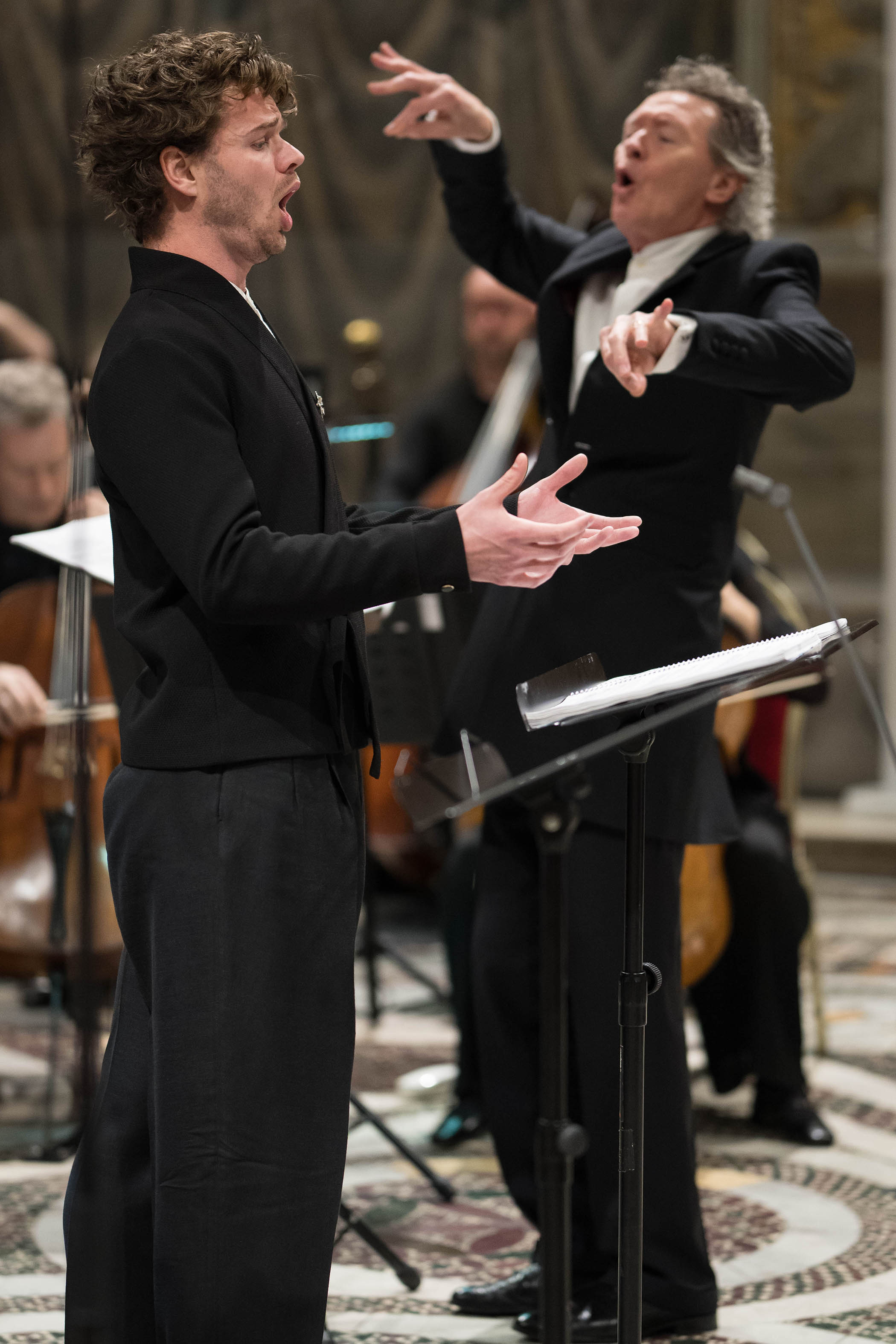
The outstanding young tenor Matthew McKinney
The chapel is not, however, a building accustomed to presenting concerts, which makes the logistics only marginally less of a headache than, say, trying to get inside a high-security prison. It has no associated administration, or dedicated staff able to sort out practical queries for choral and orchestral events (perhaps simply a glass of water). Rehearsal time is strictly limited.
Newsletters
Choose the newsletters you want to receive
View more
For information about how The Observer protects your data, read our Privacy Policy
There is no lighting rig. The Britten Sinfonia are a small, elite band of 26 players who can travel relatively lightly. Air freighting two double basses and hiring a harp and four timpani locally is not unusual for a touring orchestra. But with no lifts or ramps (or not in the right place), instruments had to be lugged up countless perilous marble stairs. Gorgeously attired pontifical Swiss Guards populate the route but do not help shift harps or timps.
In the absence of dressing rooms, players readied themselves in areas cordoned off by hospital-style screens in the august Aula delle Benedizioni (Hall of Blessings), which is en route to the loggia, where the pope blesses the crowds in St Peter’s Square. Add to all this the small matter of the Rome marathon taking place last Sunday, causing multiple road closures and jamming the city, not to mention an AS Roma football match (home win), and the potential for disaster was next level.
At last, the concert began. What would the sound be like in this lofty space with its bare walls and high, high ceiling? Raphael’s tapestries were commissioned by Pope Leo X in 1515, in part to help reduce the long reverberation time. Now, with a full chapel, the sound was clear, lively and warm. Every vocal and instrumental line rang out. MacMillan has set Willis’s poems – which include Jacob and the Ladder Reaching into Heaven, The Song of Tobias, Gabriel’s Message and more – with a mix of moods ranging from the ecstatic to the ethereal to the ferocious.
At the start, cellos burst into an explosion of sound, scrubbing their bows at top speed, digging in as if depicting chaos, only appropriate for an opening text dedicated to the creation of the world, fortissimo chorus singing of the fall. Some sections were choral, others sung by the expressive soloists – the well-established soprano Elizabeth Watts and the outstanding young tenor Matthew McKinney, together or alone. Watts’s account of the crucifixion in The Song of Mary of Magdala was heartrending and, at one point, ear-piercing.
Brass and timpani resound in the many climactic moments. All credit to these extraordinary performers that they sang, on their feet without pause, for the duration of this work – new to them as well as us – and played with authority and brilliance. With characteristic invention, MacMillan ends each section distinctively: a change of key, a simple string chord, a strange, downward glissando. This is a substantial and exciting work. Its variety will take time to absorb.
All told, Rome was a centre of innovation last weekend. The highly sought-after British artist George Rouy (b1994) is the first to feature in a year-long series on the act of reading, at the Holy See’s free gallery space, Conciliazione 5, curated by Donatien Grau, head of contemporary programmes at the Louvre. Rouy’s large abstract painting has an accompanying sound work. Both are scratched, scraped and scored like imaginary writing.
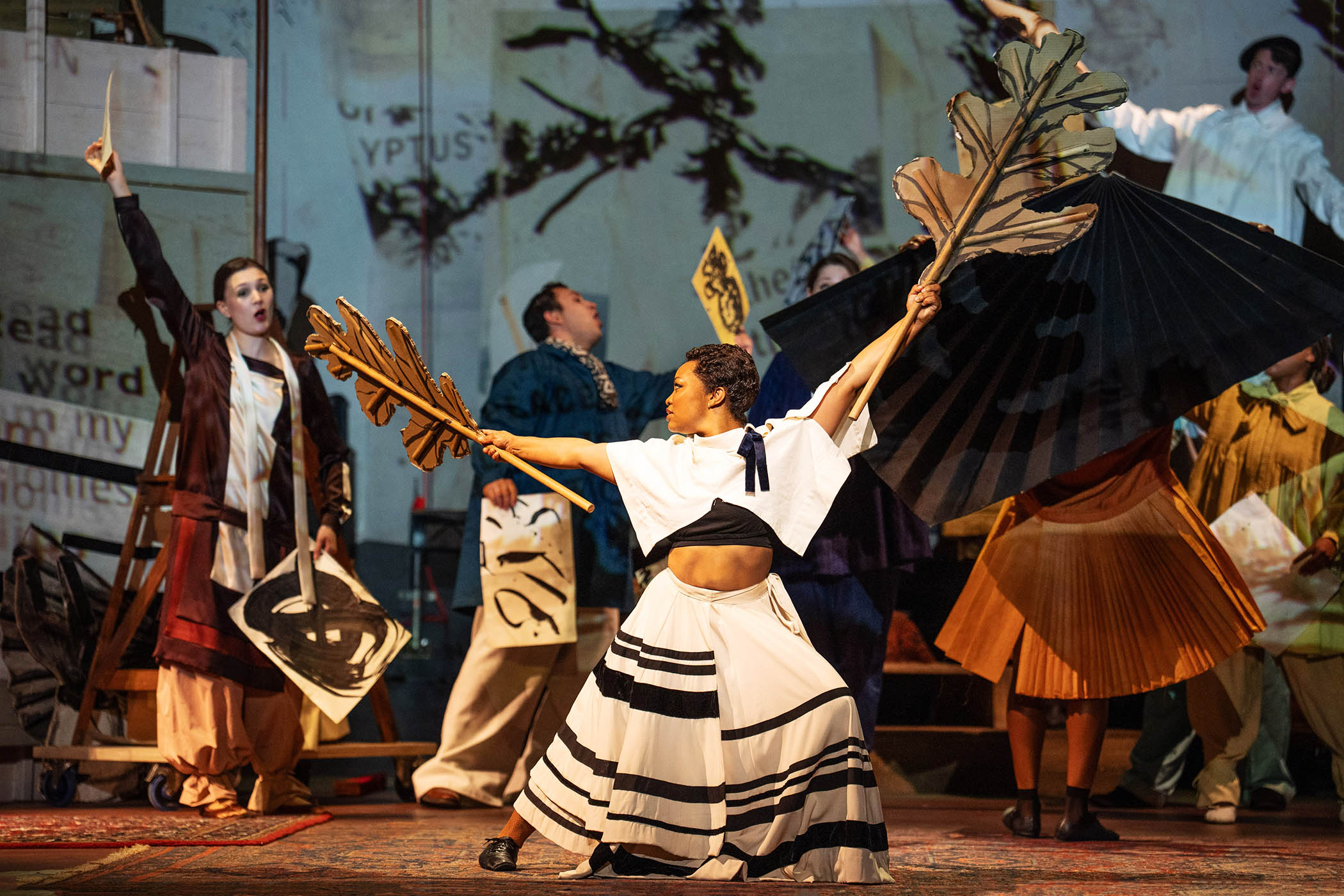
At Maxxi, Rome’s national museum for 21st-century art, you could catch the South African artist William Kentridge’s film opera, Breathe Dissolve Return, with music by regular collaborator Philip Miller, alongside other Kentridge works. There, amid the rich mix of collage, song and animation, one figure stood out: a stencilled angel, wings aloft. It turns out, in fact, to be inspired by Winged Victory on Trajan’s Column in the city. Too bad. It looked like an angel. As Studzinski says, they’re everywhere, always at your side.
The concert will be broadcast on BBC Radio 3 tonight at 7.30pm. Angels Unawares receives its UK premiere on 2 June at Cadogan Hall, London.
Photographs by Harry Richards