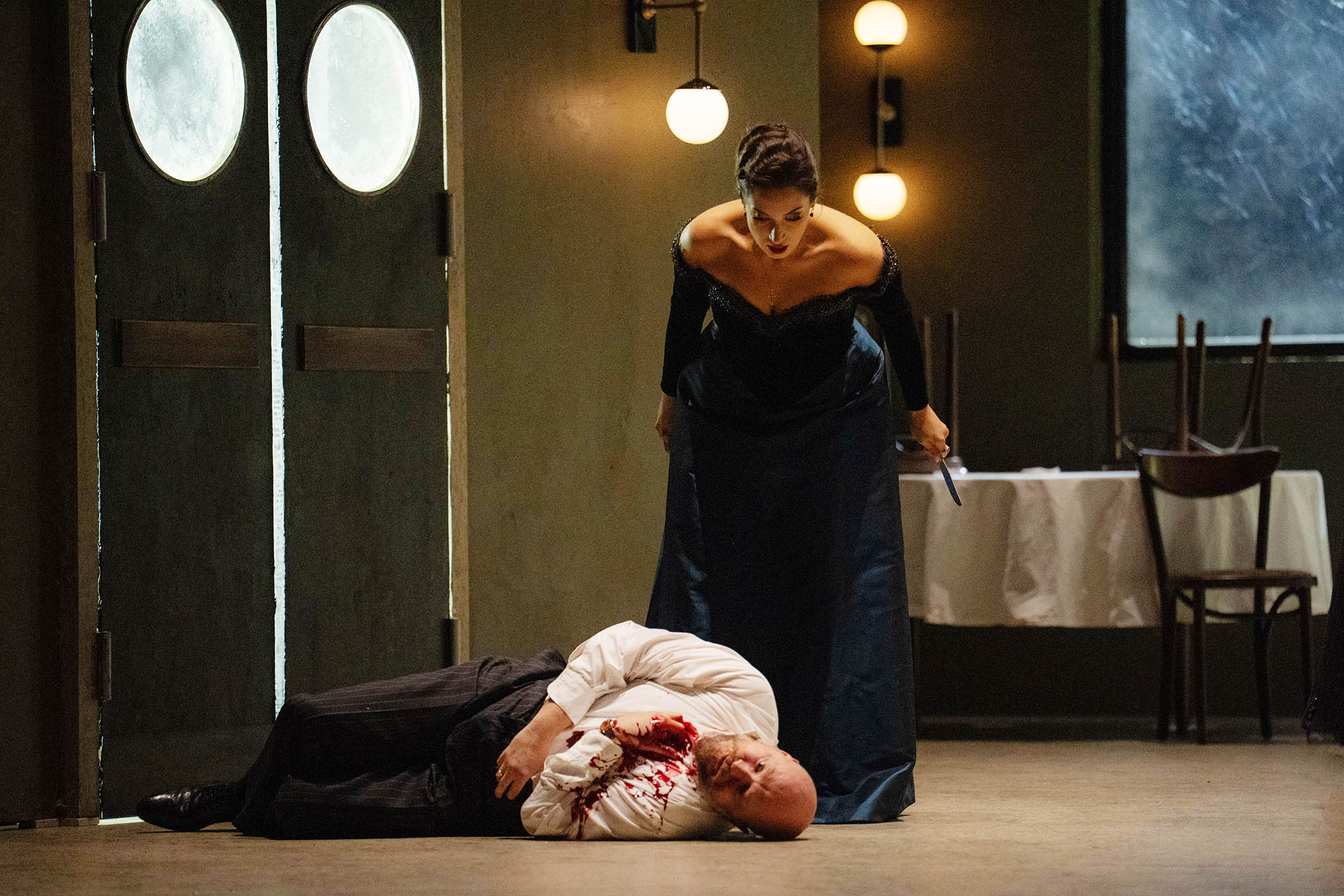

Tosca, Giacomo Puccini’s heady mix of sex, violence and religion, makes its first-ever appearance at Glyndebourne this season – and it’s not a pretty sight. With authoritarianism and the abuse of power on the rise around the world, the director Ted Huffman is determined to use the piece as a shocking warning: this is what happens when the thugs take over. Gone are the baroque fineries of elegant Rome; here is bloody reality.
He shifts the action from Napoleonic times to an indeterminate 20th century (there are 1950s costumes, 1960s furnishings and a 1970s car) and all but abandons the opera’s three distinct locations: the church of Sant’Andrea della Valle, the Palazzo Farnese and the Castel Sant’Angelo. Designer Nadja Sofie Eller gives us a drabchurch for Act 1, but then we are off into completely new territory, physically and psychologically.
Scarpia, the villainous chief of police, has swapped his grim palazzo for a sleek, upmarket restaurant, where his internalised fantasies about assaulting the singer Tosca are transformed into repellent boasts, rehearsed in front of an audience of sycophantic diners.
Tosca’s lover, the painter Cavaradossi, is brought in to be interrogated about the escape of a political prisoner and dragged into the kitchen to be tortured, while the restaurant’s clientele carry on eating. Some slip away, uneasy at the turn of events, but others linger, indifferent to the suffering and underscoring Huffman’s contention that violence can quickly become normal in a brutalised society.
Evil may be banal, but sometimes it needs to look a little more evil
Evil may be banal, but sometimes it needs to look a little more evil
The single still moment in this high-octane act is Tosca’s central aria Vissi d’arte, when she questions how her life has come to this: having to agree to sex with a monstrous bully to free her lover. Usually the focus is solely on her, but here diners distractingly still eat and drink. Huffman seems to be reminding us that sometimes private grief can descend in very public places.
The most radical departures are saved for the last act. A bleak quarry, lit by car headlamps, replaces the starlit roof of the Castel Sant’Angelo. This is a place of violent summary execution, graphically displayed here, with bodies dragged up a slope and dumped unceremoniously over the edge. You might expect that cresting rise to be the place where Tosca makes her death leap, once her murder of Scarpia has been revealed, but Huffman has another, weaker idea, one that neutralises Tosca’s power to escape her captors on her own terms. In doing so, he diminishes her role to just one more victim of the heartless thugs. That is not what Puccini intended.
At least Huffman and the conductor Robin Ticciati have an impressive cast, with strong support from the London Philharmonic Orchestra. The velvety American soprano Caitlin Gotimer gives Tosca a gloriously rich tonal palette that reflects all the nuances of her character. Her Cavaradossi is Italian Matteo Lippi, a powerful tenor who brings both poise and affecting pathos to his last act aria, E lucevan le stelle. Vladislav Sulimsky has a tougher time convincing us that he is the terrifying Scarpia, not because his baritone is anything less than commanding, but because costume designer Astrid Klein puts him in a boring business suit. Evil may be banal, but sometimes it needs to look a little more evil.
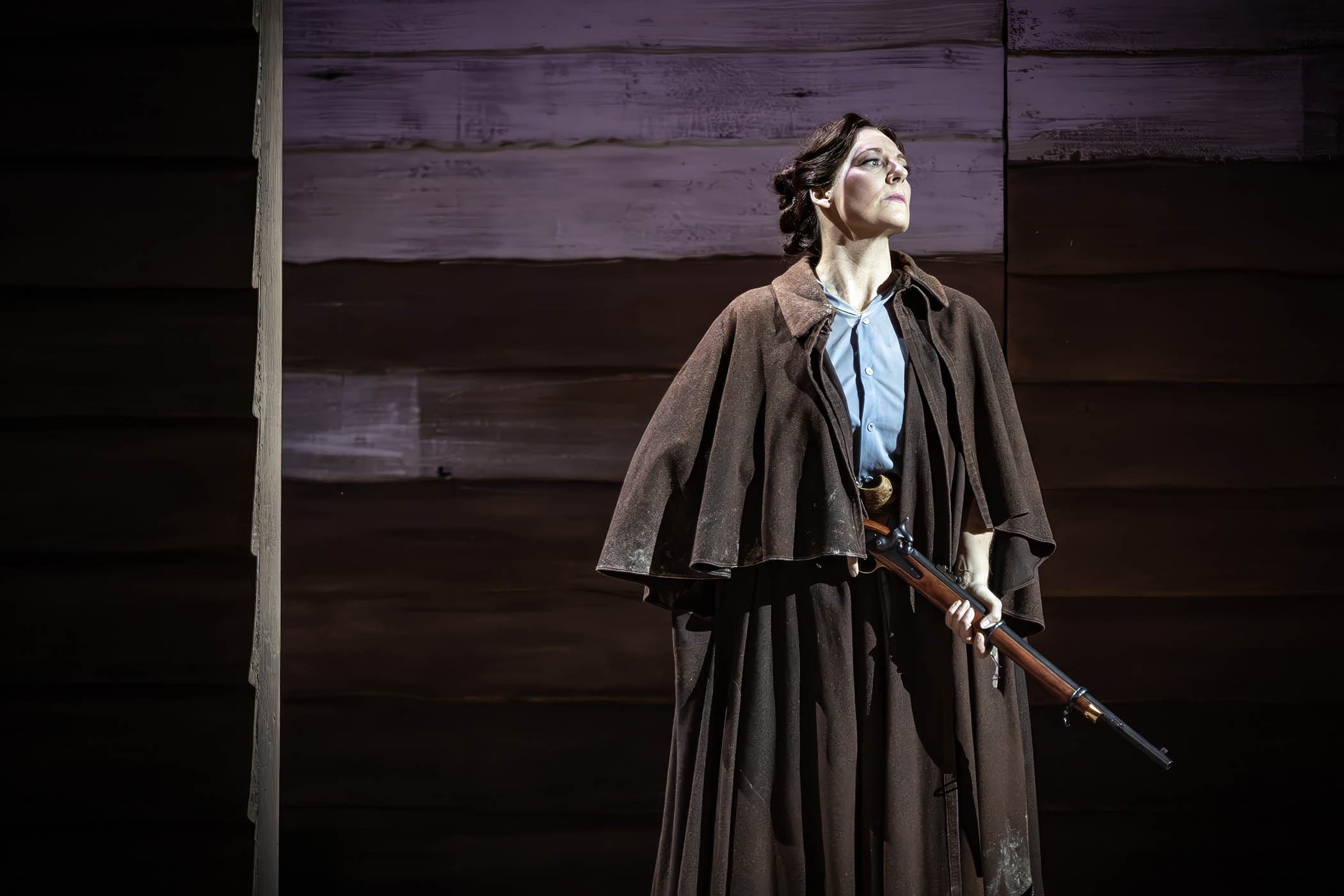
Amanda Echalaz as Minnie in La fanciulla del West
Ten years after Tosca, Puccini’s imagination was captured by the story of a totally different heroine: the strong, assertive bar keeper Minnie, who has never been in love but who tends, mother-like, to a crowd of unruly prospectors during the California gold rush of 1849. La fanciulla del West (The Girl of the Golden West) is certainly not in the top rank of Puccini’s output, but there is some fine music, particularly in the last act, when the action shifts up a gear. Stetsons off to Opera Holland Park for its new production, directed by Martin Lloyd-Evans, which opens its 30th season, a milestone for a company that consistently punches above its weight.
The all-male chorus is outstanding, responding wholeheartedly – along with the City of London Sinfonia – to the spirited conducting of Matthew Kofi Waldren. The grinding poverty of a temporary mining encampment is well observed in the costumes and designs of Anna Reid, lit by Jamie Platt.
Particularly notable is a new talent, the baritone Alaric Green, as Ashby, a Wells Fargo agent. Blaise Malaba, the sonorous bass, makes the most of his single ballad, but alas, is never heard again. Implacable Portuguese tenor José de Eça returns to OHP as Dick Johnson, the bandit who will win Minnie’s heart. Robert Hayward, as disillusioned sheriff Jack Rance, and Amanda Echalaz, as Minnie, are passionate and committed. In the sometimes rough-hewn edges to their voices, we hear the desperation of these hard-bitten characters.
Newsletters
Choose the newsletters you want to receive
View more
For information about how The Observer protects your data, read our Privacy Policy
Photographs by Richard Hubert Smith, Craig Fuller