


Debenhams is back,” said Dan Finley, the chief executive of Debenhams Group, formerly Boohoo Group, last month. “The iconic British heritage brand, bought out of administration, has been successfully turned around.”
Shares in the company, once a darling of British fashion, had hit rock bottom just a few days earlier, falling to an all-time low of 10.3p in mid-November, after torrid few years in which it was buffeted by competition from Chinese ultra-fast fashion brands, trailing consumer confidence and several scandals around its supply chain when it was Boohoo.
But Finley’s announcement accompanied first-half results showing a remarkable change of fortunes. Although revenues had fallen by a quarter in the six months to the end of August, losses had also fallen, by almost 94%, and costs had plummeted by £160m, from £292m in February 2024. In fact, costs were on-track to fall to £100m – a drop of almost two-thirds – “in the near term”.
How does a company create such a sharp change to fortunes – and what does it say about how the rest of the UK’s retails sector is adapting?
How does a company create such a sharp change to fortunes – and what does it say about how the rest of the UK’s retails sector is adapting?
Investors reacted fast: since that announcement in late November, shares have more than doubled. How does a company create such a sharp change in fortunes – and what does it say about how the rest of the UK’s retail sector is adapting to face its rivals?
For Debenhams Group, the answer lies in Finley. When the 42 year-old Oxford graduate was promoted from his role as Debenhams chief executive to group CEO in October last year, he arrived with a plan: a marketplace model. He used the former department store as his proof of concept: instead of buying up, storing and shipping goods, it would simply list other brands’ products – and the brands would shoulder the costs of storage and shipping themselves.
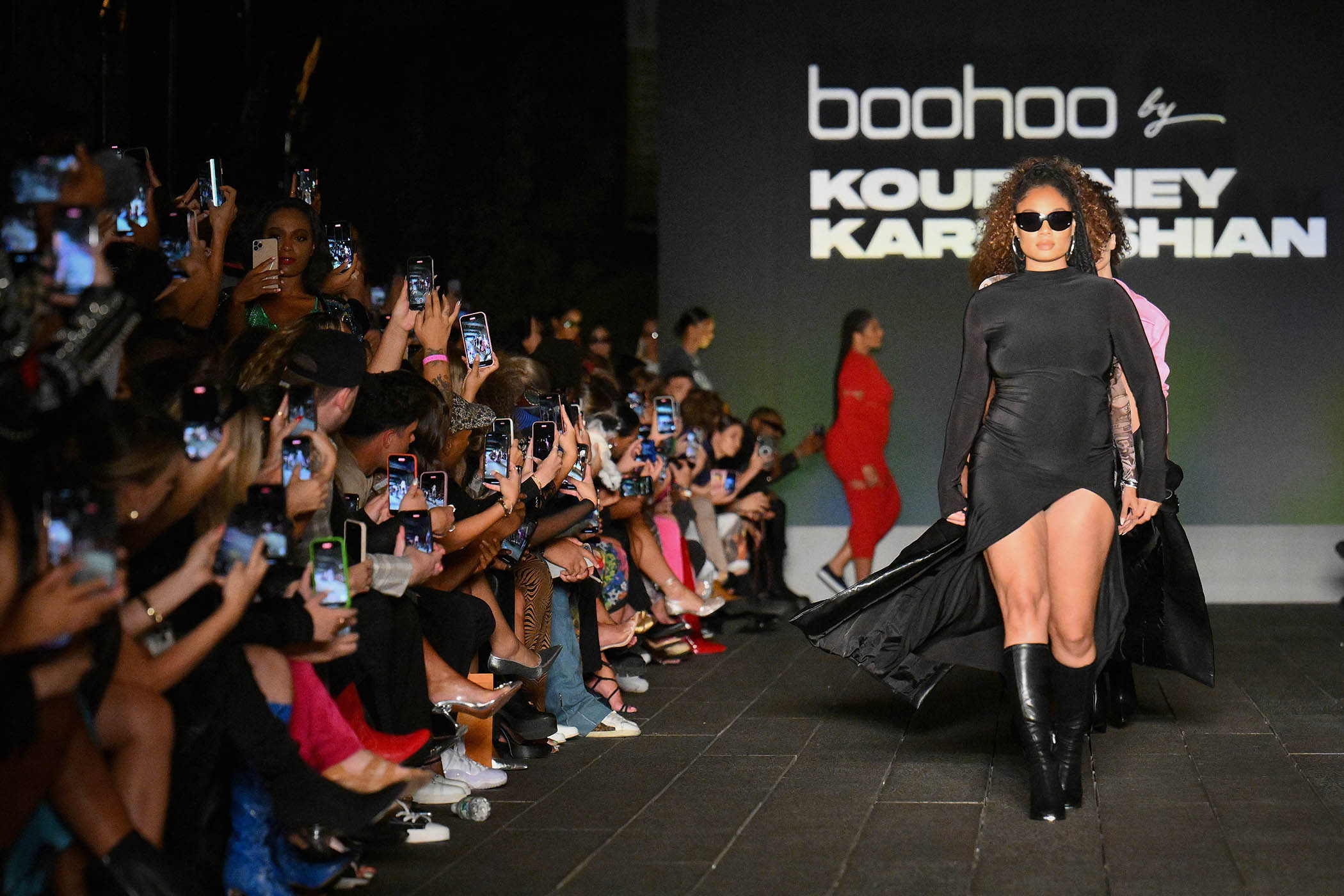
It’s hardly a new way of doing things. Both Marks & Spencer and Next have found success with versions of that model; even Superdrug has had a go. But the strategy has proven so transformative for Debenhams Group that it is in the process of applying the same treatment to its other brands, including Boohoo, PrettyLittleThing and Karen Millen. So far, the model has allowed the company to cut its head count by 70%, and it has closed several warehouses, including one in the US. Karen Millen has even branched out into pre-loved, selling vintage designer handbags.
This isn’t Finley’s first rodeo. He spent a decade honing his digital retail skills at JD Sports, then took on the role of Debenhams CEO in 2022, almost exactly a year after Boohoo bought the ailing department store out of administration for £55m.
Finley’s promotion to group CEO in November 2024 irked Mike Ashley, whose Frasers Group owns 29.9% of the company
Finley’s promotion to group CEO in November 2024 irked Mike Ashley, whose Frasers Group owns 29.9% of the company
Finley’s promotion to group CEO in November 2024 irked Mike Ashley, whose Frasers Group owns 29.9% of the company. Ashley, who has a fractious relationship with Boohoo founder Mahmud Kamani, had hopes of occupying Boohoo’s corner office himself. In an open letter, he objected to Finley’s appointment: “desperate people do desperate things,” he wrote.
Not surprisingly, Ashley hasn’t made life easy for Finley. Last December he attempted to have himself elected to the board, but that was thwarted by a shareholder vote. At another shareholder vote in March, Ashley obstructed the company’s rebrand (although it’s now known as Debenhams Group, its holding company is still Boohoo Group). Earlier this month, after the company prevented shareholders from voting on a pay deal which could see Finley awarded £148m, Chris Wooton, Frasers’ chief financial officer, called it a “disgrace”.
But insiders say they are “blown away” by Finley. “He’s unbelievably driven, very dynamic,” said one. He’s a popular leader: several members of his team at JD Sports are said to have followed him to Debenhams, including Phil Ellis, who, after a stint as chief financial officer of Debenhams, is now group CFO.
Newsletters
Choose the newsletters you want to receive
View more
For information about how The Observer protects your data, read our Privacy Policy
These companies have taken Boohoo’s ultra-low-price fashion strategy ‘and put it on speed’
These companies have taken Boohoo’s ultra-low-price fashion strategy ‘and put it on speed’
Tamara Sender, associate director fashion retain research, Mintel
The company’s fortunes highlight struggles felt by many UK fashion retailers in the face of the explosive growth of Shein and Temu, the ultra-fast fashion Chinese retailers. These companies have taken Boohoo’s ultra-low-price fashion strategy “and put it on speed”, said Tamara Sender, associate director fashion retail research at Mintel. “There’s no competing, so you have to remodel.”
Some retailers have taken swift action – over the summer H&M announced a 40% rise in third-quarter profits after it closed underperforming stores and boosted online sales, while Zara is combating Shein by going upmarket, with limited-edition collaborations with designers.
Others have struggled. Frasers itself reported a 5.8% fall in its UK sports division in the six months to the end of October, which it attributed to “very subdued” consumer confidence. At the end of November, the British Retail Consortium reported a muted 1.4% year-on-year increase in total UK retail sales.
The good news is that in the long term, Shein’s grip on the British market may loosen after the chancellor’s decision to end the de minimis rule, under which parcels coming into the UK which are valued at under £135 are exempt from customs duty. But that won’t take effect until 2029: until then, Shein’s influence will remain.
Despite Finley’s enthusiasm in November, Boohoo’s turnaround is not quite “successful” yet. Revenues are still weak, and Kantar BrandZ research shows it still has the “weakest consumer connections” of any clothing brand it covers.
But analysts are encouraged. “I don’t think I’ve seen many people attempt to turn around a business as rapidly, at such a scale as this,” said Wayne Brown of Panmure Liberum. And despite Ashley’s reservations, added John Stevenson of Peel Hunt, Finley is “exactly the right person to be driving that business”.
Photograph by Angela Weiss/AFP via Getty