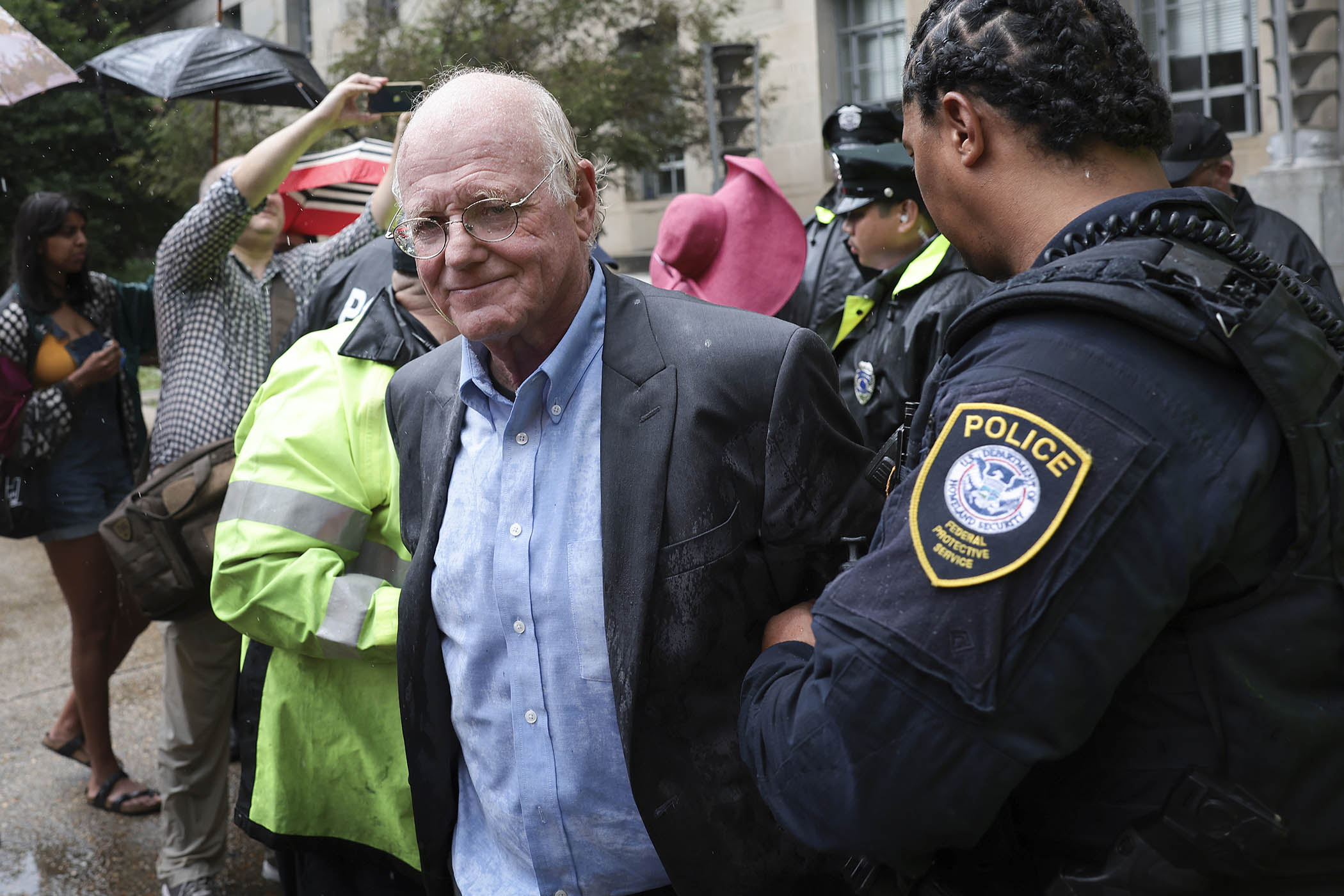


Ben Cohen was in handcuffs a year ago. A video shared on social media in May 2025 shows the then 74-year-old co-founder of Ben & Jerry’s ice-cream being escorted from the US Senate floor, hands tied, after protesting against military aid to Israel.
“Congress kills poor kids in Gaza by buying bombs, and pays for it by kicking kids off Medicaid in the US,” he yelled in the direction of the health secretary, Robert Kennedy. He was charged with a misdemeanour and later released from custody.
“I can’t call myself an American and not put my body on the line,” he told me this week in an interview on the sidelines of SXSW London. Despite a twisted ankle – and rumours circling that his beloved brand, which is now a subsidiary of the Magnum Ice Cream company, might be sold to private equity – Cohen is still campaigning.
He’s here to protest another perceived injustice. Cohen claims that Magnum is stifling Ben & Jerry’s baked-in social mission, and has “dismantled” the independent board that oversees those aims. He’s launched a campaign to #FreeBen&Jerrys, hiring a marketing team and tapping up a consortium of like-minded investors to try to buy it back. For the activist-entrepreneur who started out selling ice-cream from a service station in Vermont, it’s characteristically bold.
Magnum says it has no intention of selling, to private equity or anyone else. It denies Cohen’s claims, saying it remains committed to the company’s “three-part mission – economic, product and social” and also to the independent board structure that was agreed when the company sold to previous owners Unilever in 2000 for $326m (£242m). Cohen made roughly $40m on the sale, and donated roughly half of that to progressive causes.
So what gives? Cohen says that while he fought the sale initially, he he was “pleasantly surprised” to see the social mission thrive. Under the auspices of the consumer giant, Ben & Jerry’s launched the limited edition ice-creams, Unfudge our Future, a call for Australia’s leaders to ban fossil fuels, and Change the Whirled, a collaboration with Colin Kaepernick, the proceeds of which went to a youth rights organisation set up by the former American footballer who launched the “take the knee” campaign in 2016.
But regret emanates from Cohen: “To be quite frank, I understood that we gave it authority in writing, but I didn’t hold out very high hopes that that agreement was going to be abided by.”
Some governance experts argue that this legal framework of an independent, values-led board, while structurally ingenious, would ultimately melt without the acquirer’s willing cooperation. That was most obviously demonstrated last October, when Unilever blocked Ben & Jerry’s idea to create a watermelon-flavoured ice cream in support of Palestinians.
Six months earlier, Ben & Jerry’s chief executive, David Stever, had been ousted (the company says he stepped down) and replaced by a Unilever executive, and the parent company launched an audit of the Ben & Jerry’s Foundation’s accounts, which alleged a string of deficiencies, some of them related to the giving of funds to an NGO co-run by the chair of the independent board. Cohen says these are “false”.
‘I can’t call myself an American and not put my body on the line’
‘I can’t call myself an American and not put my body on the line’
Ben Cohen
Legal battles between Ben & Jerry’s board and Unilever were the start. But Cohen more directly attributes the moment it all started going wrong to the interventions of the activist investor Nelson Peltz.
Newsletters
Choose the newsletters you want to receive
View more
For information about how The Observer protects your data, read our Privacy Policy
“After his entrance to the board, Unilever became Trumpified,” he says of Peltz, who bought a stake in Unilever in 2021. “He’s the guy who boasts that he’s the bully billionaire. He also boasts about introducing Elon Musk to Trump.”
Cohen also notes that Peltz’s influence has been carried, with his stake, over to Magnum, where a partner from his investment fund, Trian, holds a board seat. Trian and Peltz declined to comment.
But current Ben and Jerry’s employees maintain the business is still swirled through with activism. “I don’t see it as being muzzled,” the chief marketing officer, Jay Curley, told New York Magazine last week. “I see us talking, speaking out about ICE… We’re continuing to talk about trans rights and Venezuela. We’re out being us, doing our thing.”
Granted, these are not the causes closest to the founder’s heart. Cohen’s focuses have always been disarmament, environmentalism and US foreign policy. It’s striking that he has little to say about arguably the biggest concentration of corporate power in the world today: AI companies. When I ask him whether he sees any parallels between Ben & Jerry’s story and the example of OpenAI dropping its non-profit status, he says he hasn’t followed it.
After nearly five decades of seeking to preserve purpose into the brand he founded, Cohen has learned a few lessons. These days, he advocates for the stewardship structure (which he calls “B-Corp plus” and which is championed by the likes of Patagonia) as the best defence of corporate purpose, rather than independent boards. His advice to the next generation: study the fine print closely.
“Write it into the founding legal documents. The purpose of this business is not just to maximise profits, but to address social problems. At Ben & Jerry’s, we were careful not to put the social mission into the marketing department – we wanted to make a statement that we were doing these things because we thought it was just important, not to sell ice-cream. It turned out that it did sell ice-cream.”
This article has been updated since publication to remove a reference to ‘Trump-backed investors’
Photograph by Win McNamee/Getty Images