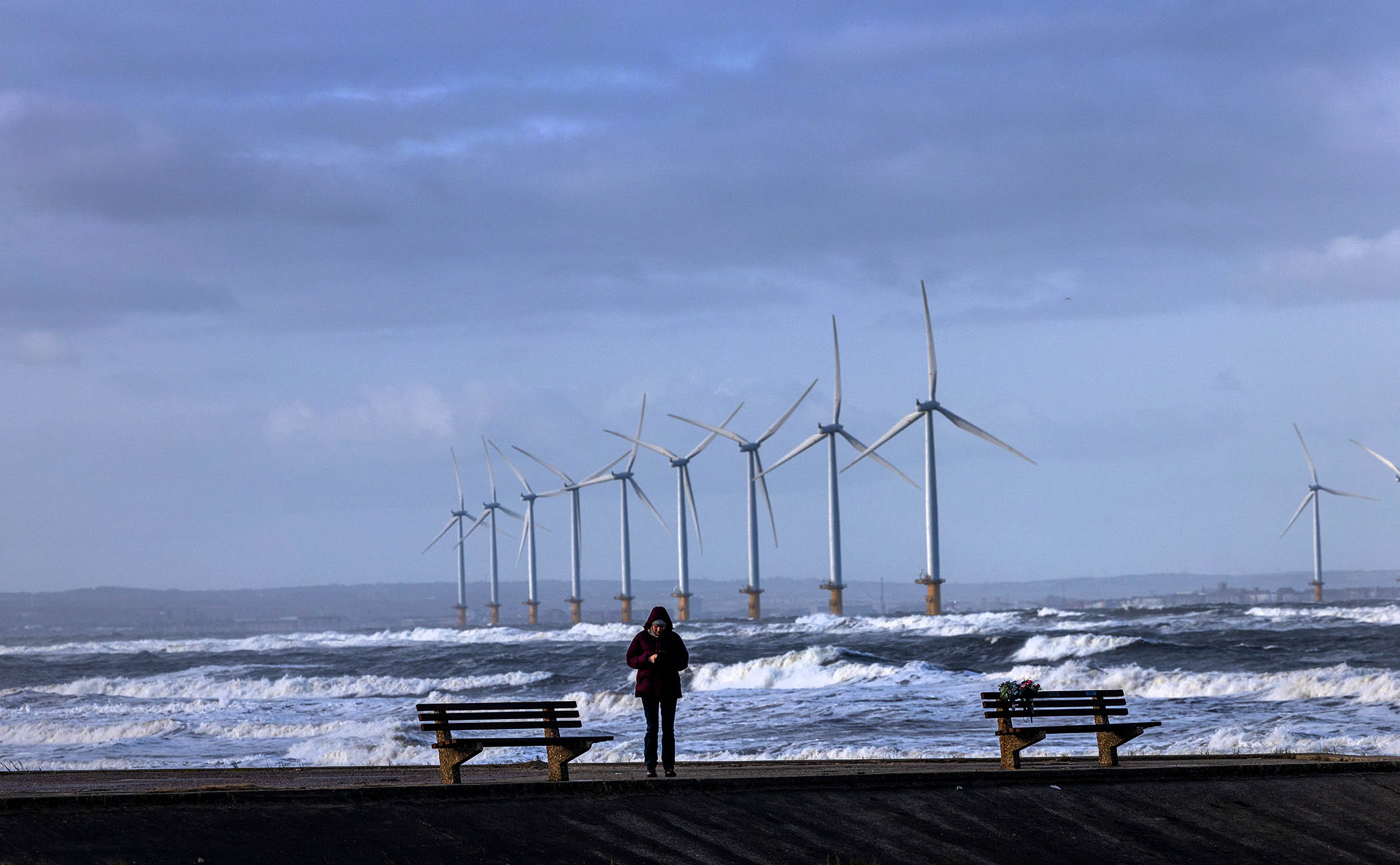



Last Wednesday was quite a moment. On 25 March 2026, Britain’s fleet of onshore and offshore wind power turbines, together with our solar and tidal power renewable energy producers, delivered nearly all our electricity needs.
You can be forgiven for not knowing. There is only one energy story anyone wants to tell at the moment – the regurgitation of Nigel Farage and Kemi Badenoch’s attack line on Ed Miliband, echoed in private and in public by our business leaders.
Miliband is crucifying British consumers and business, they say, with his crazed commitment to net zero and the high energy bills that follow, now exposed for their ultimate futility by the closure of the Strait of Hormuz. Instead, we need to open up two North Sea oil and gas fields he refuses to license, and drill, baby, drill to secure energy security and jobs alike.
His army of critics will say that nothing can be generalised from one very windy day. Except that wind and solar last year already delivered a third of our electricity requirements, and more renewable capacity is coming. In January and February, for example, the annual auctions of licences to produce onshore and offshore wind, solar and tidal power in over 200 sites, attracted the greatest wind and solar procurement bids ever made in Europe, which will supply 16m homes. Another auction has been brought forward to July.
Even solar power output, during that grey early spring day last week, did well, delivering as much power as sunny July 2025. You don’t need sun for solar power: just daylight. Amazingly, expensive gas met just 2.3% of demand for a period last Wednesday, according to the National Energy System Operator (Neso). This is not a transient moment. It foretells the future.
It’s a revolution. There are certainly hidden costs to renewable power. A core, steady electricity supply, independent of changing weather, is vital. This will become increasingly available as the nuclear power station Hinkley C comes on stream in 2030; then through small modular nuclear reactors where Britain is a pioneer, the first of which has been commissioned from Rolls-Royce SMR, in Anglesey (Ynys Môn); and then Sizewell C. Even so, for days that are calm or have short daylight hours, the potential electricity production capacity will have to be supplemented by something that can readily be turned on and off, which is not true of nuclear. Step in expensive fossil fuels, which offer such flexibility – but whose role, while crucial, will be marginal.
There is another problem. Even allowing for the hidden costs of renewables, which only work if there is flexible, costly backup capacity, they are still very much cheaper than fossil fuels. But businesses and households don’t benefit from these low costs. The price of electricity is not set by the average cost across the system but by what the least-efficient, highest-cost gas producer can afford to add to production capacity. The justification was that very efficient producers would be encouraged to invest and innovate to add capacity while the least efficient would be marginalised. But, as renewables have become more important, all the pricing regime does is keep electricity prices umbilically tied to the most expensive gas producer, higher than they would otherwise be and delivering excess profits.
Breaking this redundant link is vital, opening the way to lowering energy bills for business and households alike – so capturing the benefits of cheap renewable and nuclear energy. Miliband has initiated a review to do just that, but it is fiendishly complicated.
China’s EV drivers enjoy the lowest motoring costs in the world – so soon could ours
China’s EV drivers enjoy the lowest motoring costs in the world – so soon could ours
Contracts based on the rigged system have to be unwound. It may be impossible to complete the review before the next price cap is set this May, but it must be done in time for the autumn price cap review.
Britain is on the way to following China’s extraordinary reindustrialisation via its commitment to cheap renewable power independent of events in the Gulf, propelling an accompanying revolution in electrical batteries and EV vehicles. China’s EV drivers enjoy the lowest motoring costs in the world; so soon could Britain’s.
Newsletters
Choose the newsletters you want to receive
View more
For information about how The Observer protects your data, read our Privacy Policy
Miliband is likely to miss the government target of a 95% decarbonised grid by 2030, relying on renewables and nuclear: a more likely outcome is 80%, hitting 95% in 2032 or 2033. But even that 2030 preponderance of cheap clean renewables, together with delinking the price of energy from gas, will create some of the lowest-cost energy in Europe.
As importantly, Britain is on the cusp of creating phenomenal new industries. The prospect of Rolls-Royce becoming the world’s leading producer of SMRs helped its share price double last year: it was vital that the government held the line and did not give the £2.5bn Anglesey contract to the US firm Westinghouse, despite intense pressure from Donald Trump. In this respect, the blocking last week of the Chinese company Ming Yang’s planned wind turbine investment in Scotland makes the same strategic sense as preferring Rolls-Royce’s SMR.
Britain is in a renewables boom. At least 20 significant British-based energy scaleups in the wind turbine business (according to PitchBook data) are poised for super growth in some of the most depressed parts of the country. Let’s give them a chance.
Overall, the government has a powerful story to tell: Labour created the national health service; now it is creating a clean, cheap, resilient energy regime, with the attendant industries. Just as Nye Bevan, architect of the NHS, was reviled by the rightwing establishment for his efforts, so today is Ed Miliband.
Yet most important of all is the impact on our climate. It is blindingly obvious that climate change is breaking over us.
We must stand with the other countries, especially in the EU, that are committed to preserving our planet. Future generations deserve no less.
•
This article has been updated since publication for clarification. An earlier version said that wind and solar last year already delivered a third of Britain's energy requirements. This has been amended to "electricity requirements".
Photograph by Gary Calton/The Observer