
The Romans measured time by emperors’ reigns. Christians divided history into BC and AD. Geeks prefer BG (Before Google) and AG, marking 1998, when the search engine launched as nothing but a white text box, powered by an algorithm that ranked sites through automated peer review, counting incoming links.
From that moment on, earlier search engines such as AltaVista and Yahoo were toast, and Google grew into an internet giant that owned more than 90% of the global market for search, becoming in the process humanity’s memory prosthesis. “Google” became a verb as well as a noun, prompting writers such as Nicholas Carr to ask if it was making us stupid.
That dominance lasted for two decades until November 2022, when OpenAI launched ChatGPT and threatened to inflict on Google the same fate that it had visited upon AltaVista back in the day. Google – along with the rest of the tech industry – was caught flat-footed.
This was surprising, to say the least, given Google’s apparent mastery of the underlying technology. After all, in 2013 the company had recruited Geoffrey Hinton, the genius behind neural networks; in his first letter to shareholders after becoming chief executive in 2016, Sundar Pichai had announced his intention to move the company to an “AI-first world”; in 2017, Google’s researchers had invented the transformer architecture underpinning ChatGPT; and it had even developed its own AI chips, thereby exempting it from the “Nvidia tax” that other companies had to pay if they wanted to train large language models (LLMs).
The ensuing panic, once the company’s leaders realised they had been caught napping, was something to behold.
For the next three years, OpenAI appeared poised to become the new Google. But then, on 18 November, Google launched Gemini 3, the third iteration of its LLM, and it was OpenAI’s turn to go into panic mode.
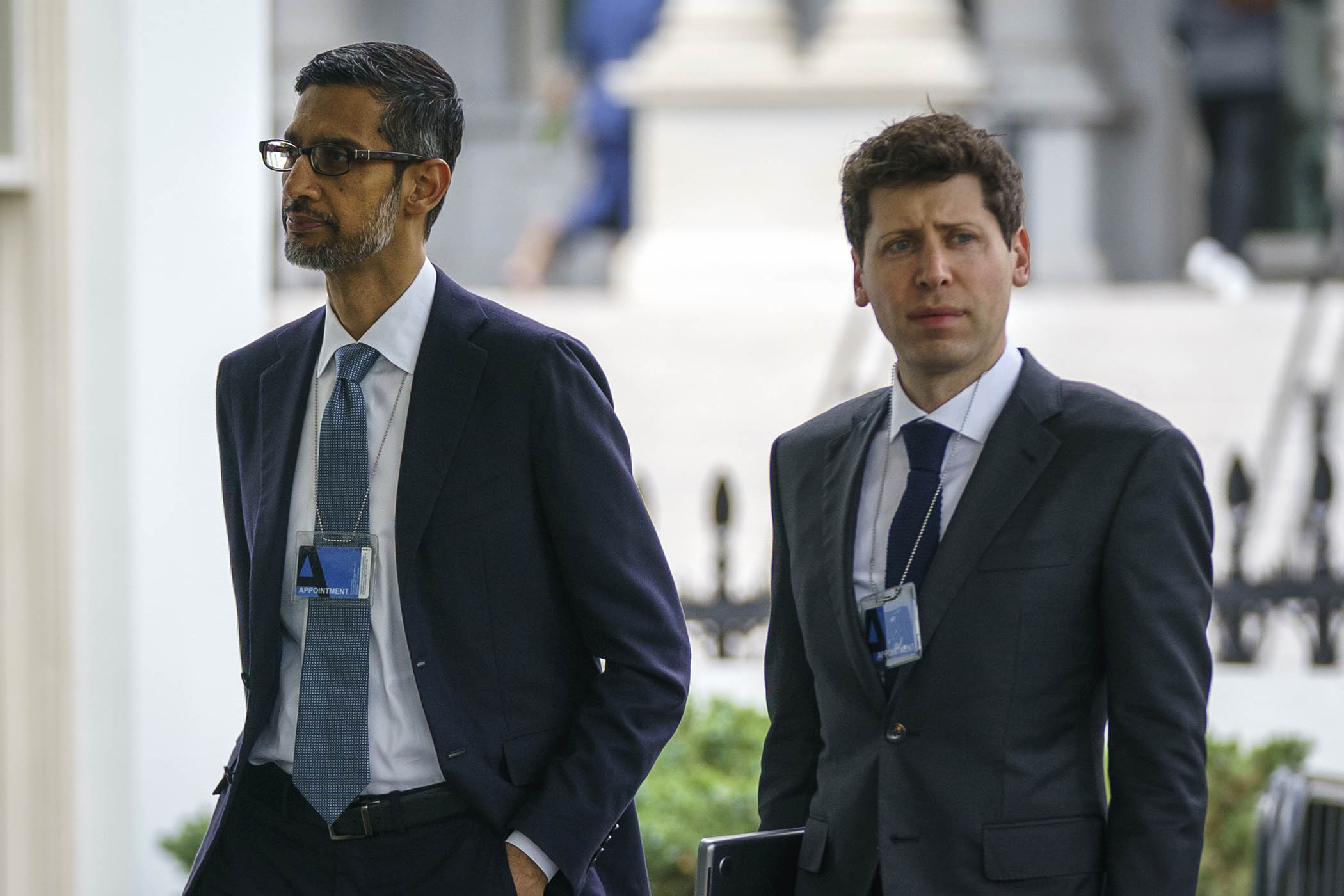
On Monday, OpenAI’s chief executive, Sam “Babyface” Altman, declared a “code red” alarm to improve ChatGPT, delaying advertising plans and other products that were in preparation. Suddenly, Gemini was putting on millions of new users and looking like a real threat.
So is this the beginning of the end for Altman’s empire? Not quite – but perhaps it is the end of the beginning. The landscape now teems with ChatGPT rivals. Nobody knows precisely how many publicly available models exist; Wikipedia lists 86, though other sources cite thousands, and both figures will be outdated by the time you read this.
Whatever the actual figure, the reality is that we are now facing a bewildering glut of generative AIs. Industry techies incessantly obsess over models’ relative scores on a range of tests and benchmarks. Which ones excel at maths? Which ones can pass the bar exams? Which are better as “reasoning”? And so on.
But these are nerdish preoccupations. Most people don’t have time for such niceties. Insofar as they think about AI at all (and in my experience, that’s not much), what matters to them are factors such as cost (ideally zero), ease of access and use, and seamless integration with the software and tools that they use in daily life.
Newsletters
Choose the newsletters you want to receive
View more
For information about how The Observer protects your data, read our Privacy Policy
Where is all this heading? Answer: towards commodification of the technology. Just as Google became synonymous with “search”, regardless of which engine users employed, so ChatGPT, Perplexity, Claude and others will become synonymous with AI – specifically, whatever model comes pre-installed on people’s phones.
This is one area where recent history provides a plausible guide to how things will pan out. If decades of daily digital interaction have taught us anything, it’s that default settings are exceedingly powerful – because most users never change them.
For example, Microsoft’s colossal wealth stems from ensuring that every PC sold from the 1980s onwards came with Windows pre-installed. And once it had discovered the web, the company was nearly destroyed in a landmark antitrust case by its attempt to ensure that every PC also came with a pre-installed Microsoft browser rather than the alternatives from Netscape and others.
In the smartphone era, the same kind of logic applies. It explains, for example, why Google reportedly pays Apple $20bn a year to have its search engine pre-installed as the default on the iPhone’s Safari browser.
So here’s the $100bn question for today. Which AIs will be the default ones on smartphones? As far as Android phones are concerned, the safe prediction is that it will be Gemini or its successors, because Google controls the handsets’ operating system.
The big puzzle, then, is what LLM Apple will allow on the iPhone or – to put it more crudely – how much OpenAI will be prepared to pay for the privilege. Stay tuned ...
What I’m reading
Follow the money
Sven Berkert on How Capitalism Made the Modern World is a transcript of an interesting conversation between the Harvard history professor and political scientist Yascha Mounk on the latter’s Substack.
Departing words
Henry Oliver on his Common Reader Substack pays a lovely eulogistic tribute to Tom Stoppard’s Ordinary Magic.
Covert operation
We Must Put an End to AI’s Culture of Secrecy is an impressive op-ed by Sneha Revanur in Time.
Photograph by AP Photo/Evan Vucci