
For more than 40 years, the question had burned: was her great-grandfather a member of the Nazi party? He had worked as a train driver during the Nazi era and flew into a rage whenever the war came up in conversation. Now she could finally find out.
Earlier this month, she typed his name into a new search engine launched by German weekly newspaper Die Zeit that allows anyone to search more than 12 million membership cards of the National Socialist German Workers’ Party (NSDAP). AI was used to turn the huge cache of documents into a form that could be easily searched.
There he was.
“Question answered,” she wrote to Die Zeit under the username “Dudettes”. “Thank you... Even though it hurts terribly.”
In the three weeks since the tool was launched, there have been more than 1 million site views. Search results are rippling through families, uncovering secrets and breaking taboos.
By now most members of the NSDAP are dead; the youngest were just 17 years old at the end of the war and, if still alive, will soon be 100. Still, it has shocked some people to learn their relatives were members. For others, it has confirmed long-held suspicions that simmered round the dinner table.
“I’m a bit confused,” wrote “JuliCar” after finding a grandfather and his brothers in the database. “Our family story has always been that he wasn’t a Nazi”.
The search engine shows how AI is being used to process archives – and in this case, potentially narrow the gap between public and private memory in Germany.
Germany's Erinnerungskultur or memory culture has been held up as an example of how a nation should deal with its dark past; the horrors of the Holocaust and the Nazi regime are commemorated in monuments, museums and national days of remembrance.
And yet, many Germans still perceive their own ancestors as having little to no involvement in what happened. In a 2025 study commissioned by Die Zeit, only 3% of respondents believed their family had actively supported the Nazi regime. Twenty-one percent said their ancestors had been “followers”, while 26% believed they had opposed it.
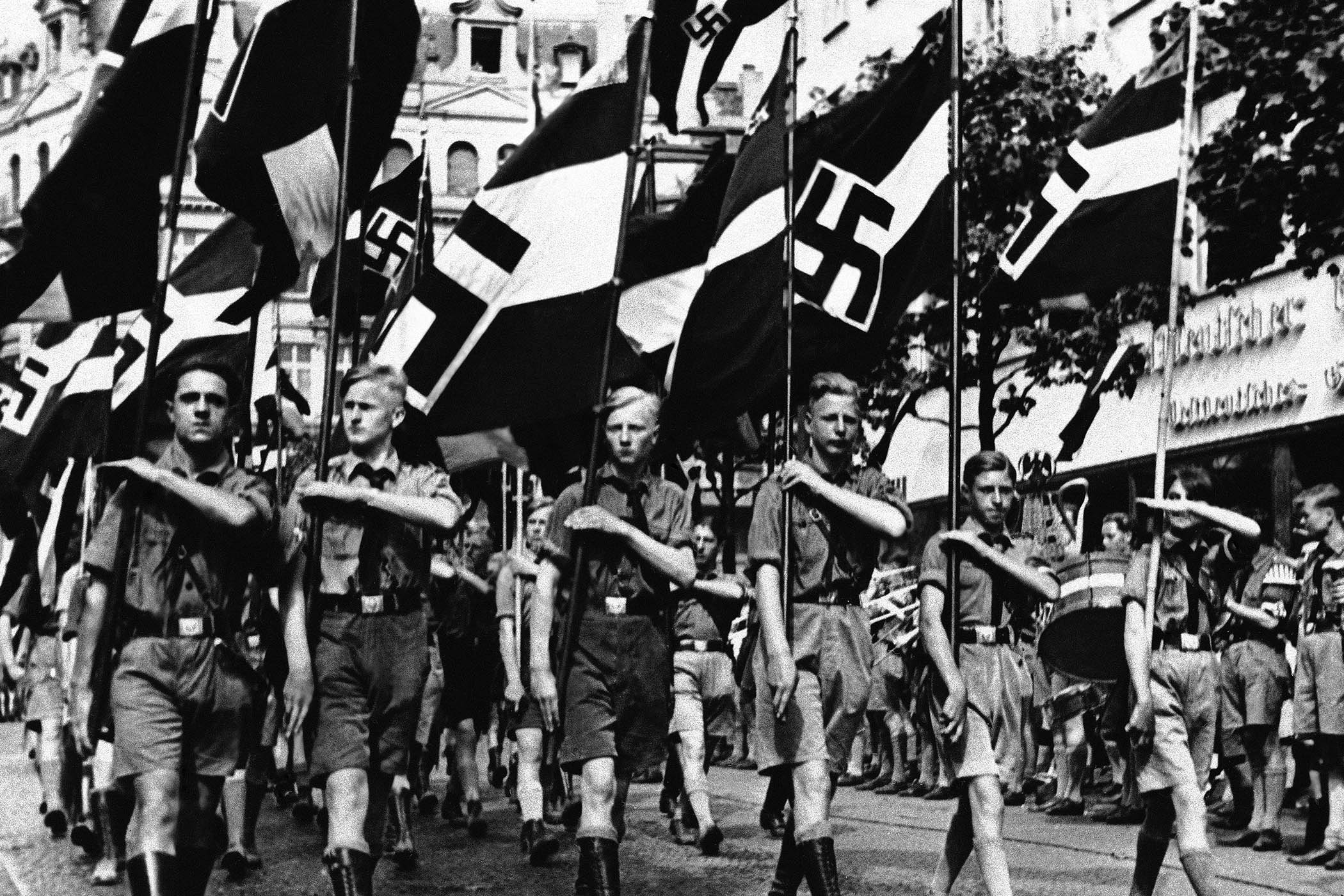
That perception is at odds with historical fact. By the end of the war in 1945, approximately every fifth adult German — about 8.5 million people — was a member of the NSDAP. Statistically that means there is likely one, two or more members of any extended German family who joined the party, said Christian Staas, head of Die Zeit’s history department.
“There’s a gap between the official memory culture and the knowledge about what has happened within the family,” said Staas. "Our tool might help a little bit to close this gap".
As Allied forces closed in, Nazi officials shredded and burned reams of documents, but large parts of two party membership-card indexes survived.
American forces secured the documents in 1945 and used the files to prepare for the Nuremberg trials before transferring them to the US National Archives. Germany’s Federal Archives also held digital copies, but access was limited by strict privacy laws. Information only becomes public 100 years after a person’s birth or 10 years after their death. To look someone up, it was necessary to submit a written request and prove a direct family connection.
When the US National Archives made microfilm copies of the Nazi Party membership files available online last month, they were unprepared for a surge of traffic from curious Germans.
Data experts at Die Zeit downloaded the two databases containing 12-13 million cards pages in different kinds of text and handwriting including old German Sutterlin. “It was very complicated to make this readable and we wouldn't have been able to do so without artificial intelligence,” said Staas.
Interest in researching ancestry has grown in Germany over the past decade, reflecting broader trends. The German Federal Archives receive around 75,000 requests for access to personal documents relating to National Socialism per year.
But that does not necessarily mean full acceptance. “We shouldn't imagine that the story of German memory has been a one way process where Germans are gradually faced up to the Nazi past; it’s really not that simple,” said Hans Kundnani, author of Utopia or Auschwitz: Germany’s 1968 Generation and the Holocaust.
In the immediate aftermath of the war, Germans saw themselves primarily as victims who had been misled and manipulated by the Nazis. While leaders stood trial, supporters played down their own complicity even as the scale of the crimes committed became increasingly clear.
The next generation began to reckon what their parents had done. Growing awareness of the Holocaust materialized into monuments.
More recently, however, there has been a reversal: “Especially in the last 25 years it's been going not in the direction of greater awareness of the Holocaust but sort of the opposite direction,” said Kundnani.
The search engine will equip people with historical facts “to confront liars and minimizers”, said Die Zeit in an editorial, adding that it was a duty to explore one's own history “without reservation”.
“Entering your own family name into our search engine can be a first step.”
Dozens of people have written in to the paper with their results.
“So, my grandfather was also a member of the Nazi Party, as I learned today,” wrote “Lovescience”. “My mother and her sister refuse to acknowledge it. It can’t be true, they say. Luckily there are siblings and cousins who are also grappling with this and who don’t want to hide from uncomfortable truths”.
“Aunt Horst”’s research into her family history had always focused on the Jewish side, which was wiped out in the Holocaust. She was shocked to discover the husband of a Jewish great-aunt had joined the NSDAP in 1933. He likely divorced her before she was murdered using a gas van in occupied Poland. “This Nazi Party membership has really preoccupied me now,” she wrote.
Others were surprised not to find their ancestors.
“My grandfather wasn't there, but he really should have been. After all, according to him, he was somewhat involved,” said Nedemalos, questioning whether the records were reliable. “But anyway: He was one of the nicest and most peaceful people I knew. And I seriously wonder why we’re supposed to dig around in our own families now? So we can be considered one of the good guys? No, I won’t hear a bad word said about that old man!”
For many, the results only raised more questions. Membership of the party alone doesn’t reveal why a person joined or how they behaved.
“The danger of publishing this is that you can no longer question people today, and they can no longer defend themselves or explain their actions,” wrote “Brigitte1”. “My father was certainly no follower… He said that there were mass registrations without consent”.
Beyond one’s own family, there is nothing to prevent people from looking up anyone whose basic details they have.
Alma Koppe was relieved to find neither of her parents in the database, but both her paternal grandparents’ names popped up. She struggled to absorb that the “quiet, gentle, friendly” village schoolteacher she knew as her grandfather had joined the NSDAP in East Prussia in 1933. “Why? Was it expected or required? Or was he convinced?,” she wrote. “I'll never know.”
The dates offer some clues. Before the Nazi party seized power in 1933, members would likely have been highly politicised and ideologically committed. Later on, membership was often seen as necessary for personal advancement. For civil servants, teachers, and lawyers, it was often mandatory.
Whatever the motive, joining the party enabled and conferred legitimacy on a regime that exterminated six million European Jews.
“Our family members who were in the Nazi Party were (for most part) not evil people, not monsters. Just ordinary people, with their needs, fears, and desires who adapted to societal developments. But by doing so, they supported and enabled this unimaginable crime,” wrote “Lovescience”.
It should serve as a lesson for today, when “right-wing extremists” are downplaying and relativising the Holocaust, he said.
There are caveats.
Just as some members of the party may not have been fully committed, so others who weren’t could have perpetuated or profited from the persecution of Jews.
“I haven’t found anyone yet. But I don’t think that’s any “exoneration”, wrote Kant 1965, recalling an antisemitic comment his grandmother once made.
Historians estimate that 10% of the records – relating to about 1 million party members – are missing.
Photograph by Hi-Story / Alamy
Newsletters
Choose the newsletters you want to receive
View more
For information about how The Observer protects your data, read our Privacy Policy