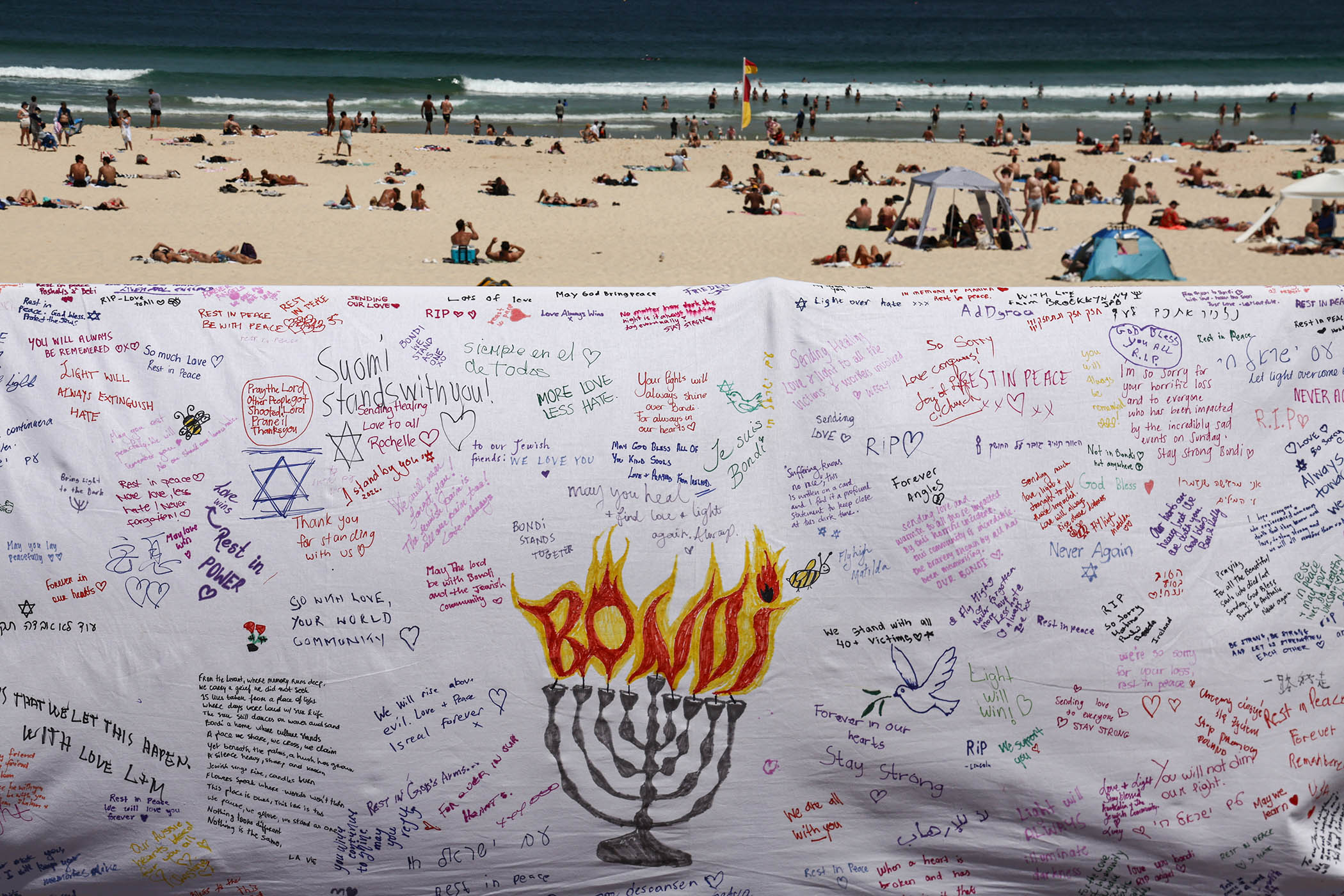
Bondi is almost exactly how you imagine it to be. They really do surf there. The water really is that blue. And the people really are in a seemingly permanent state of beach body readiness. Almost, but not entirely.
If you gaze beyond the metronomic crash of waves and the hordes of backpackers, you might notice the area is also home to one of the largest Jewish communities in Australia. One that is, like a growing number around the world, grieving.
When I first heard the news: “Shooting in Bondi”, I knew instantly. I’m no clairvoyant, but come on. Who else is hated so much, by so many?
Jewish existence has long been securitised to within an inch of its life in places like France and Sweden. But Australia was different. In the aftermath of the second world war, almost 30,000 Holocaust survivors migrated Down Under, wanting to get as far from Europe as possible. Their bet paid off – for both Jews and the nation.
Jews have been active across the whole of Australian public life, contributing two governors-general as well as working in the arts, law, business and healthcare. The country has been just about the best place to be Jewish in the history of space and time. But that has changed.
Less than 24 hours after Sunday’s antisemitic rampage, which at the time of writing has taken 15 innocent lives at a Hanukkah celebration, I returned to Bondi. I walked with flowers. A man carrying flowers usually signals wrongdoing or contrition. On this day, everyone understood the purpose. A few cars honked their horns, but most people looked up and then away.
The vigil had an air of unreality and inevitability about it. Silence punctuated by tears. That changed when a pro-Palestinian protester emerged, draped in a keffiyeh. After she was ejected by police, there was a noticeable shift. The scene became a little more chaotic, mourners talking to each other. It felt like the sudden social permission strangers get to speak to one another following a major train delay. How are you feeling? How did you get here? Would you like some water?
I listened as mourners respectfully but unguardedly spoke to the local MP, Allegra Spender. The stories were variations on a theme. The young woman in the arts shunned by friends and colleagues because she shared social media stories about antisemitism. The young man whose union refuses to utter the J-word, even after the shootings.
I approached Spender and said the first thing that came to my mind. That I felt if there were a global plebiscite, or even one restricted to Australia, asking if the Jews should be allowed to stay, I’m not convinced we’d win it. She appeared genuinely heartbroken by the suggestion.
Benjamin Newman, 45, a new friend, told me, “There have been so many messages of support in the last 24 hours, it’s very humbling. But I’m getting a few stark reminders about the limits of human compassion too.” A close friend of his had informed him that the number of people murdered in Bondi doesn’t equate to civilians killed in Gaza.
Newsletters
Choose the newsletters you want to receive
View more
For information about how The Observer protects your data, read our Privacy Policy
It’s curious. Racists have a hierarchy of race, yet all too many anti-racists appear to have their own for racism. I’d met Benjamin last Sunday at an LGBT Hanukkah celebration not far from Bondi. There were no fatalities, though one wonders whether that was only because we kept the location secret.
In the past few days there has been what had previously been almost wholly absent: visible support for the Jewish community – indeed, visible Jewishness at all. Vigils, commemorative swims, the Sydney Opera House lit up with a Hanukkah menorah. And while prime minister Anthony Albanese has managed to avoid apologising for doing only as much for Jewish safety as had been politically expedient, he has now been forced to acknowledge the incontrovertible: he could have done more.
How did we get here? A precedent had been set two days after 7 October 2023 when pro-Palestinian protesters took to the Opera House shouting “Fuck the Jews” and perhaps more ominously, “Where’s the Jews?” (Answer: at home. The police had sent urgent messages warning Jews that it was not safe to be in the vicinity.) Then there was the doxxing of Jewish creatives, arson attacks in Jewish neighbourhoods.
Before the end of September this year, antisemitic incidents were running at five times the average of the decade before October 2023. The government-appointed antisemitism envoy produced a report with numerous recommendations. These have sat on the prime minister’s desk for six months. Jewish groups had explicitly warned urgent action was needed. Their cries fell on deaf ears.
Perhaps it feels worse in Australia, because its Jewish community, which has contributed so much to this wonderful nation, has had it good for so long. The obvious question is: if not Bondi, where is it safe to be Jewish now? Answers on a postcard.
Jack Kessler writes the Lines to Take newsletter
Photograph by David Gray/AFP via Getty Images